


The next budget meeting’s on your calendar and you can hear the question before it’s even asked: "What's the ROI?"
Every marketing leader I talk to is feeling the same pressure. Tools, campaigns, channels—if you can’t prove the return on investment, it's on the chopping block.
Which makes AI search something of a conundrum.
On the one hand, more and more companies are waking up to the fact that they need to do something for answer engine optimization (AEO) (or generative engine optimization—pick your poison).
But AEO is a new, often zero-click channel that laughs in the face of the traditional attribution models CFOs love. That makes proving ROI (let alone benchmarking it) difficult.
So you’re left with multiple bad options:
- Reporting on AI-referred traffic only, which is just the tip of the iceberg
- Reporting on SEO only and assuming that just because you’re doing SEO well, you’re also doing AEO well (it's not one-to-one)
- Sticking your head in the sand and hoping no one asks any questions
Or you can do what Scrunch does and focus on impact.
I’m not talking about anecdotal evidence or feel-good vibes, but quantifiable improvements to the metrics that matter in AI search. The kind that hold up when your boss’s boss squints at your slide deck.
Here’s the how—and the why.
Last-click attribution doesn’t work if there’s no click
Business leaders have been trained to think of ROI in terms of pay-per-click math. X amount of dollars go in, Y amount of dollars come out.
But attribution gets messy in AI search. And teams that try to retrofit outdated frameworks will end up frustrated.
Just like with SEO, AEO influences the entire marketing funnel, from awareness to consideration to conversion.
And just like with SEO, you can’t force AEO into a last-click ROI box. That negates the value of everything that comes before someone smashes the “buy” button.
But explaining this is even harder with AEO because the action’s not happening on your website.
Traditional SEO aims to get you noticed in search results. The endgame? Someone clicks through to your site and discovers what you're all about.
They may not make a purchase every time, but you can point to numbers like traffic, time on site, pages per session, etc. (this is the last mile of AEO).
With AEO, you’re optimizing so that AI models mention your brand when answering questions—and represent you accurately when they do.
Often there’s no immediate click-through to your website. The LLM's response is the entire interaction.
AI isn't directing people to your brand—it's interpreting your brand for them. All the decision-making that used to happen on one of your landing pages is now happening inside a chat window.
When someone finally does land on your site, there’s a good chance that they’ll come through as direct traffic (i.e., they plugged in your URL or domain into their search bar after they got all the info they needed from an LLM).
That means that without the right tooling (hint: Scrunch), brands can’t even get their hands on the metrics SEOs use to justify their work.
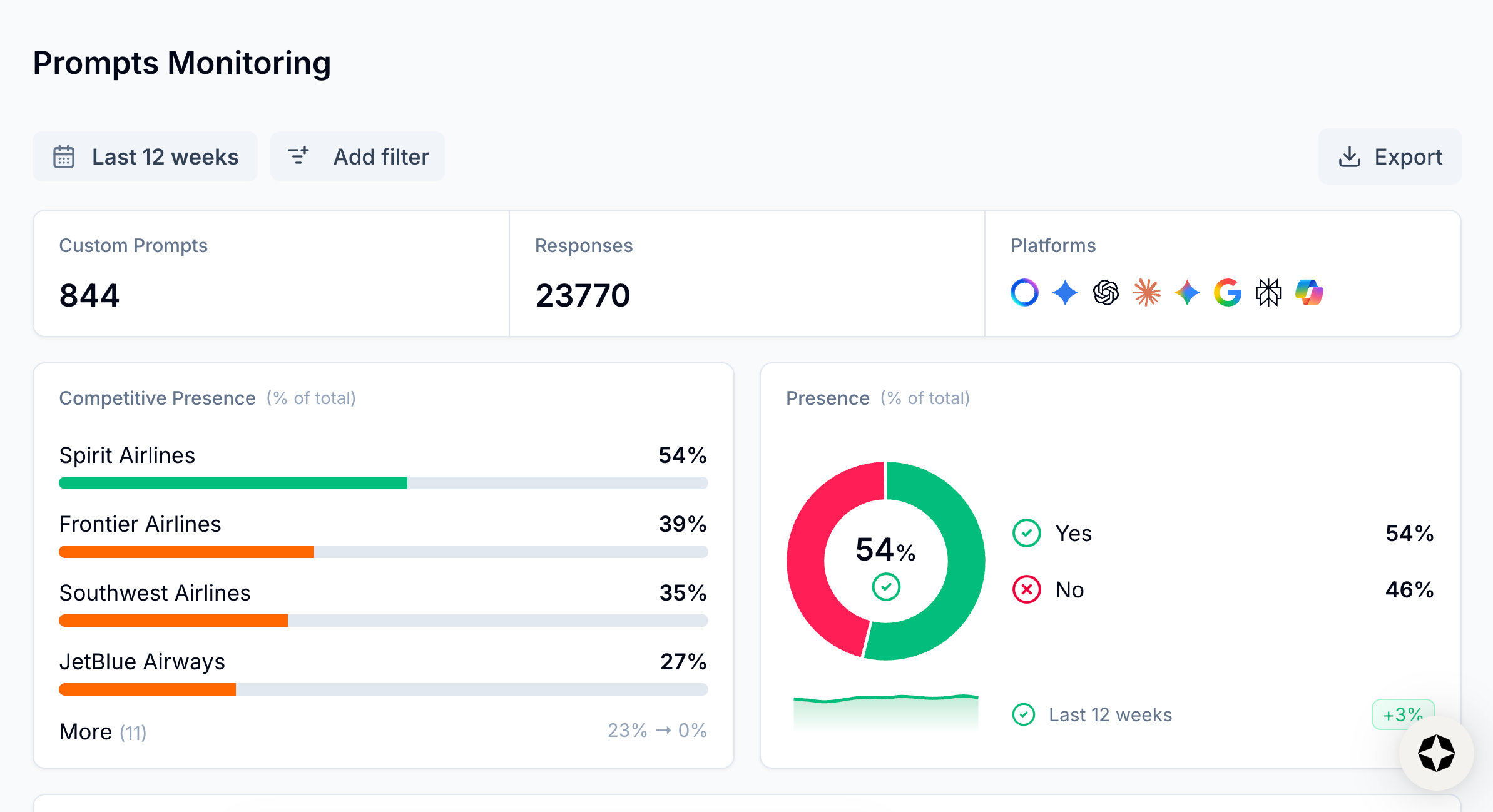
In SEO, it’s impressions, keyword rankings, backlinks, and organic traffic. In AEO, it’s brand presence, prompt position, citations, and LLM or referral traffic.
Do AI searchers convert at a significantly higher rate than the average website visitor? Yes, we have customers who see 2.5x-plus increases in conversions and revenue from AI referrals versus SEO.
But basing the ROI of AEO solely on last-mile action makes its value seem much smaller.
Move the metrics that will connect with leadership
So how do you prove the value of AEO beyond dollars and cents?
By focusing on the kind of impact leadership will care about:
- Is our brand more visible in AI search today than last month?
- Is our performance in AI search better than our top competitors?
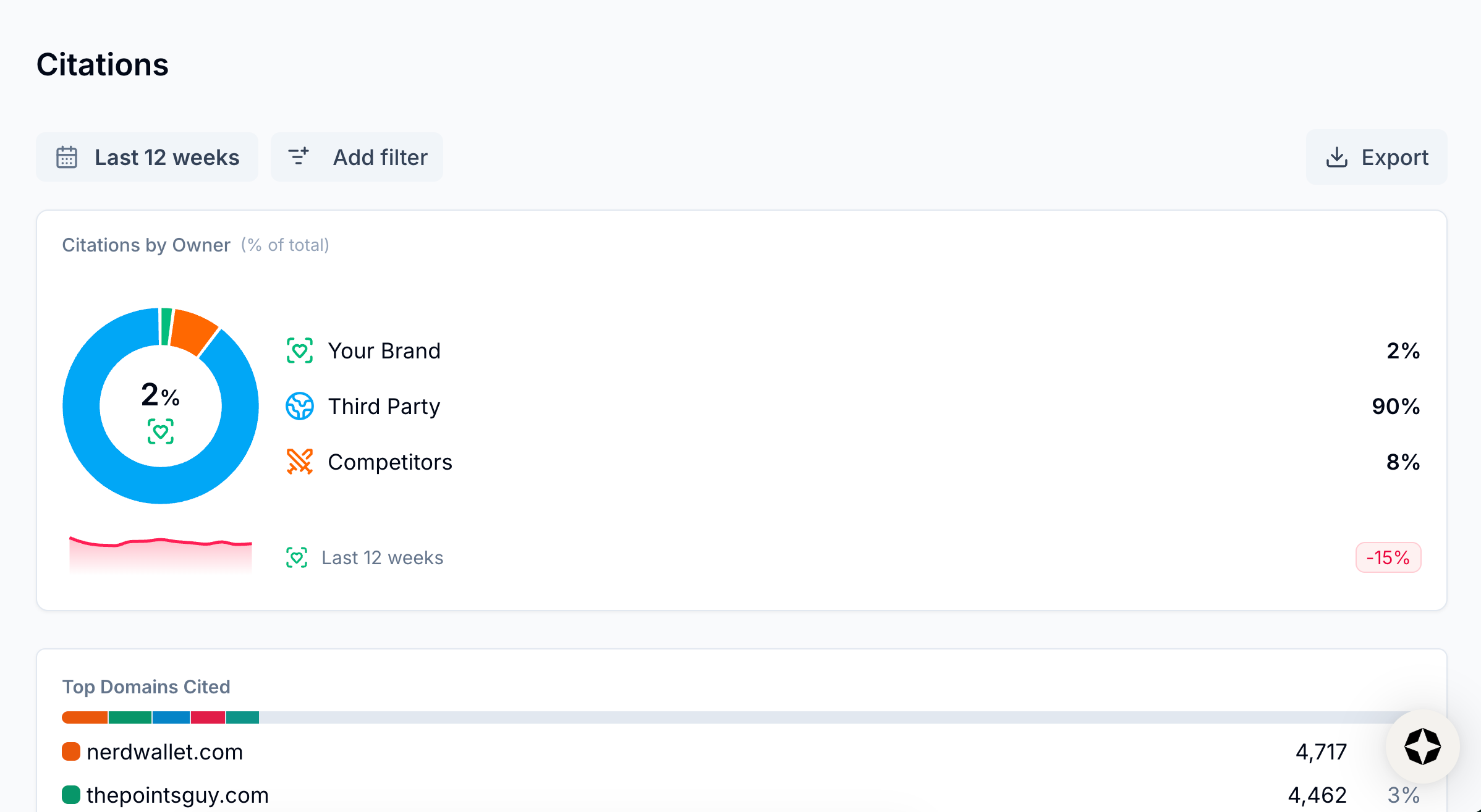
- Is AI citing our website when it answers brand-relevant questions?
- Is AI consistently describing our products and services accurately?
Those are measurable outcomes. They don’t require complicated revenue attribution all-nighters. And each one is part of the journey that ultimately leads to a conversion.
Here’s how to get started:
Focus on 4 signals
Different brands may care about different things, but I highly recommend you zero in on four pillars:
- Brand mention frequency: Is your brand being mentioned more in responses to the prompts you care about?
- Competitive share of voice: Is your brand beating competitors for presence in responses to the prompts you care about?
- Citation rate: Is your content being cited more in responses to the prompts you care about?
- Answer accuracy and depth: Are answers about your products and services correct and higher-quality?
Almost every AEO improvement will show up in one or more of these areas.
That’s not to say you shouldn’t measure other things. AI agent traffic and referral traffic are also metrics that matter in AI search.
But these four signals give you a clean, realistic view of your progress. Even better if you drill down into performance across specific personas and funnel stages to really drive it home for leadership.
Set a baseline and implement changes
Measure current performance across business-relevant prompts.
Where do things stand right now across mentions, share of voice, citations, and accuracy? Use industry peers and competitors as a benchmark.
Then get to work.
AI search visibility depends on many factors that a vendor doesn’t control. Site structure, technical health, content quality.
Ultimately it’s up to you to make the updates that drive results:
- Identify content gaps
- Scale mentions in cited sources (and citations of your own)
- Fix technical blockers
- Optimize content for LLMs
- Deliver content in an AI-friendly format
Look for lift
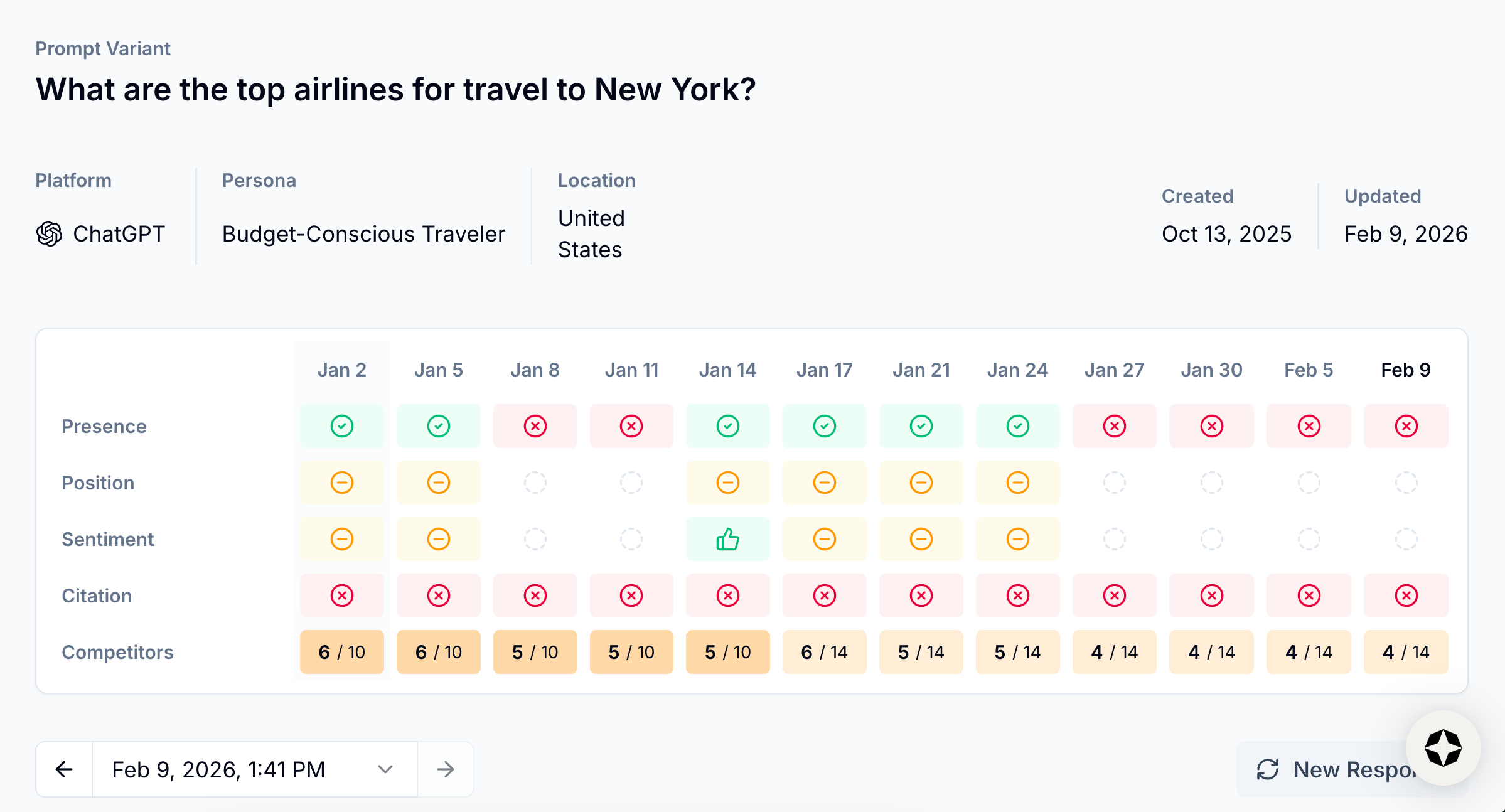
Measure percentage improvements and trend lines over time.
The easiest way to understand AEO impact is through simple before-and-after comparisons.
Here are some examples of what I mean:
Example: A brand used to be mentioned or cited in only 10% of AI responses to core prompts. Now it’s mentioned or cited in 40%.
Impact: Brand presence lift
Example: A brand used to only dominate share of voice against competitors for two out of 12 core prompts. Now it dominates share of voice against competitors for eight out of 12 core prompts.
Impact: Competitive lift
Example: LLMs used to return an accurate description of a brand’s product only 33% of the time. Now they return accurate descriptions 92% of the time.
Impact: Brand accuracy lift
These are the kinds of improvements leadership can’t ignore.
They’re easy to explain, easy to measure (with the right tools), and they clearly illustrate how AEO helps AI systems understand and favor your brand, even without a revenue model attached.
Impact frameworks beat ROI traps every time
AEO isn’t a paid ad (at least not yet). It’s not a one-time transaction.
It’s about continuous monitoring and optimization to make sure that your brand is seen and understood in the modern discovery layer.
When you measure the right signals, impact becomes clear. Visibility increases. Narratives align. And AI systems begin to prefer your brand.
And that makes all the difference, because AI agents are now the ones facilitating relationships between your business and your customers.
The more citations you get, the more brand mentions you get. The more citations and brand mentions you get, the more AI-referred and direct traffic you get. And the more traffic you get from AI-qualified buyers, the more at-bats you get with customers who convert at a significantly higher rate.
The marketing teams that embrace impact frameworks now will avoid ROI traps later. More importantly, they’ll make it clear just how they’re helping their companies win the future of search.
Prove the ROI of AEO with Scrunch
Track brand mentions, share of voice, citations, answer accuracy, AI bot traffic, AI referral traffic, and more in Scrunch. Try Scrunch free for 7 days or schedule a demo to see it in action first.


