


We wanted to take a pulse check on how consumers are interacting with AI assistants at the beginning of 2026. Our goal was to see where audiences are “showing up” in the funnel when they use AI platforms—and what the dominant patterns are in different stages.
We decided to focus on a fast-changing, high-interest category.
Fun fact: It turns out that more people are currently asking AI about GLP-1s than movies and TV. Based on a subset of our panel data, we estimate that roughly 4 million AI conversations were related to GLP-1s in the month of January 2026 alone.
The data painted a clear picture of AI search archetypes and behavioral loops—as well as opportunities for brands. Namely, how to make sure you’re monitoring the right prompts, serving the right personas, and creating the right content for the AI-first customer journey.
You can dig into our findings below.
The main takeaway? AI search isn’t just displacing traditional search—it’s reconceptualizing what search looks like.
AI is more than an answer giver at a single point of need. Instead, it’s a genuine companion from awareness to conversion and beyond.
The funnel has moved inside AI interfaces
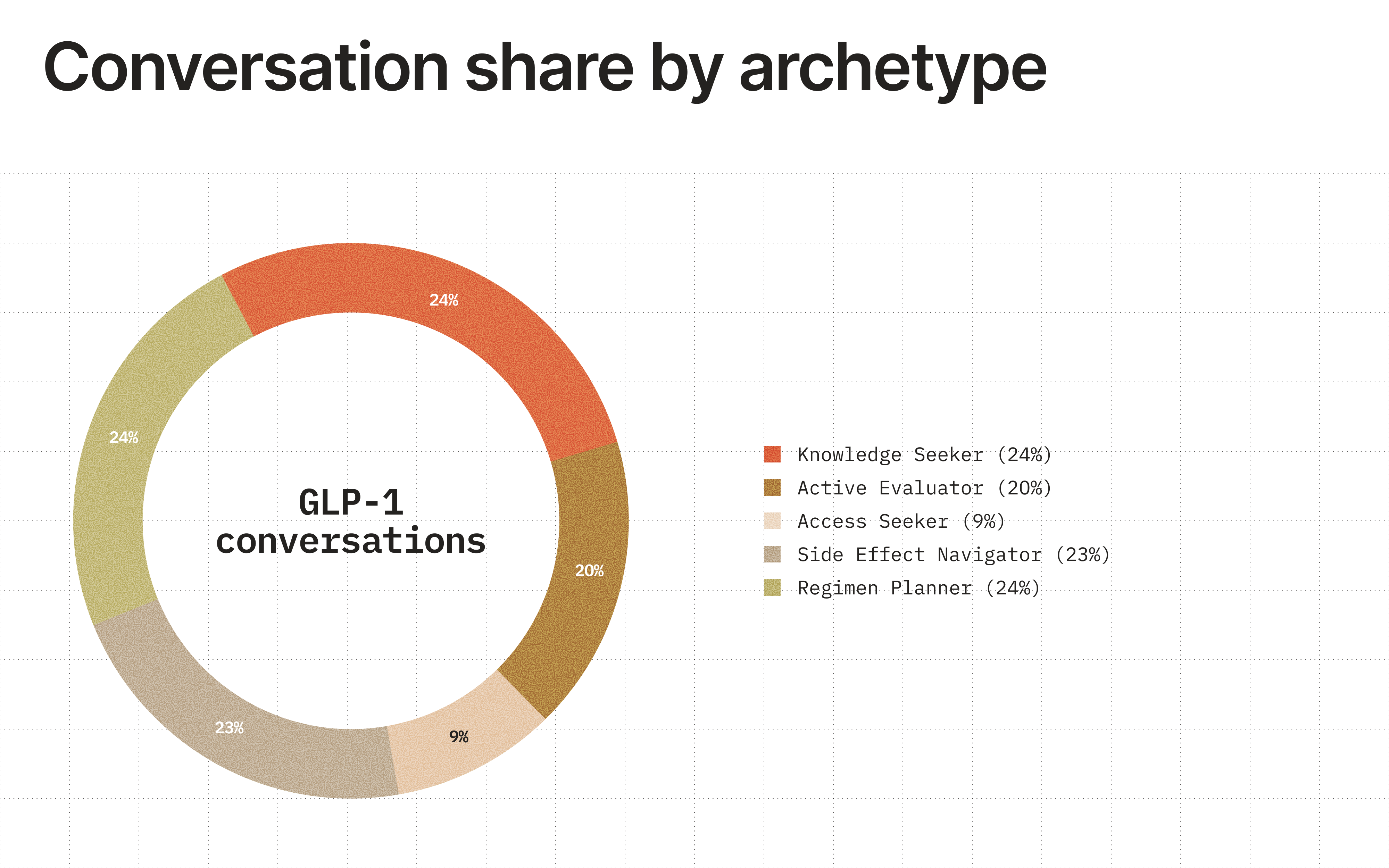
We bucketed AI users into five archetypes (aka audience clusters) based on their jobs to be done:
- Knowledge Seeker (~24% conversation share): People who are curious about GLP-1s but not yet committed. They’re pre-treatment and building a mental model. This could be considered the entry point to the funnel.
- Active Evaluator (~20% conversation share): People who are actively comparing options before making a decision. These users are the most likely to switch brand intent based on a single piece of content. They also have the highest conversion potential.
- Access Seeker (~9% conversation share): People trying to find, obtain, or prescribe medication. This includes both patients and practitioners. It’s a niche archetype compared to the others, but commercially important.
- Side Effect Navigator (~23% conversation share): People who are already on medication and anxious about symptoms. They’re looking for reassurance and guidance versus product information. These users have the highest conversation return rate.
- Regimen Planner (~24% conversation share): People who are already on medication and are trying to optimize it. They’re looking for frameworks, tools, and subscriptions. These users represent the highest customer lifetime value opportunity.
The share of jobs to be done was remarkably balanced across four of the five archetypes—no single use case dominated.
Access Seeker is the outlier. It’s a smaller, high-intent group with distinct commercial needs.
Applying population-weighted archetype proportions, the estimated addressable US audience per archetype is:
| Archetype | Estimated US AI-active users | Worth noting |
|---|---|---|
| Knowledge Seeker | ~750K-1.2M | Biggest reach opportunity, mostly unbranded intent |
| Active Evaluator | ~600K-950K | Decision-moment audience, high conversion value |
| Access Seeker | ~300K-500K | Includes ~20–25% commercial/clinical operators |
| Side Effect Navigator | ~700K-1.1M | Largest ongoing support need, high churn risk if unmet |
| Regimen Planner | ~950K-1.5M | Largest post-stratified segment, tool/subscription opportunity |
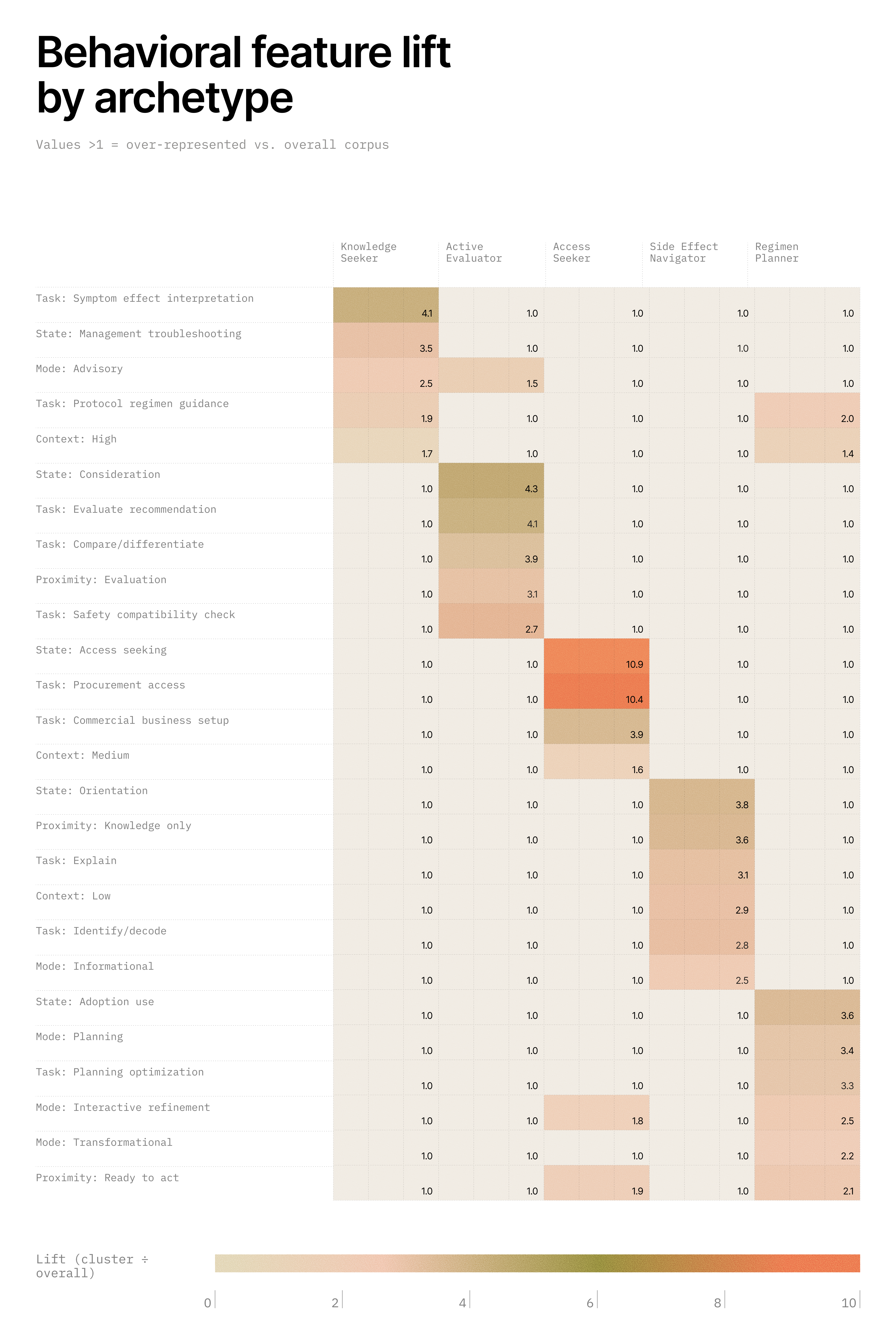
You can see which behavioral features are disproportionately common in each archetype versus the overall dataset in this heatmap:
Let’s dig in to learn a bit more about our audience clusters:
Knowledge Seeker
Details: ~24% of conversations, broadest unique user base
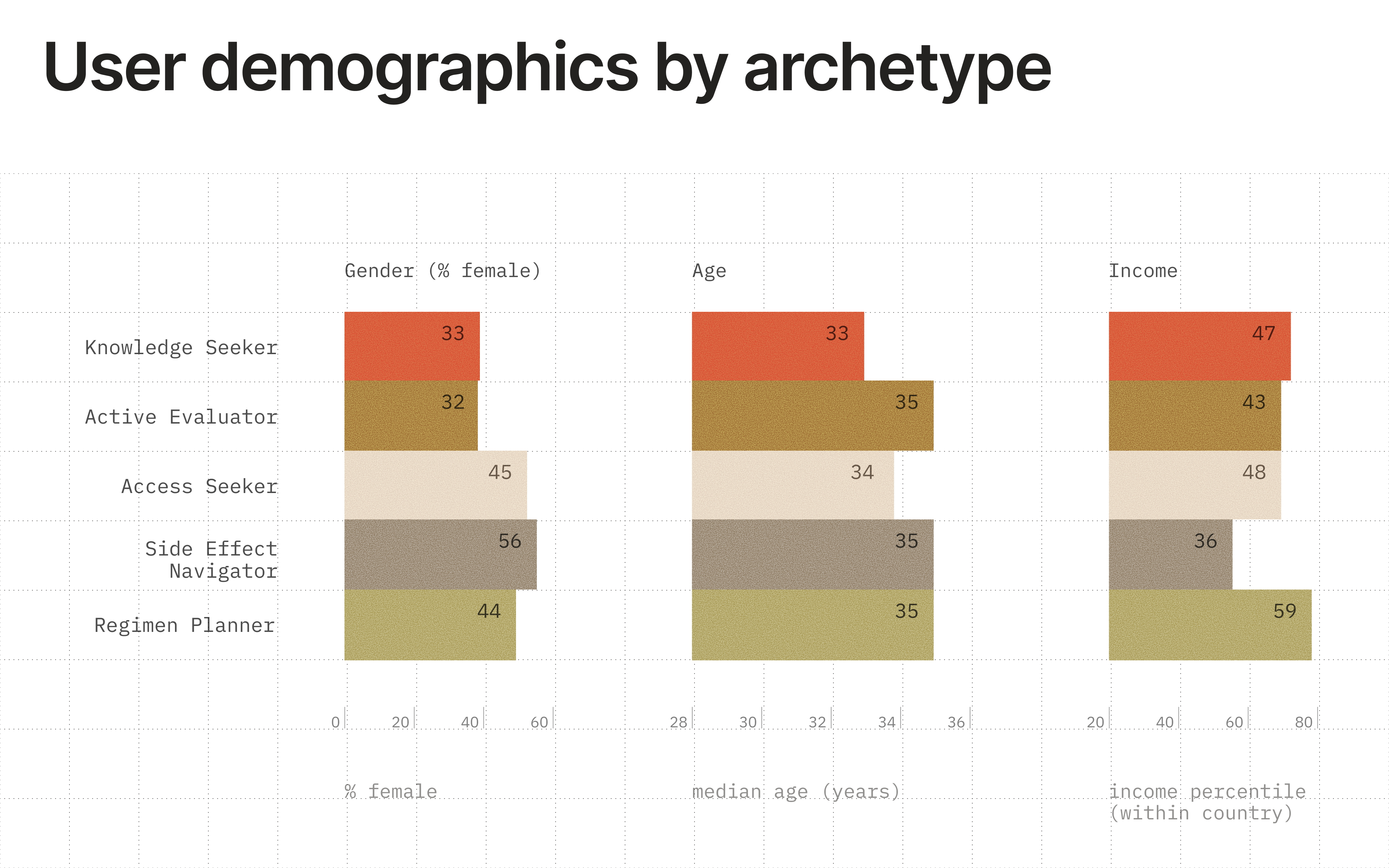
Who they are: Predominantly male (~65%), median age of early 30s (the youngest archetype), slightly below-median income
Overview: Knowledge Seekers typically ask one or two questions and leave. This is an awareness-phase audience with no declared purchase intent.
Example prompts:
- "What's the difference between a GLP-1 and a GIP agonist?"
- "Are GLP-1 supplements the same as GLP-1 drugs?"
- "What are the long-term effects of GLP-1 medications?"
- "What’s the difference between Wegovy and Ozempic?"
- "What is Tirzepatide and how does it work?"
Example content opportunities:
| Content | Format | Priority |
|---|---|---|
| Beginner's guide: GLP-1 medications explained | Pillar page | 🔴 High |
| Myth-busting: What GLP-1s do and don't do | Article & video | 🟡 Medium |
| Quiz: Which GLP-1 type matches my goals? | Interactive quiz/lead gen tool | 🟡 Medium |
Active Evaluator
Details: ~20% of conversations, most transient user base (aka most likely to move between different archetypes)
Who they are: Predominantly male (~65%), median age of mid-30s, slightly below-median income
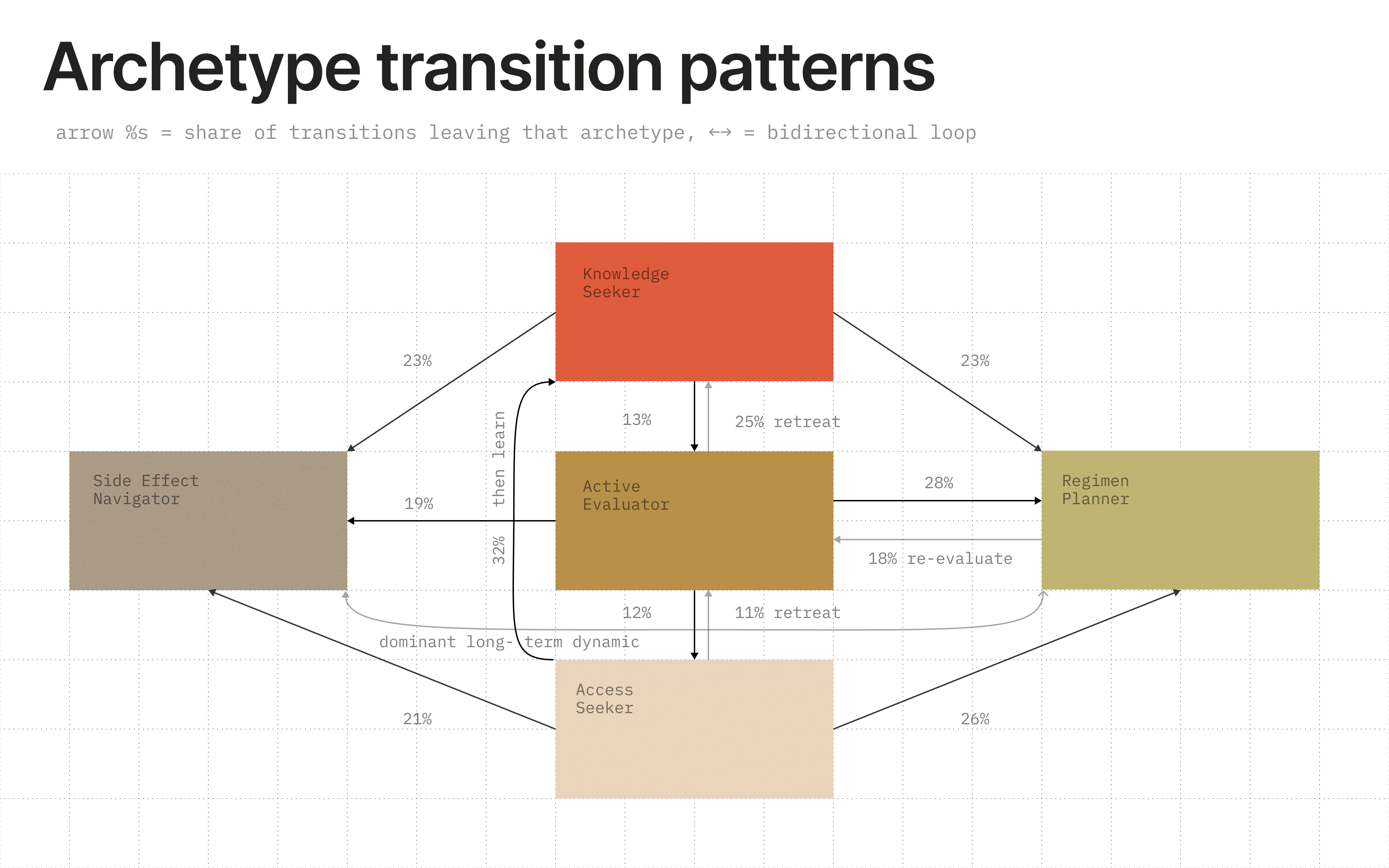
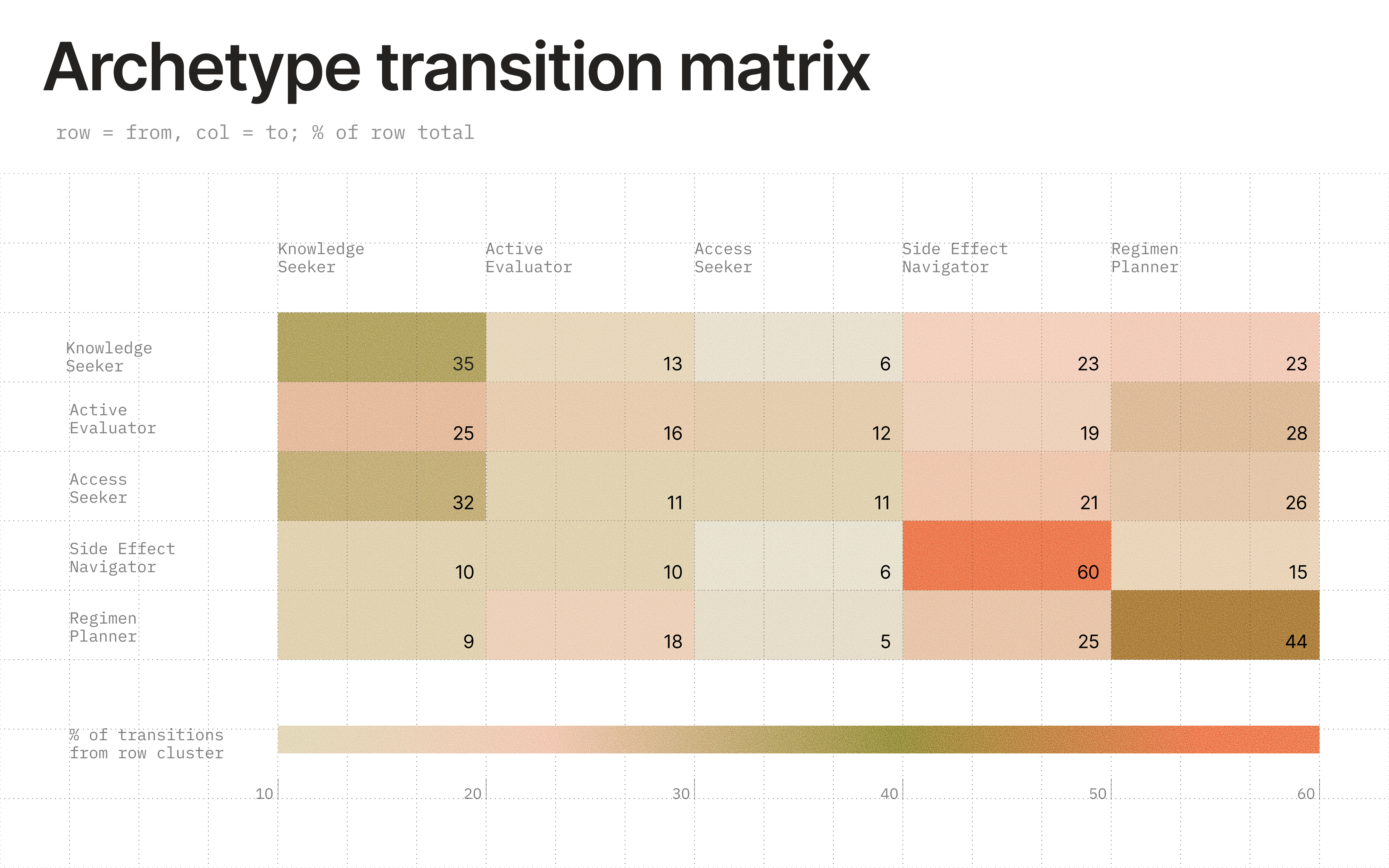
Overview: About a quarter of Active Evaluators retreat back to being Knowledge Seekers rather than committing, and roughly 18% of Regimen Planners cycle back to being Active Evaluators. This suggests that this stage is revisited across the treatment journey, not just at the start.
That said, this is the highest-conversion moment in the funnel. Active Evaluators have clear purchase intent and are searching for direct answers to comparison questions.
Example prompts:
- "What are the pros and cons of Mounjaro vs. Wegovy?"
- "Is Mounjaro or Semaglutide better for weight loss?"
- "Are compounded GLP-1 injections as effective as brand name?"
- "Is it safe to take vitamin D and fish oil with Ozempic?"
- "What is the glow-up stack—weight loss jabs plus skincare?"
Example content opportunities:
| Content | Format | Priority |
|---|---|---|
| Mounjaro vs. Wegovy vs. Ozempic | Comparison page | 🔴 High |
| Evidence summary: What clinical trials actually show | Data-driven article/case study | 🔴 High |
| Cost vs. outcome calculator | Interactive calculator | 🟡 Medium |
Access Seeker
Details: ~9% of conversations, highest intent, mixed patient/practitioner audience
Who they are: Balanced gender split, median age of mid-30s, median income
Overview: Access Seekers are a mixed group—some are patients navigating healthcare systems, others are practitioners or entrepreneurs. Approximately one-fifth of this archetype shows commercial business setup intent, indicating a meaningful practitioner sub-segment.
Example prompts:
- "Where can I buy Zepbound?"
- "Which online service should I use to get Mounjaro?"
- "How do I get prescribed Tirzepatide?"
- "What's the cheapest legitimate source for Semaglutide?"
- "How do I set up a private clinic to prescribe GLP-1 medications?"
Example content opportunities:
| Content | Format | Priority |
|---|---|---|
| Clinic directory: Legitimate GLP-1 prescribers | Interactive database | 🔴 High |
| Step-by-step guide: Getting a GLP-1 prescription online | How-to article | 🔴 High |
| Formulary navigation: What insurers cover and how to appeal | Downloadable guide | 🟡 Medium |
Side Effect Navigator
Details: ~23% of conversations, highest conversation return rate (~2x the average)
Who they are: Predominantly female (~55%), median age of mid-30s, below-median income
Overview: Side Effect Navigators are a post-purchase segment—they’re already on the medication. Conversations reflect lived experience rather than a research exercise. They often return to conversations with AI assistants to check new symptoms.
Example prompts:
- "Is it normal to feel nauseous on week 2 of Mounjaro?"
- "Can Wegovy delay your period?"
- "Is hair loss on Ozempic common?"
- "I woke up with spotting—could it be related to my GLP-1?"
- "What should I do if I feel dizzy after my injection?"
Example content opportunities:
| Content | Format | Priority |
|---|---|---|
| "Is this normal?": FAQs by symptom & week of treatment | FAQ hub | 🔴 High |
| Side effect tracker/symptom diary | Interactive tool | 🔴 High |
| Side effect management guide (meals, timing, hydration) | Downloadable guide | 🟡 Medium |
Regimen Planner
Details: ~24% of conversations, second-highest return rate (~1.7x the average)
Who they are: Balanced gender split, median age of mid-30s, above-median income
Overview: Beyond being the only above-median income archetype, Regimen Planners are the most likely to seek interactive, iterative help across AI search sessions. They have a high return rate and treat AI as an ongoing coach. This is a strong signal for tool and subscription opportunities.
Example prompts:
- “I'm on week 4 of Mounjaro—can you build me a weekly meal plan?"
- "How do I titrate from 5mg to 10mg Tirzepatide safely?"
- "Can you update my training plan to account for starting GLP-1 injections?"
- "What happens if I miss a dose and how do I get back on schedule?"
- "I'm starting a new thread—continuing my Mounjaro protocol from last time."
Example content opportunities:
| Content | Format | Priority |
|---|---|---|
| Missed dose protocol & restart guide | Downloadable guide | 🔴 High |
| Personalized meal plan generator (calibrated to dose & side effects) | Interactive tool | 🟡 Medium |
| Training plan adjustment guide: Exercise on GLP-1 | Article & video | 🟡 Medium |
AI search behavior follows clear patterns
This is only one study focused on one category at one moment in time.
It’s also a microcosm of how consumers are using AI search today:
The full funnel lives inside LLMs
Every stage of the marketing funnel is playing out inside AI chat interfaces right now—at a staggering volume and variety.
In our GLP-1 dataset, conversations spanned awareness, consideration, evaluation, purchase, and retention. It’s a safe bet that the same scenario is playing out across industries, products, and services, from high-level informational queries to bottom-of-funnel decision-making.
The funnel is less linear than ever
Marketers have long said the idea of a strictly linear funnel is outdated. AI conversational data clearly proves it.
While the dominant long-term dynamic in our dataset is either Side Effect Navigator or Regimen Planner, users regularly re-entered the funnel at different stages based on their ongoing conversations with AI assistants, moving from active evaluation back to high-level awareness or post-purchase planning back to evaluation.
When AI is treated as a trusted expert, long-term decisions become more revisitable.
AI is a trusted partner, not just a search engine
People aren't just using AI to look things up—they're using it to think things through. And they trust it to give them the right answer.
The conversational format—the sense that the AI is actually engaging with your situation rather than returning a list of blue links—seems to make users more comfortable using it as a trusted advisor versus a standard Q&A machine.
If people are putting their trust in AI for medical questions and lifestyle changes, it’s likely they’re doing the same for less life-altering decisions, like buying a car or choosing a software vendor.
AI search is like traditional search on steroids
AI's conversational nature—and its ability to respond to granular, highly constrained queries—means people are using it in ways that go well beyond traditional search behavior.
Two examples:
Role-playing prompts:
- “This is a picture of me now. Show me what I’ll look like after 4 weeks on Ozempic.”
- "Walk me through what my first week on Wegovy will feel like day by day."
- “Pretend you're a nutritionist working with GLP-1 patients. What's the most common mistake you see?”
Constraint-based prompts:
- "I'm vegetarian, I work out 5 days a week, and I just started Ozempic. Build me a meal plan that accounts for all of that."
- "I travel for work 2 weeks a month and need a GLP-1 protocol I can actually stick to. What would that look like?"
- "I work night shifts and my eating schedule is completely irregular. How do I time my injections around that?"
What users ask isn’t always what you’d expect
The GLP-1 data revealed a potential gap between the prompts marketers might think to track and the ones people are actually typing (or speaking, depending on how they like to use their AI).
Conventional wisdom says someone researching GLP-1s is asking about brand comparisons, side effects, dosing, etc. And they are—but they're also asking their AI assistant to build them a skin and hair glow-up plan.
This presents an opportunity for brands to gain visibility market share based on prompts they may have otherwise overlooked.
The same patterns are playing out in your category
The patterns we observed in our GLP-1 research—full-funnel behavior, non-linear movement between stages, AI as a trusted advisor and assistant—are almost certainly playing out in your category right now.
Here's what to do about it:
Track what your audience is actually asking
Without visibility into the prompts people are typing into ChatGPT and other AI platforms about your brand and industry, your content and optimization strategies are educated guesses at best.
Monitoring gives you the raw material: what's being asked, who’s being cited, where you're showing up, and where you're not.
This reveals sometimes unexpected opportunities to gain visibility and trust with target audiences.
Find the gaps between what you track and what you answer
Does your content calendar match your buyer’s journey?
AI needs content to read and reference. If a prompt matters to your business and you don't have content that answers it directly, you're invisible at the moment that matters.
Scrunch just launched a new feature—Content Gaps—built for exactly this. But no matter what technology or methodology you use, it’s vital to identify and prioritize topics where your audience is asking and you don’t have an answer.
Make sure AI can read your site
Creating content is step one. Getting AI to consume it is step two.
You need to understand how AI bots are navigating your webpages and where they’re getting stuck.
That means investing in page-level monitoring and technical audits to fix problems like robots.txt files that block AI user agents, JavaScript rendering that AI can’t see, and content quality issues that push AI bots toward competitors or third parties for content.
Don't overlook citations
AI platforms don't just crawl your site. They synthesize from dozens of sources—industry publications, review sites, competitors, etc.—and produce a single answer.
If your brand message isn't present in the sources AI trusts most, someone else's version of your story is filling the gap.
Keep an eye on citation sources to learn where your brand is being referenced, which domains carry the most weight in AI responses, and where you have room to influence the narrative.
Treat bot traffic like the signal it is
When an AI user agent visits your site, it's not random noise. Retrieval bots indicate that a real person just prompted an AI about your or your category—and the model came to you to find an answer.
Get visibility into which models are visiting your site, which pages they're hitting, and what that activity signals about your target audience and the questions they’re asking.
Pairing that with AI referral data gives you a glimpse of what happens after—when AI-assisted users actually click through to your site.
Pay attention to trends
Our GLP-1 data was a snapshot from a single month. The category is already shifting. New drugs, new questions, new archetypes emerging as the market matures.
The same is true in your space. New prompts surface. Categories evolve. Competitors make moves.
Stay on top of AI search trends to understand what's heating up before it peaks so you can get ahead of shifts instead of reacting after the fact.
The data in our study isn’t particularly groundbreaking for the brands that are already taking AI search seriously.
For the rest, it’s a reminder that AI search isn’t just a new channel—it’s a new way for customers to think, decide, and act.
The prompts are flying fast. The question is whether your brand is showing up in the answers.
Optimize for the AI-first customer journey with Scrunch
Deliver a customer experience designed for AI. Start a 7-day free trial or get in touch to see how Scrunch can help you show up better in AI search results.
A quick note on our methodology:
Behavioral taxonomy annotation
Conversations in our analysis were scored by an LLM against a purpose-built behavior-first taxonomy. Rather than categorizing by topic or drug name, the taxonomy asks what the user is trying to do. Every conversation receives a label on each of five dimensions:
- User state
- Primary task
- Assistance mode
- Personal context dependence
- Decision proximity
Annotation used structured outputs with a strict JSON schema, enforcing valid label combinations. Confidence was also recorded; the vast majority of conversations (~96%) were labeled at high confidence.
Data-driven archetype assignment
Rather than assigning archetypes by hand-written rules, the five taxonomy dimensions were one-hot encoded (29 binary features) and clustered using k-means. The number of clusters (k=5) was chosen objectively by maximizing a combined score of:
- Silhouette coefficient on a discovery split: measures how well-separated the clusters are internally
- Adjusted Rand Index (ARI) on a held-out validation split: measures whether an independent reclustering of new data produces the same structure
This two-stage validation approach guards against over-fitting the cluster count to a single sample. k=5 was selected over simpler alternatives because it produced both tight internal separation and strong replication on held-out data.
Archetype names were assigned after clustering by inspecting the dominant feature values (via lift) in each group.
Enrichment and population projection
User demographics were joined to cluster assignments and deduplicated at the user level. Income is reported as a within-country percentile rank (0–100) so that figures are comparable across markets without anchoring on local currency amounts.
Panel observations are weighted by usage-frequency cohort against AI-active adult population estimates following the observatory population estimation framework (cohort_weight = cohort_population/panel_users_in_cohort). US GLP-1 prescription volume sourced from IQVIA public data; AI adoption rate sourced from published consumer survey data.
Access Seeker (~9% of sample) has a smaller observation base; lift values and transition rates for this archetype are directional. Demographics for this group use smoothed estimates.


