Agent Experience
Monitoring & Insights



Moving fast, flying blind
What 600-plus marketing and PR professionals reveal about the gap between AI search confidence and AI search competence.
Why we surveyed the market
Today there are more machines browsing the web than human beings. And those machines increasingly decide whether people discover and choose your brand.
Marketers are feeling the pressure. They’re tasked with making sure their companies or clients show up in AI answers—consistently, accurately, and favorably.
They know they need to compete in an AI-first world—they’re just not always sure how.
Scrunch, the Agent Experience Platform (AXP), and Scribewise, a B2B marketing agency, sit on different sides of that challenge.
Scrunch helps brands show up more often—and in the right context—in AI answers. Scribewise builds the content and communications strategies that help shape what those answers say.
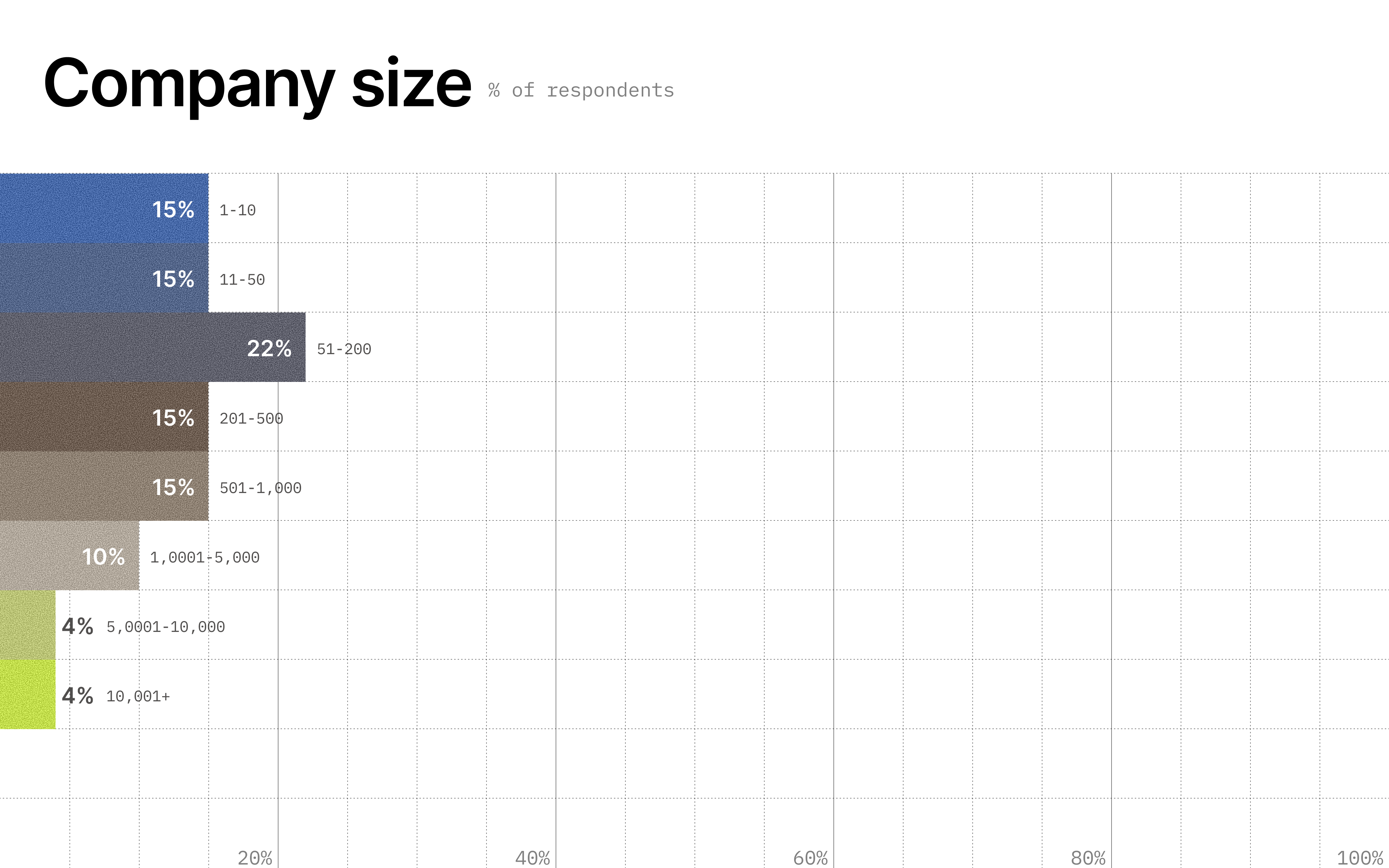
We wanted to understand what marketers are actually doing in response to the rise of AI search—not just what they think they should be doing. So we surveyed more than 600 US-based marketing and PR professionals across roles, seniorities, industries, and company sizes.
The results show just how far the AI search space has come in a very short time—and how much further it has to go.
If you see yourself in this data—confident one moment, unsure the next—remember: You’re in good company.

⊹ Key takeaways
| Takeaway Ready, fire, aim | Data 84% of respondents say they're confident they can shape AI answers, but 51% aren't sure their strategy is right. |
| Takeaway Stuck in the starting blocks | Data 45% are testing visibility across AI platforms. Fewer update existing content or map it to real prompts. Just 33% analyze AI bot traffic. |
| Takeaway Quantity over quality | Data 42% are scaling content production to win AI search. Only 23% are focused on optimizing the content they already have. |
| Takeaway SEO habits, AI blind spots | Data 62% of teams are judged on old SEO metrics. 71% of agencies that offer GEO spend more time explaining it than doing it. |
| Takeaway Tools of the trade | Data 73% have invested in tooling, but much of it is bolted onto legacy SEO or PR platforms. Only 41% can turn data into action. |
| Takeaway Pressure to perform | Data 87% feel more pressure to build technical skills, but 58% say their training isn't keeping pace. |
🔌 Shameless plug: Hungry for more data? Check out Scrunch Labs for trends, data studies, and free tools designed to help you take control of your AI search strategy.

⊹ Ready, fire, aim
84% of marketing and PR professionals say they're confident they can influence AI answers, but:
| 47% don't know what content AI platforms are using. | 51% aren't sure their approach to AI visibility is correct. | 56% can't tell AI search optimization from SEO. |
Our survey surfaced a split personality.
Marketing and PR professionals sound sure of themselves on AI search—until you ask them how it works and what they’re doing.
Under the surface, confusion and anxiety are readily apparent—especially lower on the corporate ladder.
Marketers agree AI search is the future:
- 82% believe early adopters of AI search optimization will have a lasting competitive advantage.
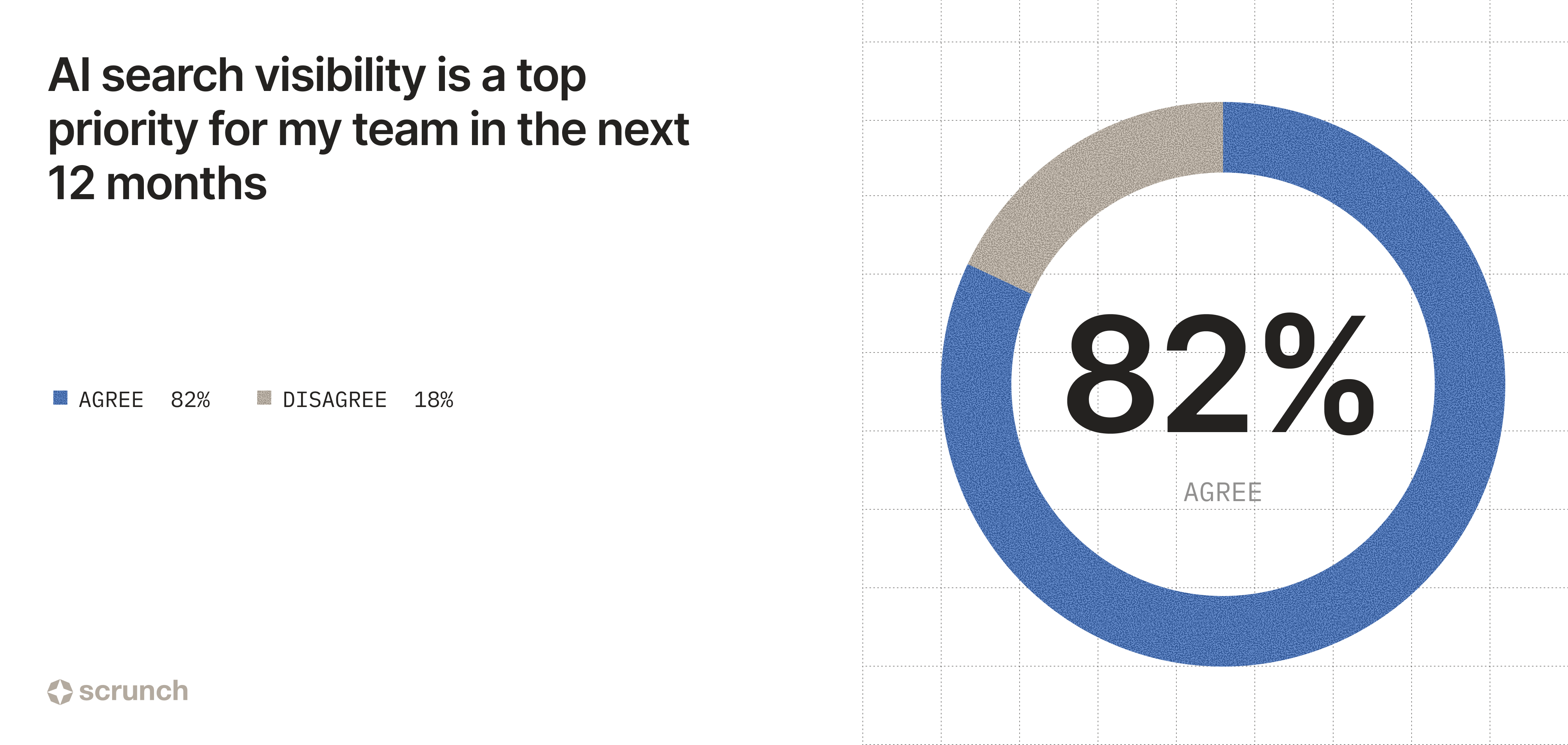
- 82% say AI search visibility is a top priority for their team over the next year.
- 90% agree that formal AI visibility monitoring will become essential for KPI reporting within the next two years.
Marketers have a plan to realize that future:
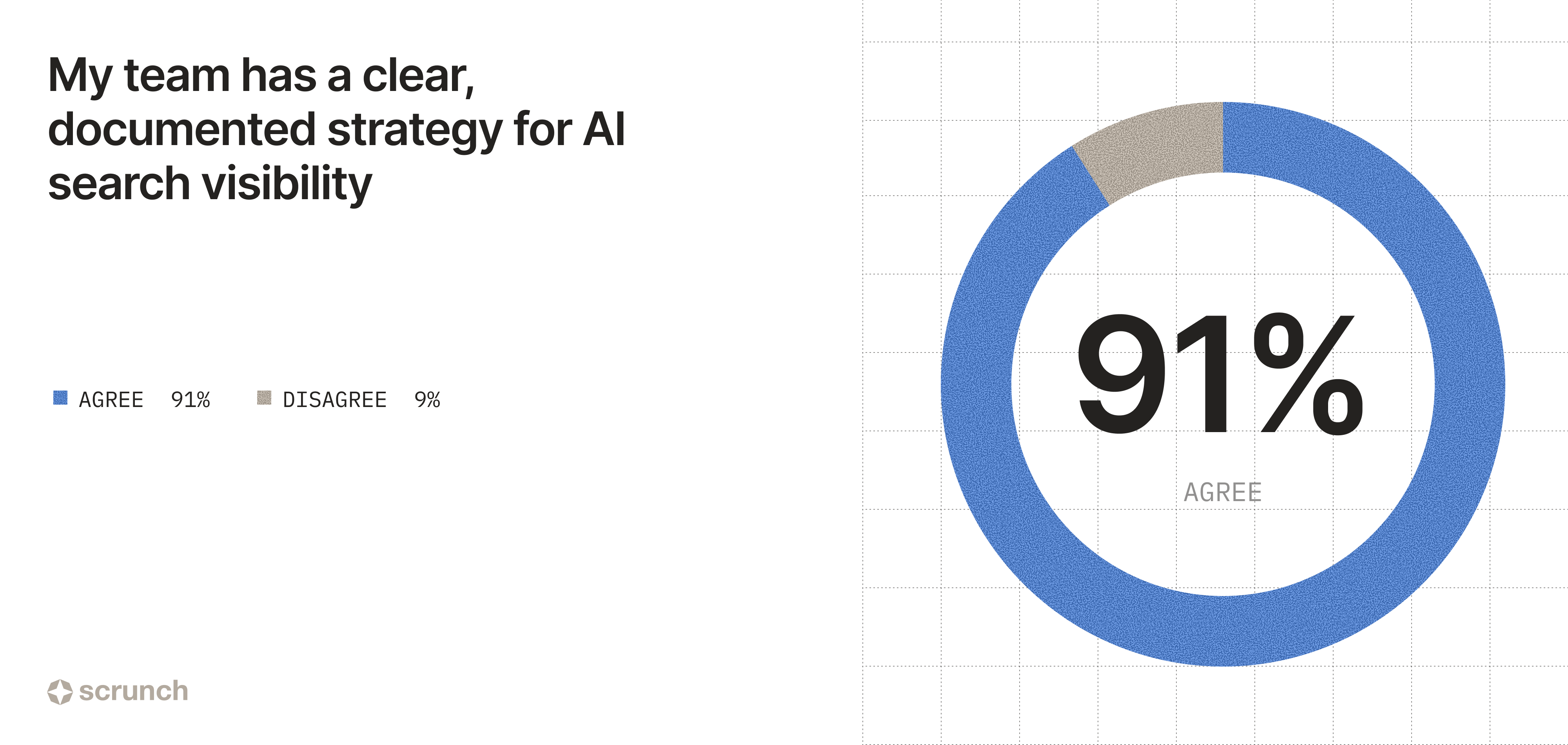
- 91% say their team has a clear, documented strategy for AI search visibility.
- 84% say they're confident they can influence how their brands or clients appear in AI answers.
- 81% say their organization can clearly connect AI search efforts to business impact.
But confidence disappears under scrutiny:
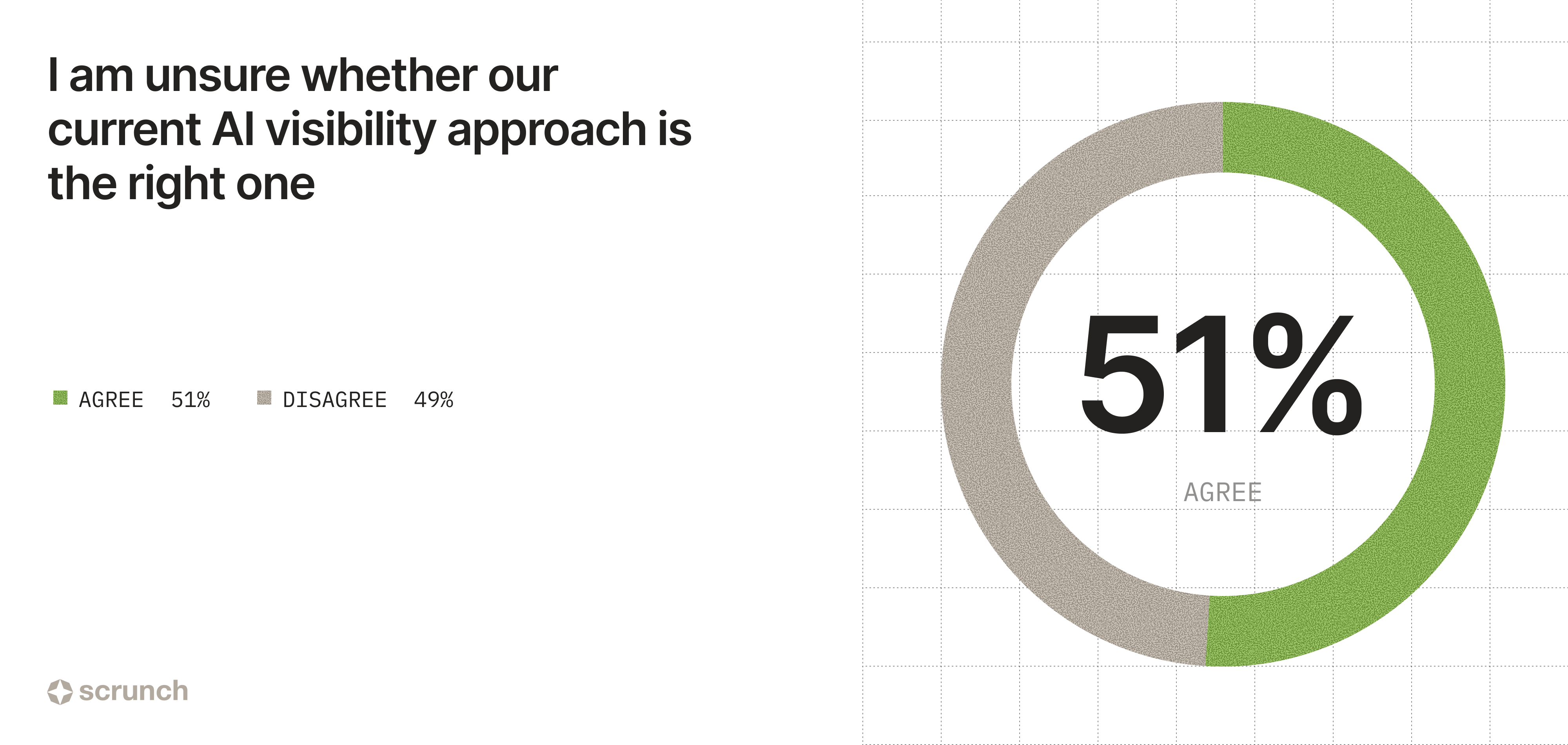
- 51% are unsure whether their current AI visibility approach is the right one.
- 46% say their organization may have moved too fast into AI visibility tactics without a clear long-term strategy. Junior staff—often the ones in the trenches doing the work—were 41% more likely than C-suite or VP-level leaders to raise this red flag.
Fear, uncertainty, and doubt get more evident the deeper you go:
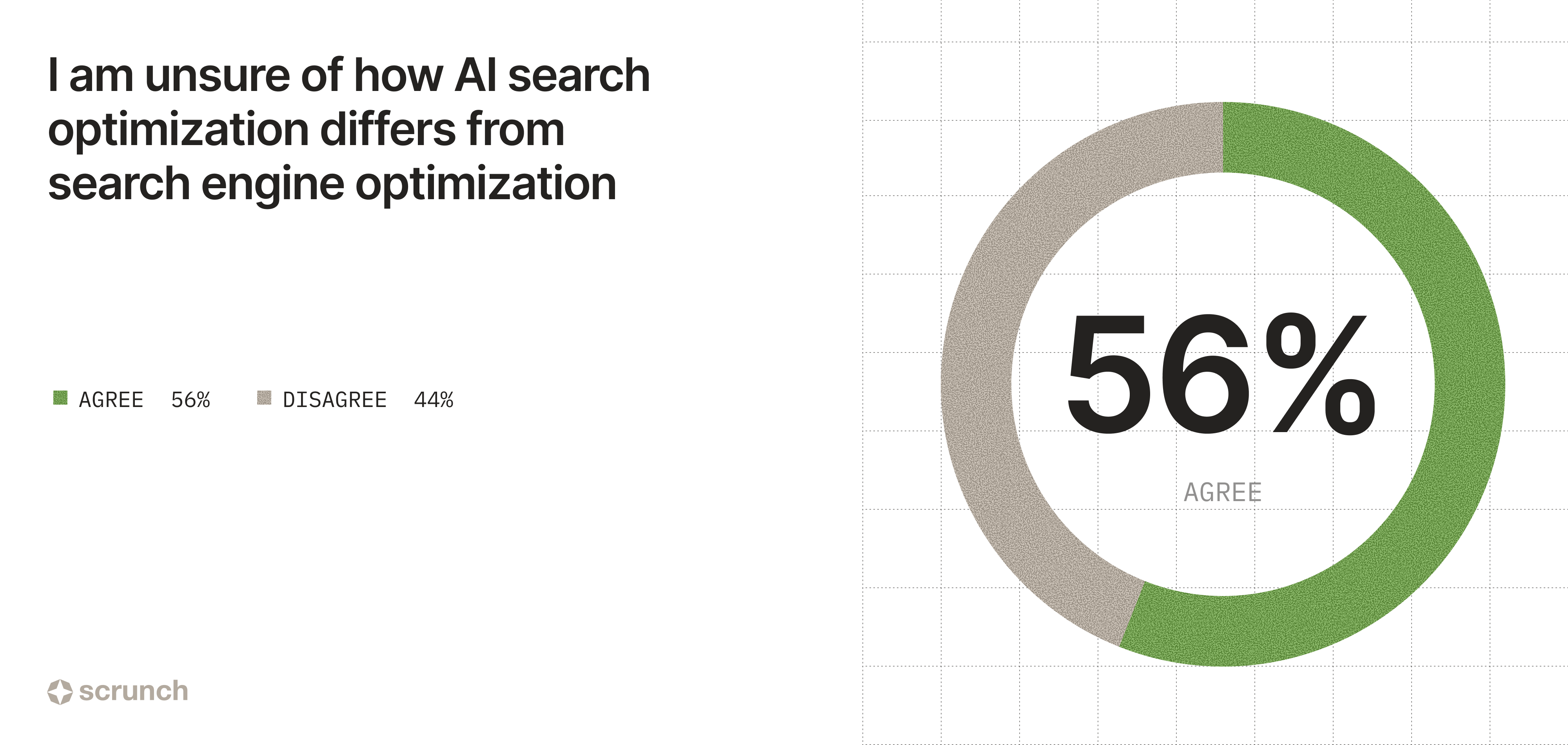
- 56% are unsure how AI search optimization differs from SEO. Junior staff were 36% more likely than senior leaders to say this.
- 47% don’t understand what content AI search engines are actually using to generate answers (something junior staff were 16% more likely than senior leaders to report).
This feeds directly into heightened anxiety about falling behind:
- 67% say their brands or clients appear less frequently in AI-generated answers than they’d like.
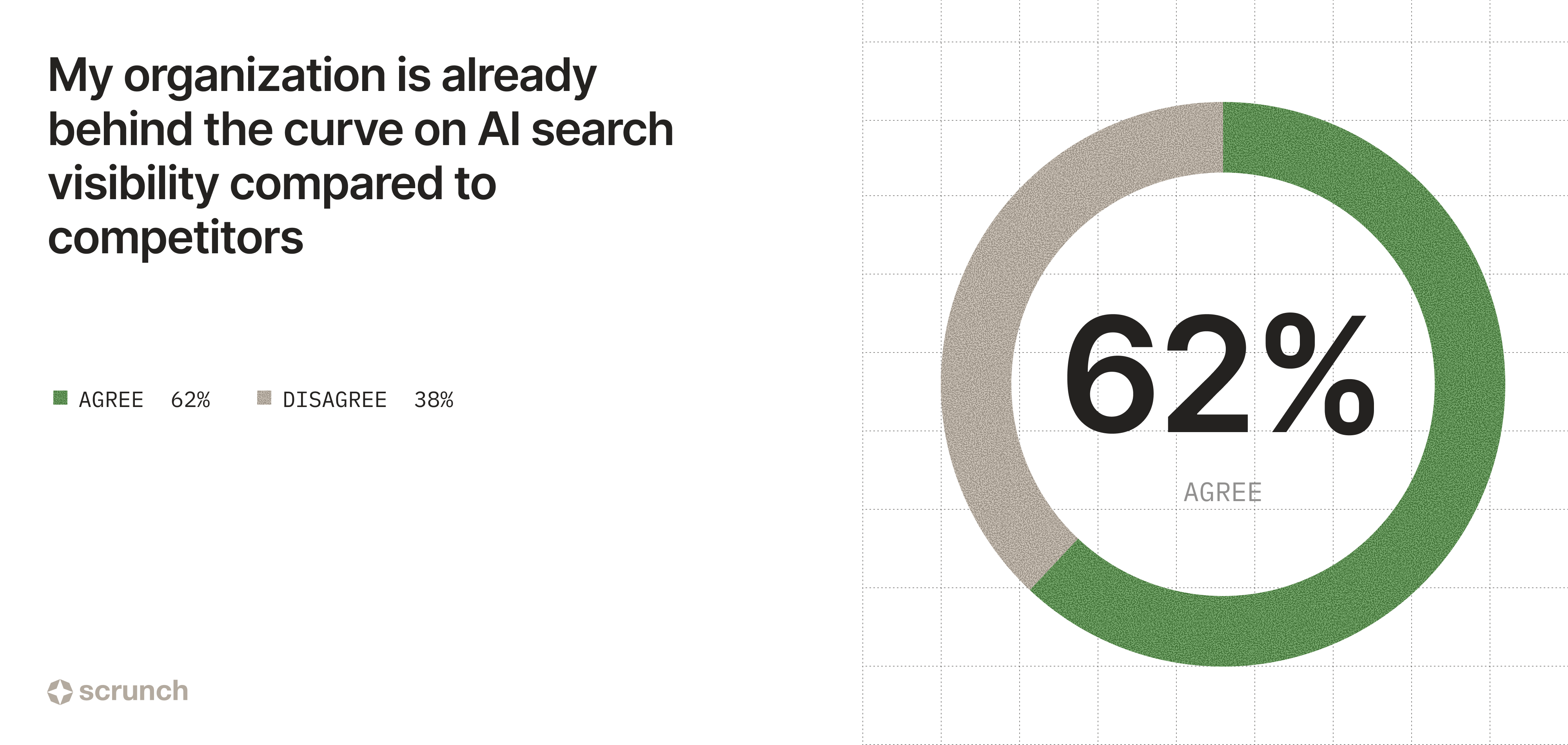
- 62% believe their organization is already behind the curve on AI search visibility compared to competitors.
- 58% are concerned their competitors are getting more AI visibility than their brand or clients.
But fear of missing out is only part of the concern. There’s also significant anxiety about being misrepresented by AI:
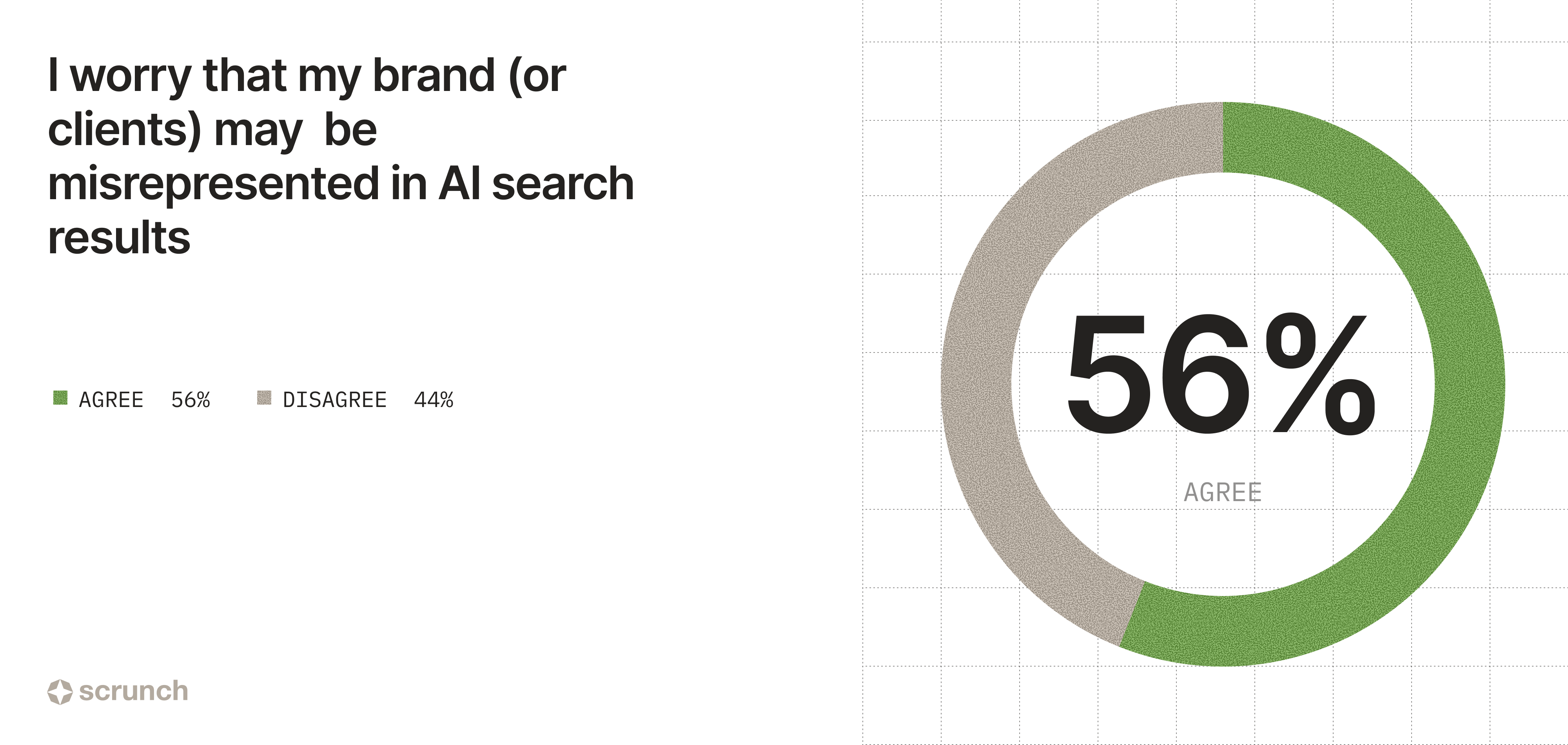
- 56% worry their brand or clients may be misrepresented in AI search results.
- 50% say they’ve observed misrepresentation happen in the past 12 months.
The divide we see in our data isn’t between confident teams and worried teams. It runs straight through the middle of the same teams.

⊹ Stuck in the starting blocks
45% of marketing and PR professionals are testing their brand's visibility across AI platforms, but:
| 67% aren’t analyzing AI bot traffic. | 70% aren’t monitoring sentiment toward their brand. | 71% aren’t tracking share of voice against competitors. |
Many marketing and PR professionals appear stuck on the first step of AI search optimization: monitoring.
That’s the foundation of AI search, not the finish line. Even still, too many teams are only seeing part of the picture.
While 45% are testing their brand’s or clients' visibility across multiple AI platforms, most aren't doing anything with the data they're gathering—58% aren’t updating existing content to improve AI citation likelihood and 63% aren’t mapping content, press materials, or campaigns to real audience prompts.
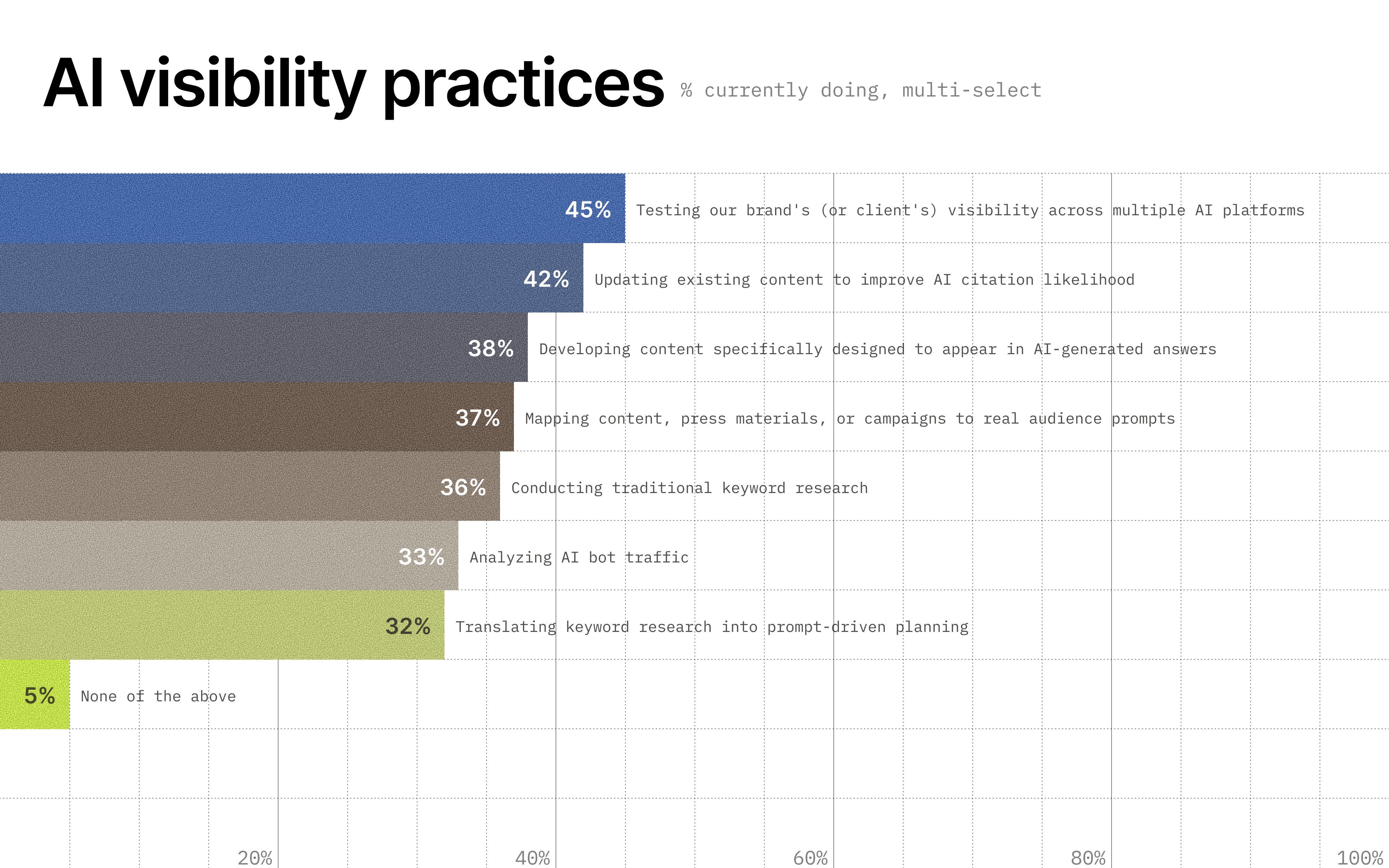
Most teams are only scratching the surface:
- 60% aren’t analyzing which media sources are surfaced by AI systems.
- 67% aren’t analyzing AI bot traffic.
- 70% aren’t monitoring sentiment toward their brand in AI answers.
- 71% aren’t analyzing AI share of voice against competitors.
What’s more, of the teams actively tracking their AI search performance, 37% are using AI platforms to manually check brand mentions (e.g., going into ChatGPT to see how they show up for certain prompts).
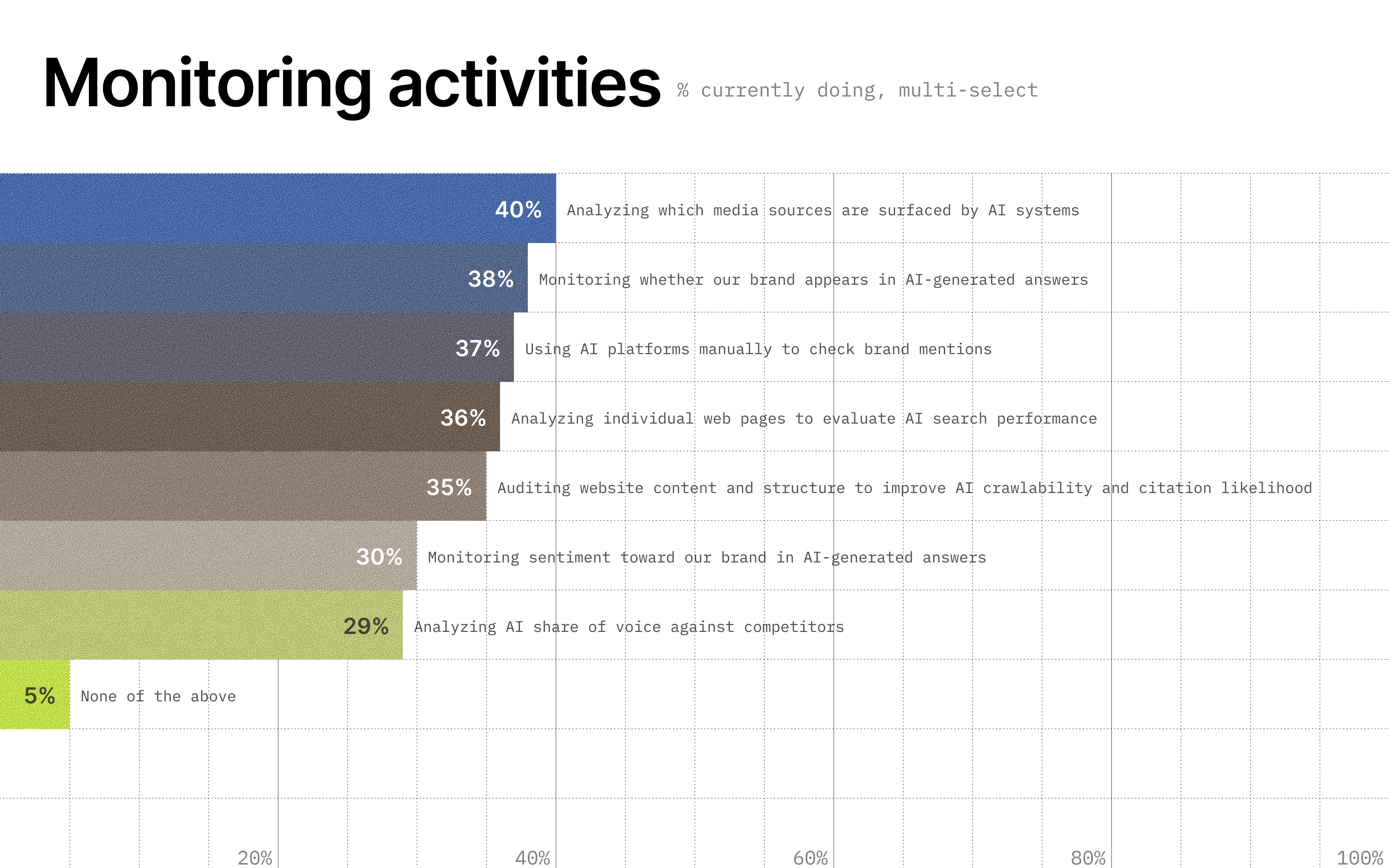
Meanwhile, they’re struggling to turn monitoring findings into action:
- 56% aren’t using AI trend insights to update existing content or messaging.
- 58% don't review which third-party sources AI systems cite most frequently in their category.
- 60% don't review AI-generated answers for content gaps their brands should address.
- 70% don't incorporate AI prompt data into their editorial calendars.
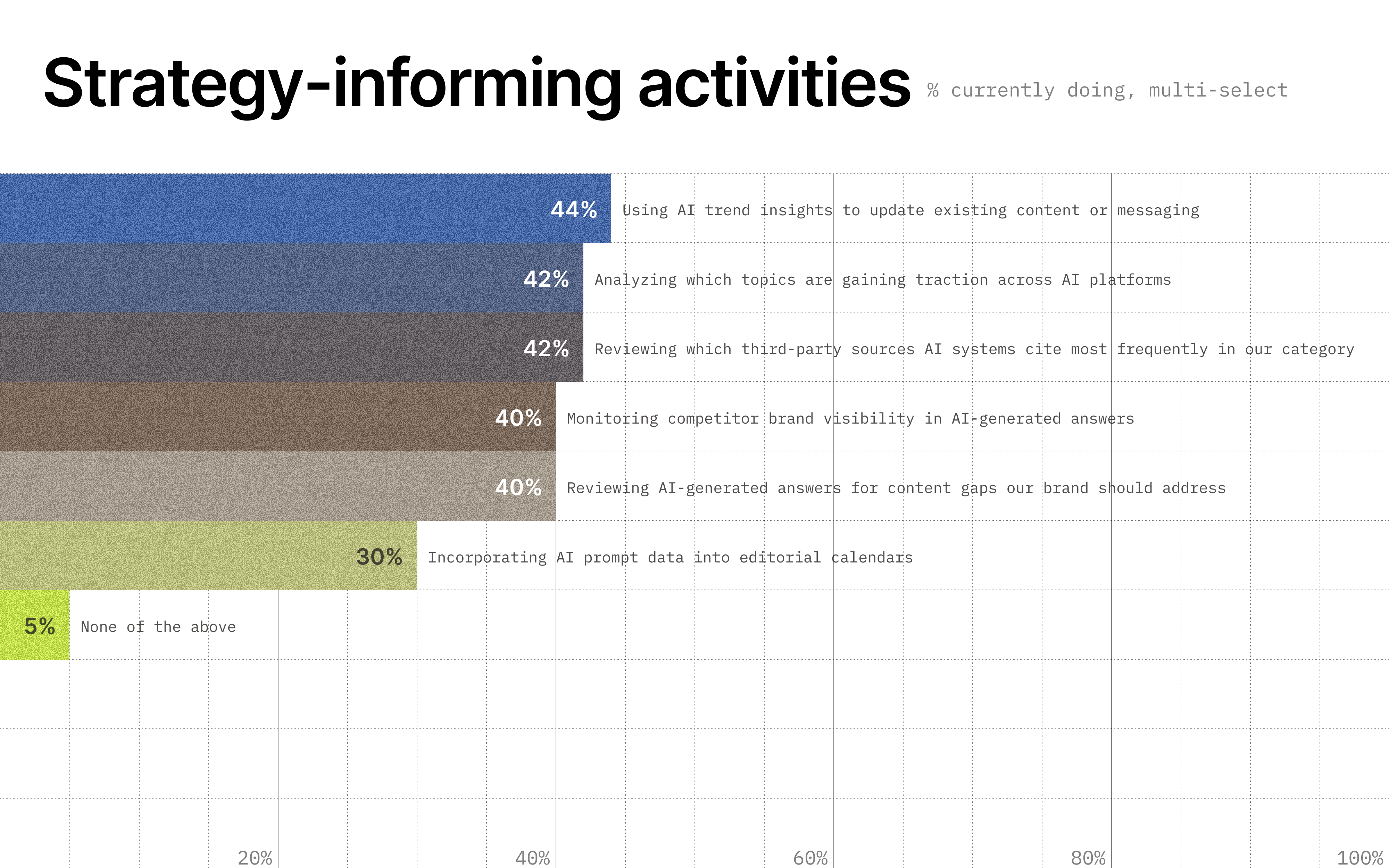
The fact that only about one-third of our respondents are analyzing AI bot traffic is an issue worth highlighting. It’s not a minor gap; it's a missed signal.
When AI user agents retrieve content from your site, it means real people are prompting about you or your category. That's a prospective buyer, mid-research—and it’s something most teams are ignoring.

⊹ Quantity over quality
42% of marketing and PR professionals are betting on scaled content to win AI search, but:
| 61% aren’t working to secure brand mentions in trusted media sources. | 72% aren’t concentrating on informing content based on audience prompts. | 77% aren’t focused on optimizing the content they already have on their site. |
For a quarter century, digital marketing has been dominated by SEO tactics. But AI search is a different animal. Or vehicle, if you will.
The team at Scribewise likes to say that SEO is like a spark plug—without it, the car won't go. But you can't drive a spark plug to your destination. Our data shows that many marketers are operating with an SEO mindset for AI search, and likely getting frustrated that the spark plug isn't moving fast enough.
Some teams see content volume as the solution (i.e., give web crawlers more content, rank better in search engine results pages, show up better in AI answers). Today that means using AI to create content faster.
However, studies have shown that while scaling AI-generated content can lead to rapid improvements in traditional and AI search performance, the falloff comes quickly and leaves brands worse off than before.
Still, that’s the path many are taking. In the process, they’re skipping over content already on their site that can be optimized via AI accessibility, technical hygiene, and LLM-friendly content improvements.
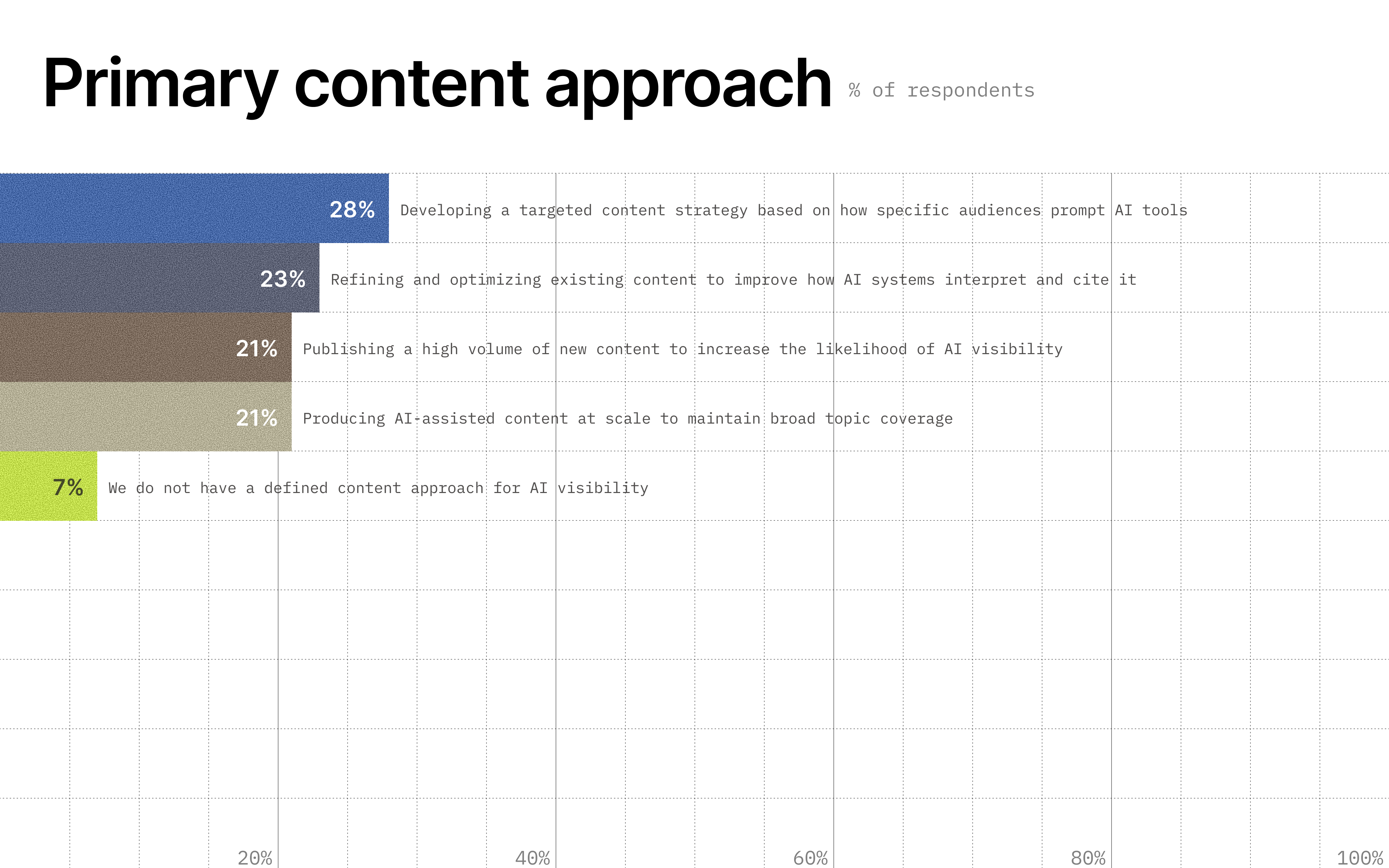
When asked to describe their organization's primary approach to AI visibility content, 21% say “Publishing a high volume of new content to increase the likelihood of AI visibility” and 21% say “Producing AI-assisted content at scale to maintain broad topic coverage.”
AI-generated or not, 42% of respondents are indexing on scaled content as their fix to AI search optimization.
As far as content priorities, 72% aren’t concentrating on developing a targeted content strategy based on how specific audiences prompt AI tools, and 77% aren’t focused on refining and optimizing existing content to improve how AI systems interpret and cite it.
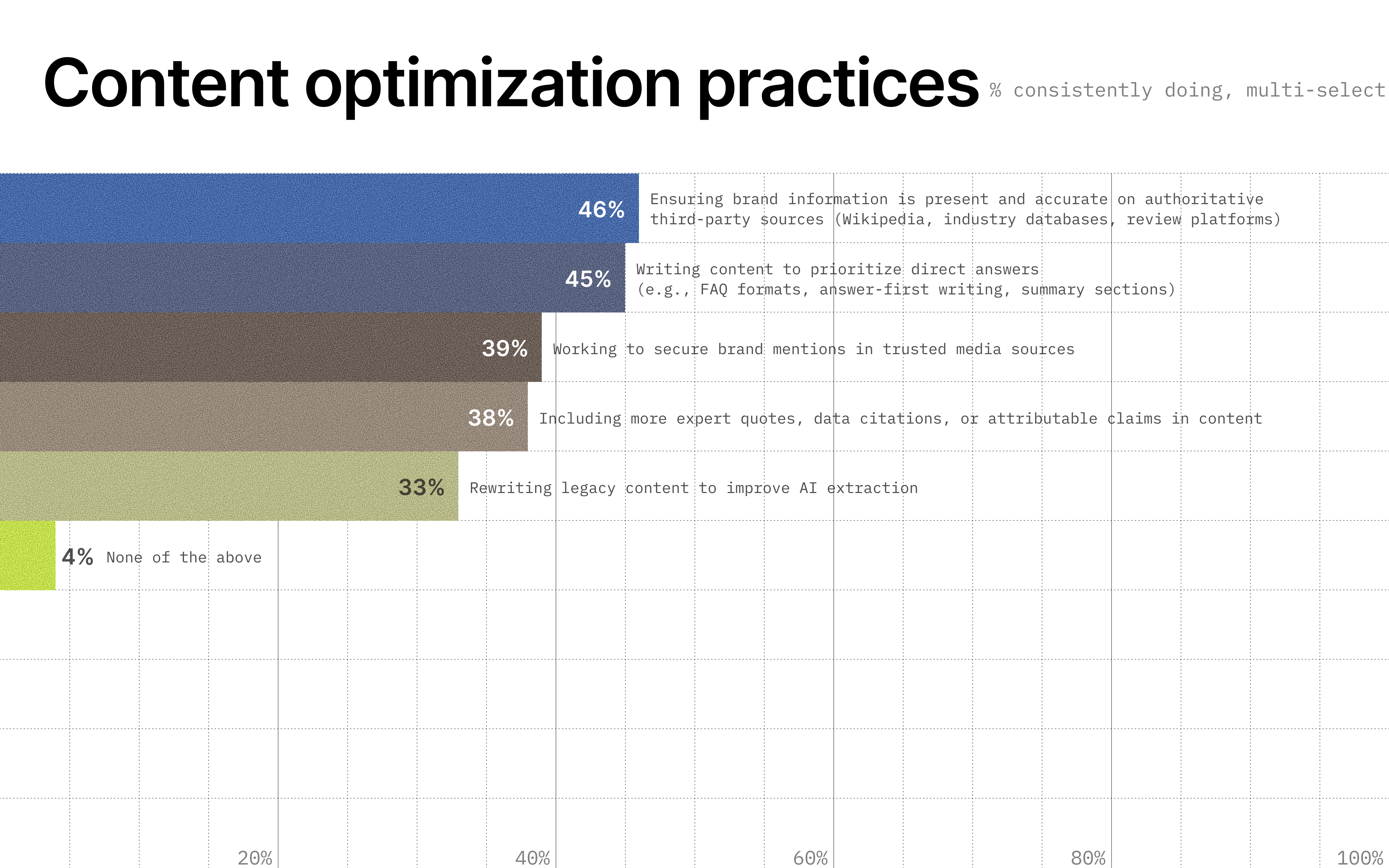
When it comes to what teams are doing to make their content more visible to AI, 45% are employing tactics like writing content to prioritize direct answers (e.g., FAQ formats, answer-first writing, summary sections).
And in terms of offsite content, 46% are ensuring brand information is present and accurate in authoritative third-party sources (e.g., Wikipedia, industry databases, review platforms).
But 61% aren’t working to secure brand mentions in trusted media sources.
The Navy SEALS have a saying: “Slow is smooth, and smooth is fast.” If the goal is sustainable and compounding improvement, putting the work in to optimize content for AI is more important than simply generating content for AI.
⊹ SEO habits, AI blind spots
Marketing and PR professionals are stuck explaining instead of executing:
| 62% are judged on traditional SEO or traffic metrics. | 52% say metric misalignment is limiting their execution. | 71% of agencies spend more time explaining GEO than doing it. |
Misalignment is a direct tax on execution, and it’s a tax lots of companies are paying.
Many departments outside of marketing view answer engine optimization/generative engine optimization (AEO/GEO) as SEO 2.0. The thinking goes that if you rank well in Google, you’ll show up prominently in AI answers.
SEO still matters. It has a direct impact on AI responses. But it’s not one-to-one. For instance, studies have pegged the overlap between Google's top-10 organic results and AI Overview citations at just 17-38%.
The upshot is that teams are struggling to execute on AI search strategies because they’re too busy educating key stakeholders:
- 46% have difficulty explaining the value of AI visibility investments to non-marketing or communications teams.
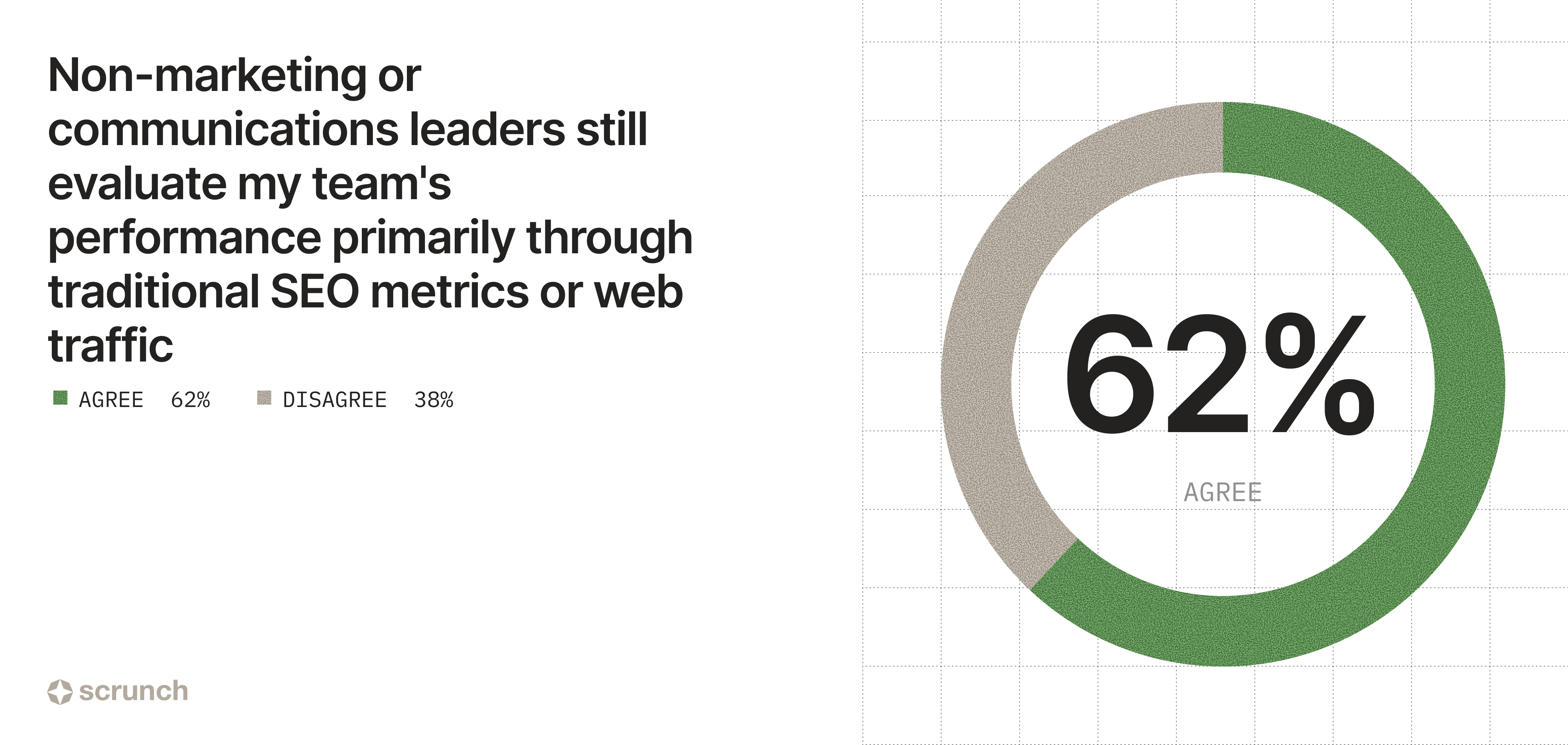
- 62% say non-marketing or communications leaders still evaluate their team’s performance primarily through traditional SEO metrics or web traffic.
- 52% say misalignment around AI visibility metrics is limiting their team’s ability to execute an effective AI visibility strategy.
Meanwhile, 76% agree that more input from sales teams on customer questions and objections would improve AI visibility strategy, and 81% say more collaboration from technical teams, such as web development, would improve their AI visibility strategy.
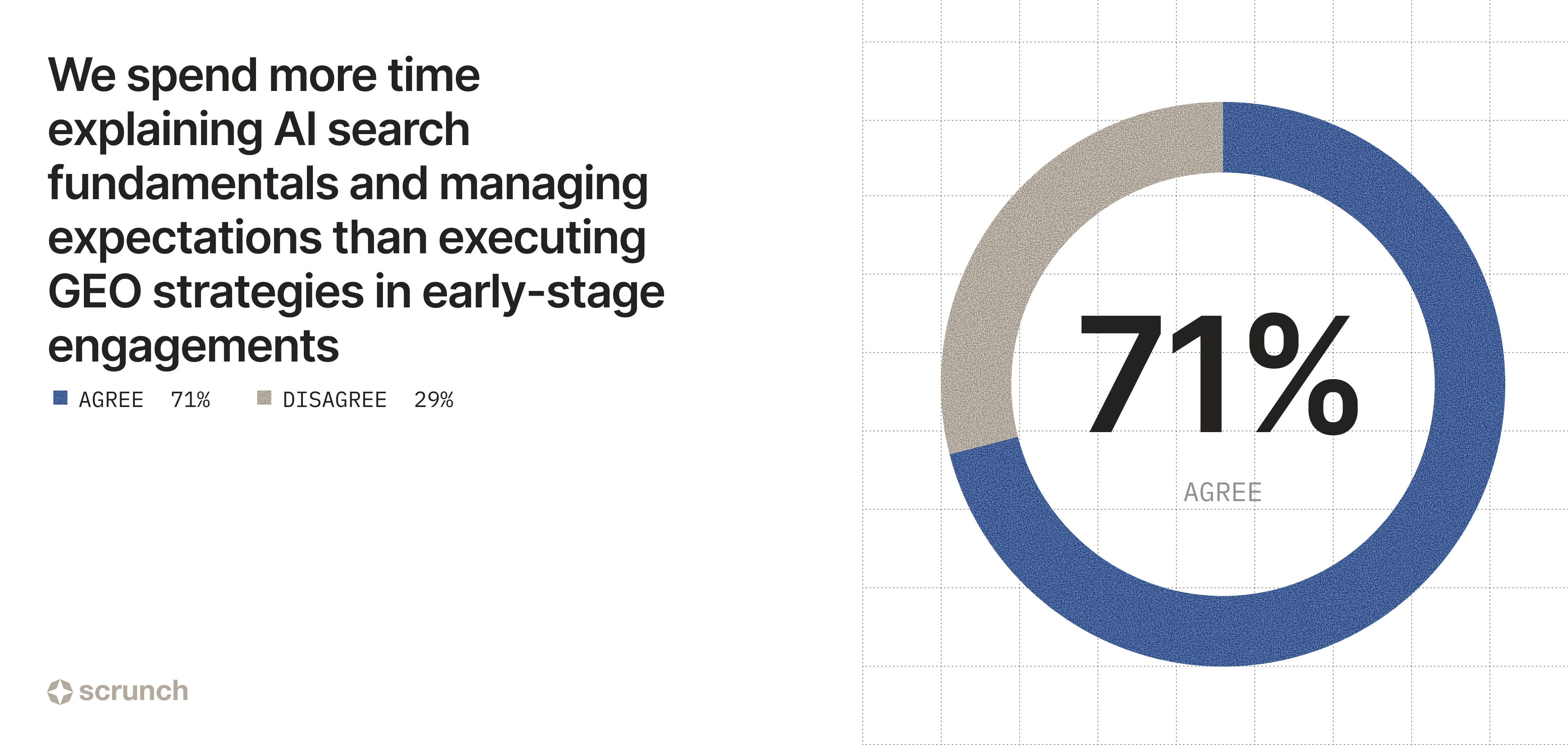
On the agency side, 71% of respondents who offer GEO as a service say clients don’t understand how the rise of AI search impacts their brand’s visibility:
- 34% find it difficult to align client expectations with AI visibility indicators such as citations, prompt inclusion, or AI share of voice.
- 71% spend more time explaining AI search fundamentals and managing expectations than executing GEO strategies.
- 80% say clients often interpret search through a traditional SEO lens.
Ranking in traditional search is not the same thing as being the answer in AI search. And you can’t measure probabilistic AI answers the same way you would more deterministic SERPs.
The fix starts with agreeing on what good looks like so everyone’s grading the same test.
⊹ Tools of the trade
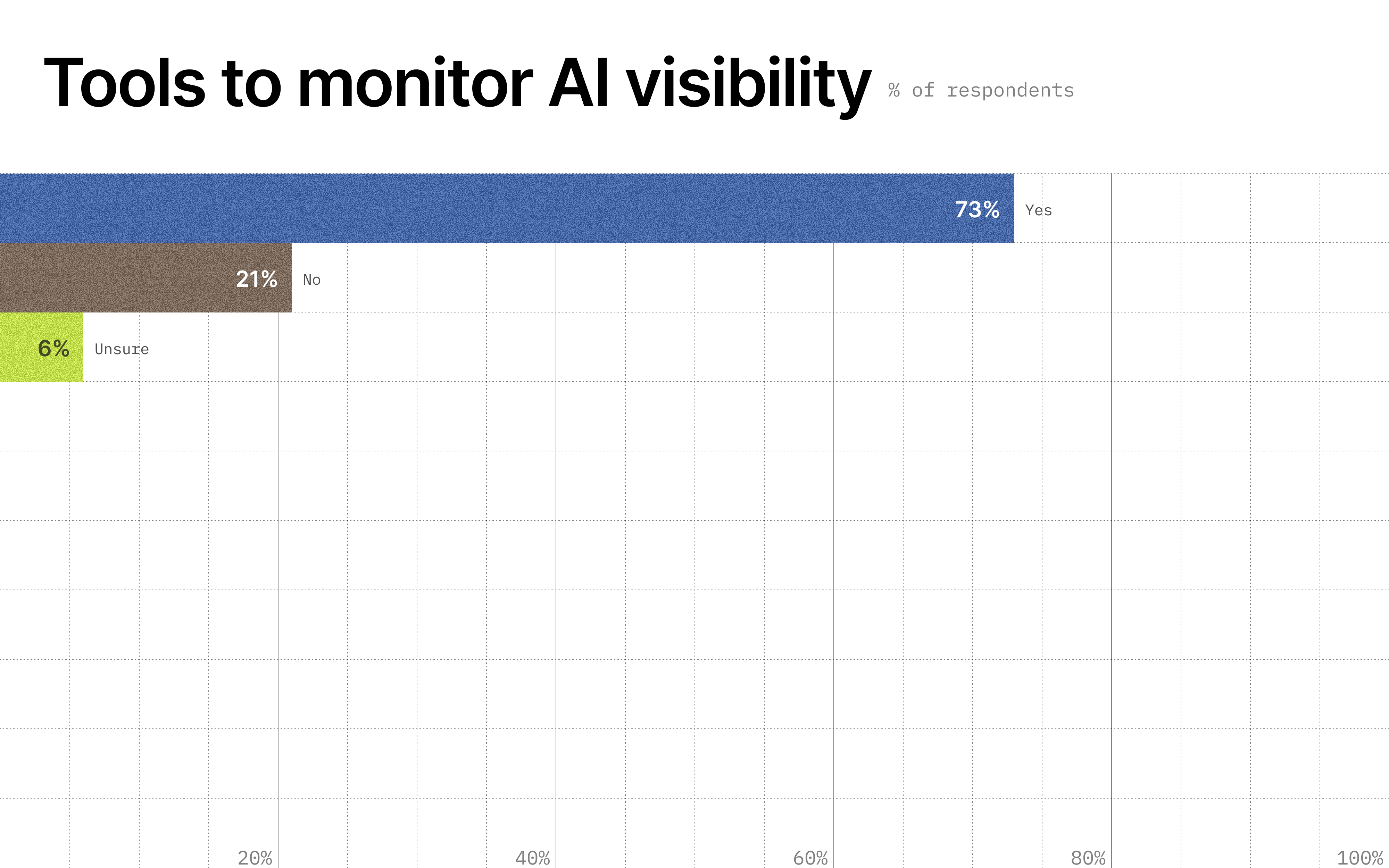
73% of marketing and PR professionals have invested in tools to monitor AI visibility, but:
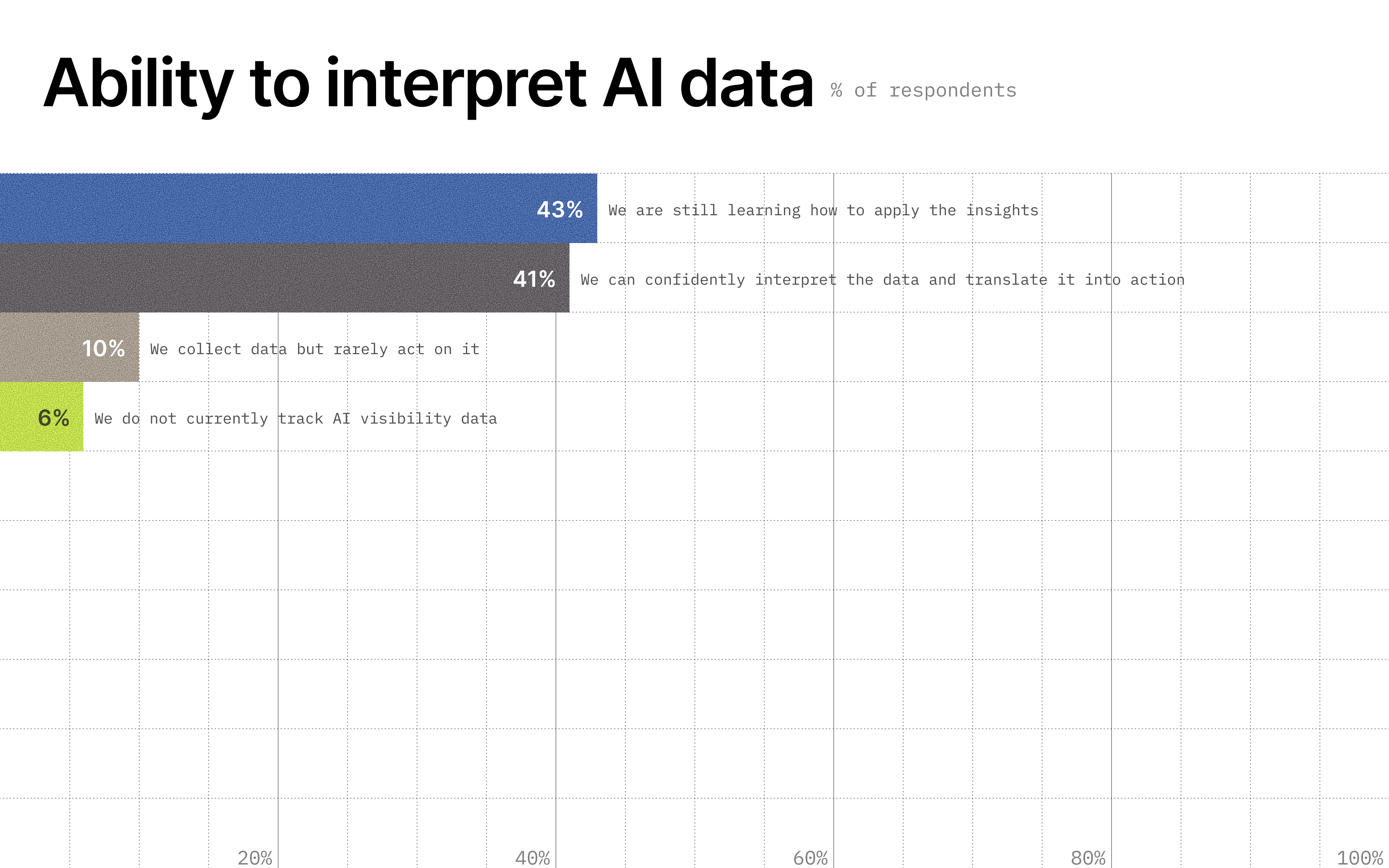
| 10% rarely act on the data. | 43% are still learning how to apply data insights. | 59% can’t turn data into action. |
Most teams are investing in technology for AI search optimization: 73% currently use tools to monitor brand or client visibility in AI answers.
But many of these tools are not purpose-built for AI search.
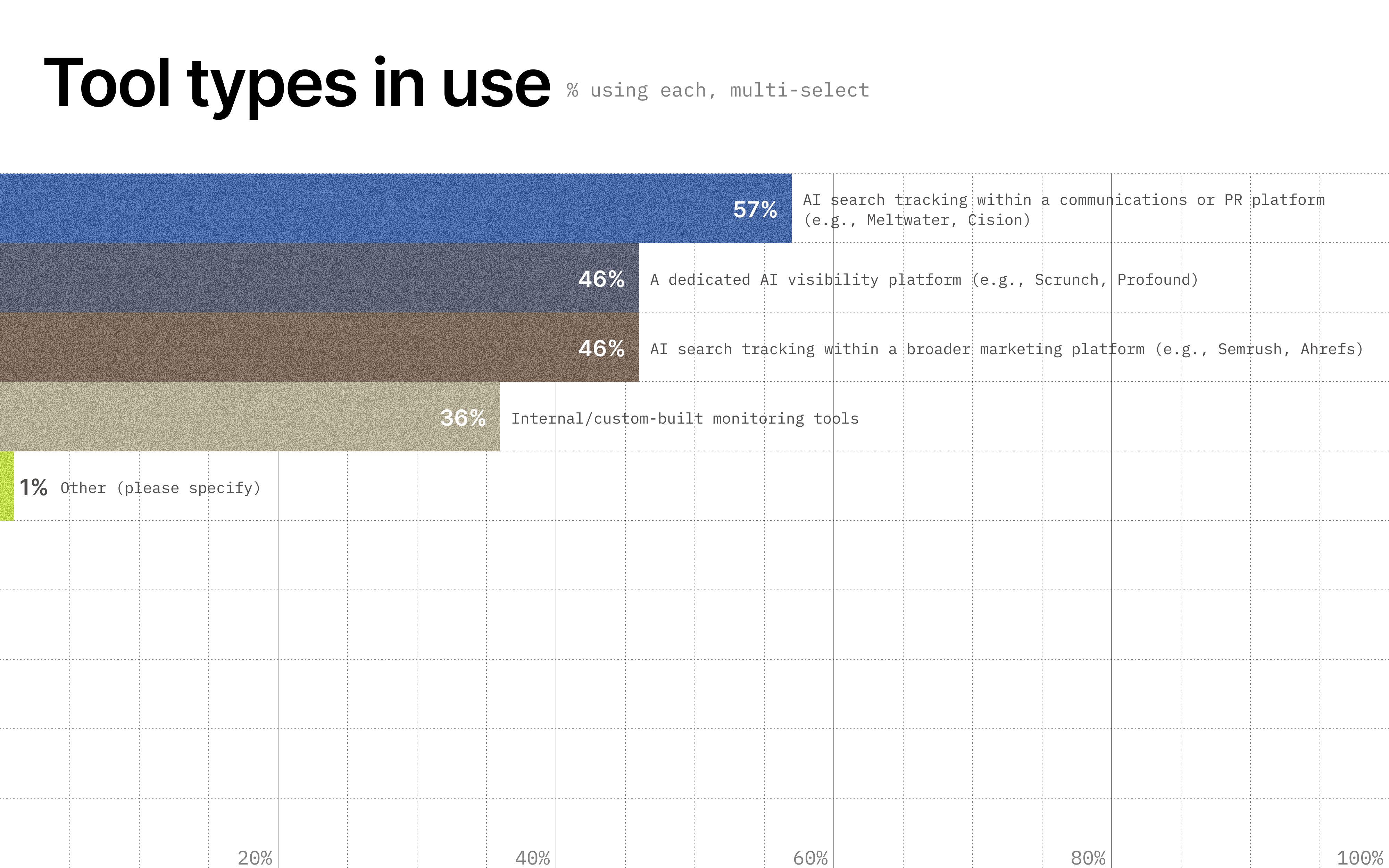
While nearly half of respondents are using dedicated AI search platforms, many are using AI search tracking that’s Frankensteined together:
- 36% say they’re using internal/custom-built tools.
- 46% are using AI search tracking bolted on to a broader marketing platform.
- 57% are using a communications or PR platform.
That might help explain some of the challenges teams have turning visibility data into next steps:
- 10% collect data but rarely act on it.
- 43% are still learning how to apply the insights.
- 59% can’t confidently interpret the data and translate it into action.
AI search monitoring has become commoditized to a large degree. Many vendors now offer AI visibility dashboards.
The hard part comes after: Turning data into clear actions. That's where teams get stuck, and it's reflected in the numbers above.
Still, it’s worth pointing out that the teams using a dedicated AI search tool outperformed on 25 of the 26 tactics we measured for this report.
⊹ Pressure to perform
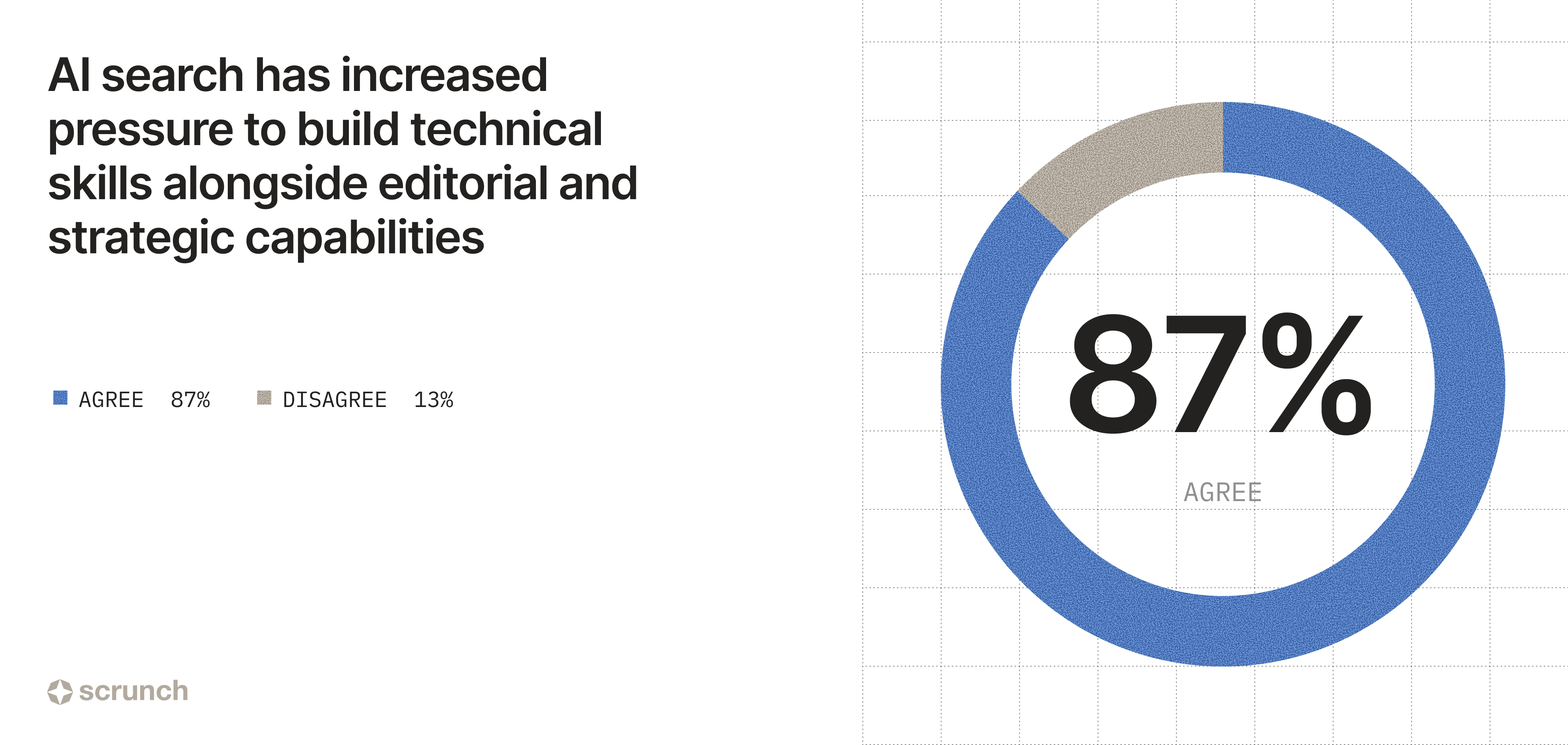
87% of marketing and PR professionals feel more pressure to build technical skills, but:
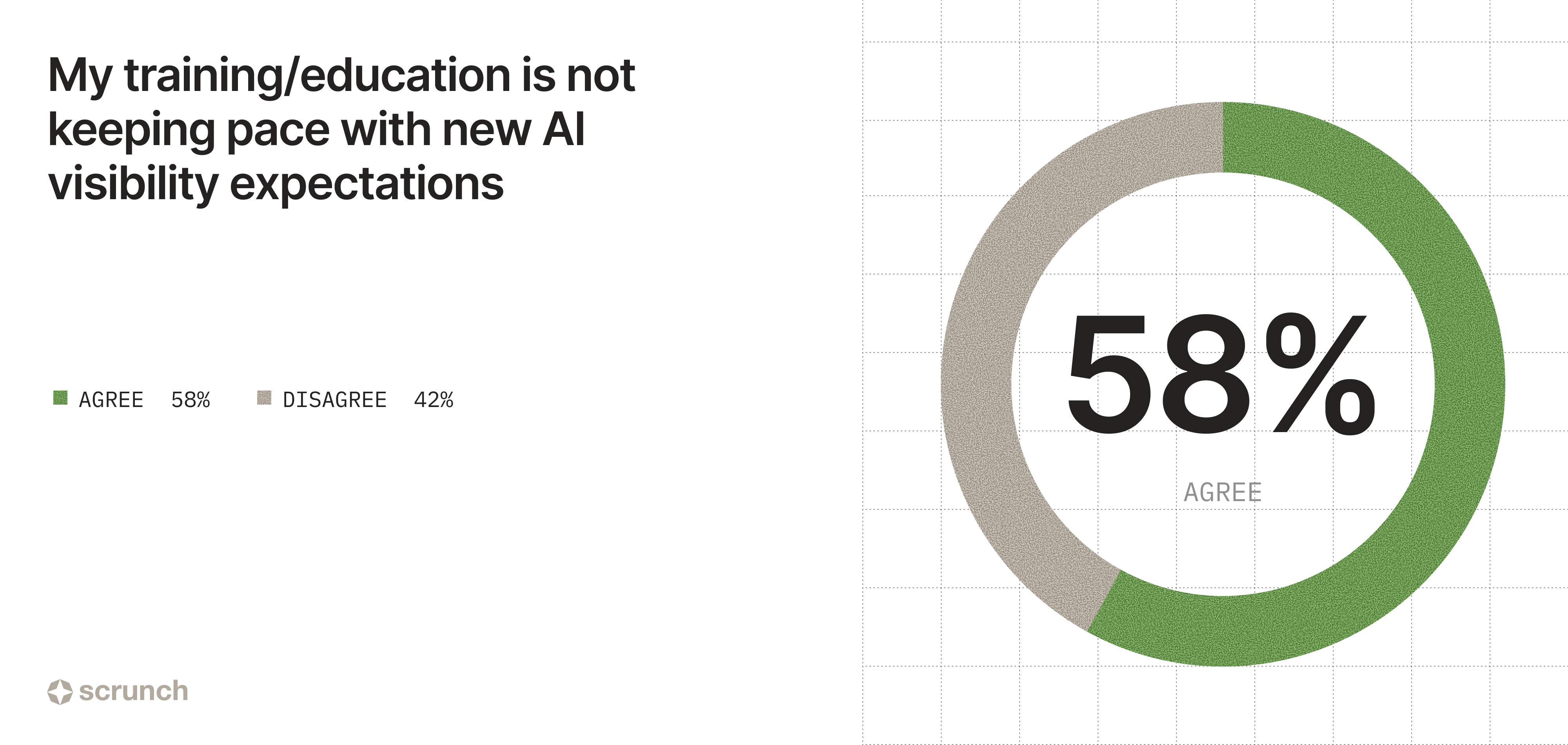
| 58% say their training isn't keeping up. | 57% of teams aren't planning to upskill employees. | 56% of teams aren't planning to develop or formalize AI visibility policies. |
While teams are swinging between self-assurance and insecurity, 87% agree that AI search has increased pressure to build technical skills alongside editorial and strategic ones.
But 58% say their training/education is not keeping up.
Some companies are investing to close the gap over the next year:
- 33% say they plan to bring in outside agency support for GEO efforts.
- 43% say they’re planning to upskill existing employees.
- 44% say they’re planning to develop or formalize internal AI visibility standards, guidelines, or playbooks.
- 46% say they’re planning to increase AI visibility monitoring technology investments.
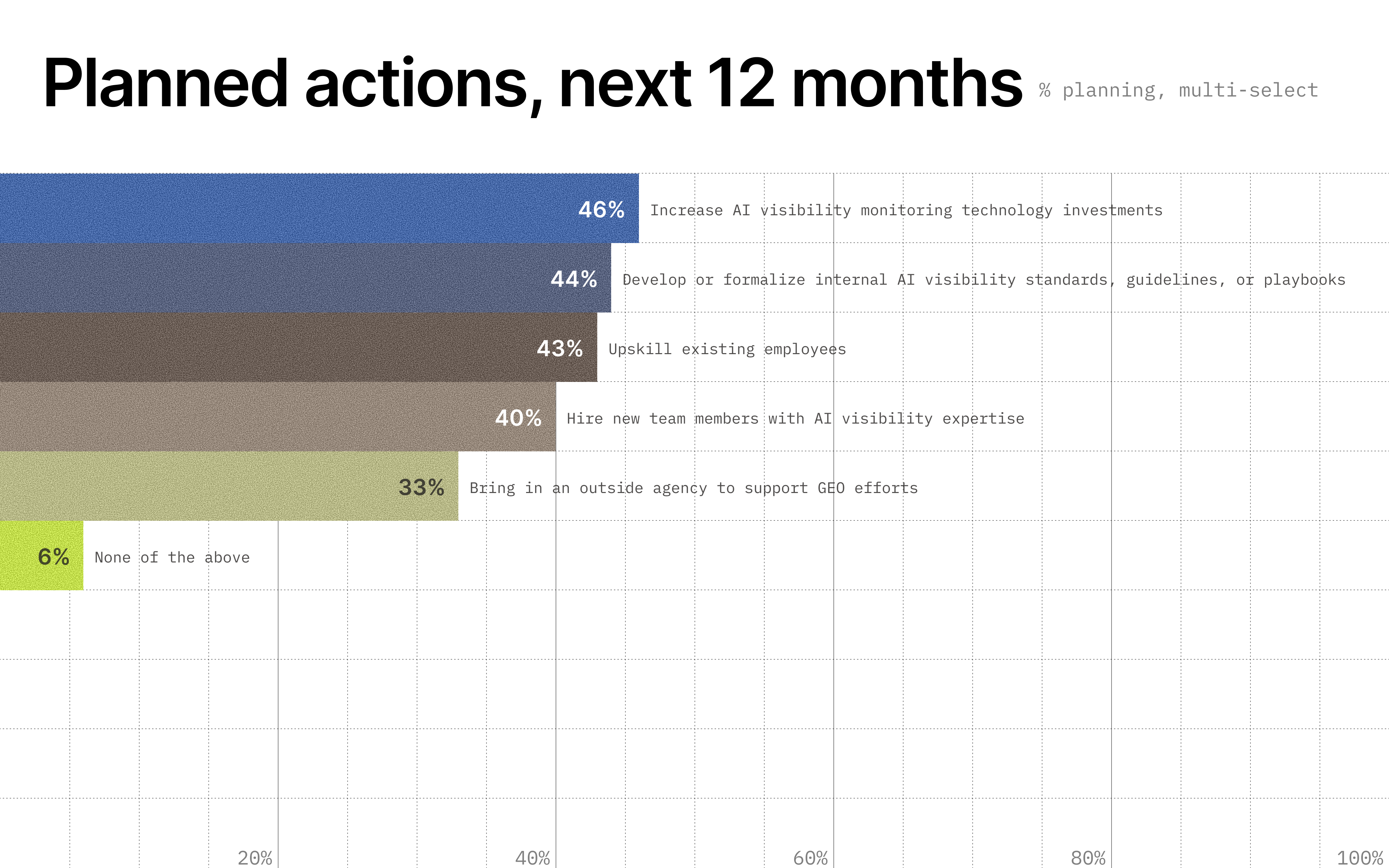
Only 6% are not planning any action around AI search visibility in the next 12 months. The awareness is near-universal; the gap is in capability.
Organizations that treat the solution as a deliberate build rather than a slapdash fix stand a better chance of turning confidence into competence.
And for agencies, the 33% of in-house teams planning to bring in outside support represents a significant and near-term opportunity.
Our advice: See the gap as an opportunity
The divide this report uncovers isn't about teams that care about AI search versus teams that don't. Everyone cares.
It's about teams knowing they need to do something versus actually doing it.
The good news: That gap is an opportunity.
The teams that win in AI search won’t necessarily be the ones with the most headcount or the biggest budgets.
The winners will be the ones that adopt a continuous learning mindset, embrace adaptability, and dive into what’s sure to be a career-long conversation for most of us.
This is a fast-moving space and the stakes are high.
AI agents now handle the discovery, research, and comparison work that used to span a dozen touchpoints—often in a single conversation.
Win that moment, and the rest of the funnel opens up to you. Miss it, and you may not get a second chance.
The hunger is there. And the ingredients are there. Now teams just have to cook.
Get started with Scrunch
Get your site AI-ready so you show up in answers, get cited, and grow revenue. Try a free 7-day trial or book a demo.
⊹ Methodology
Dig into the data below:
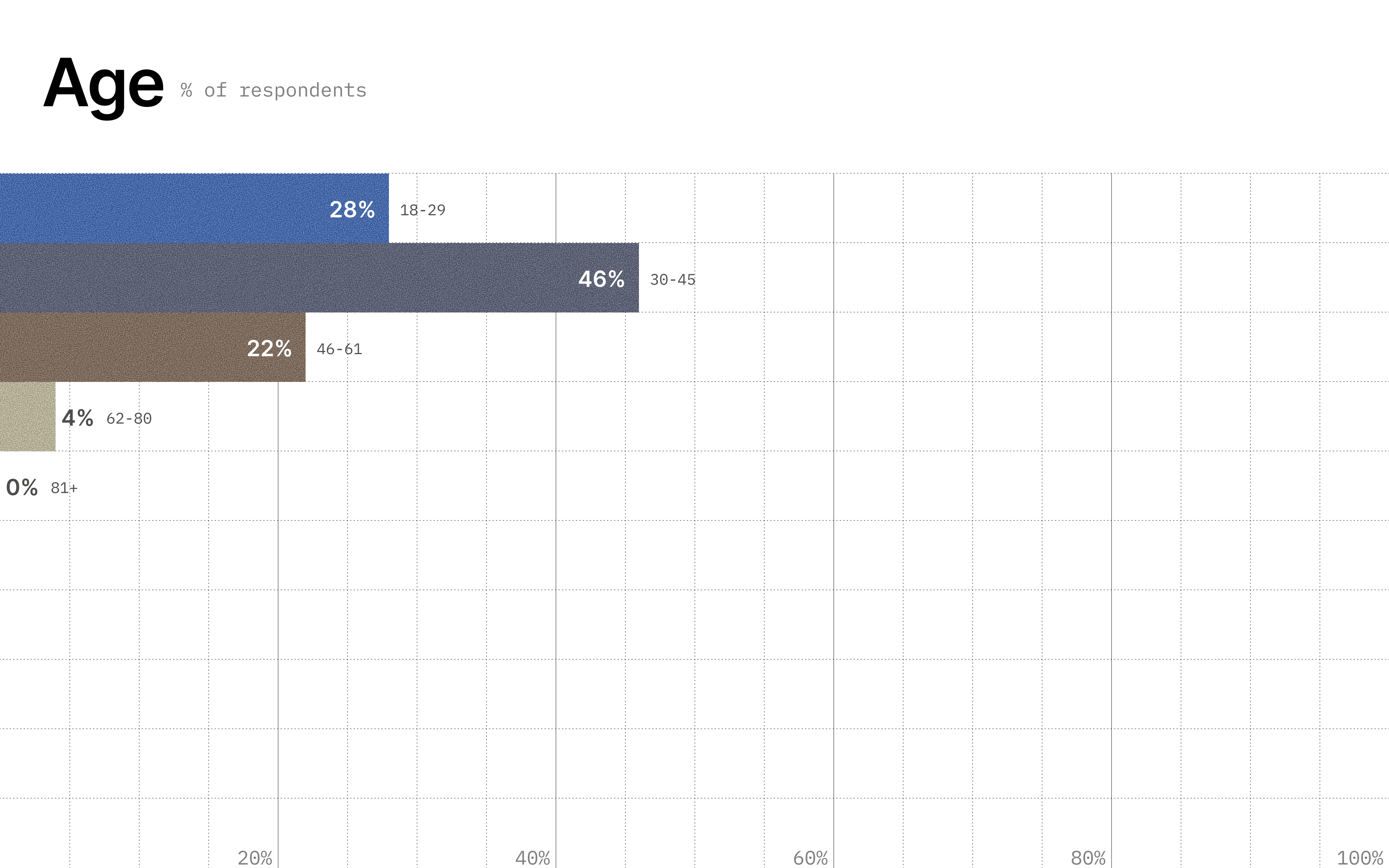
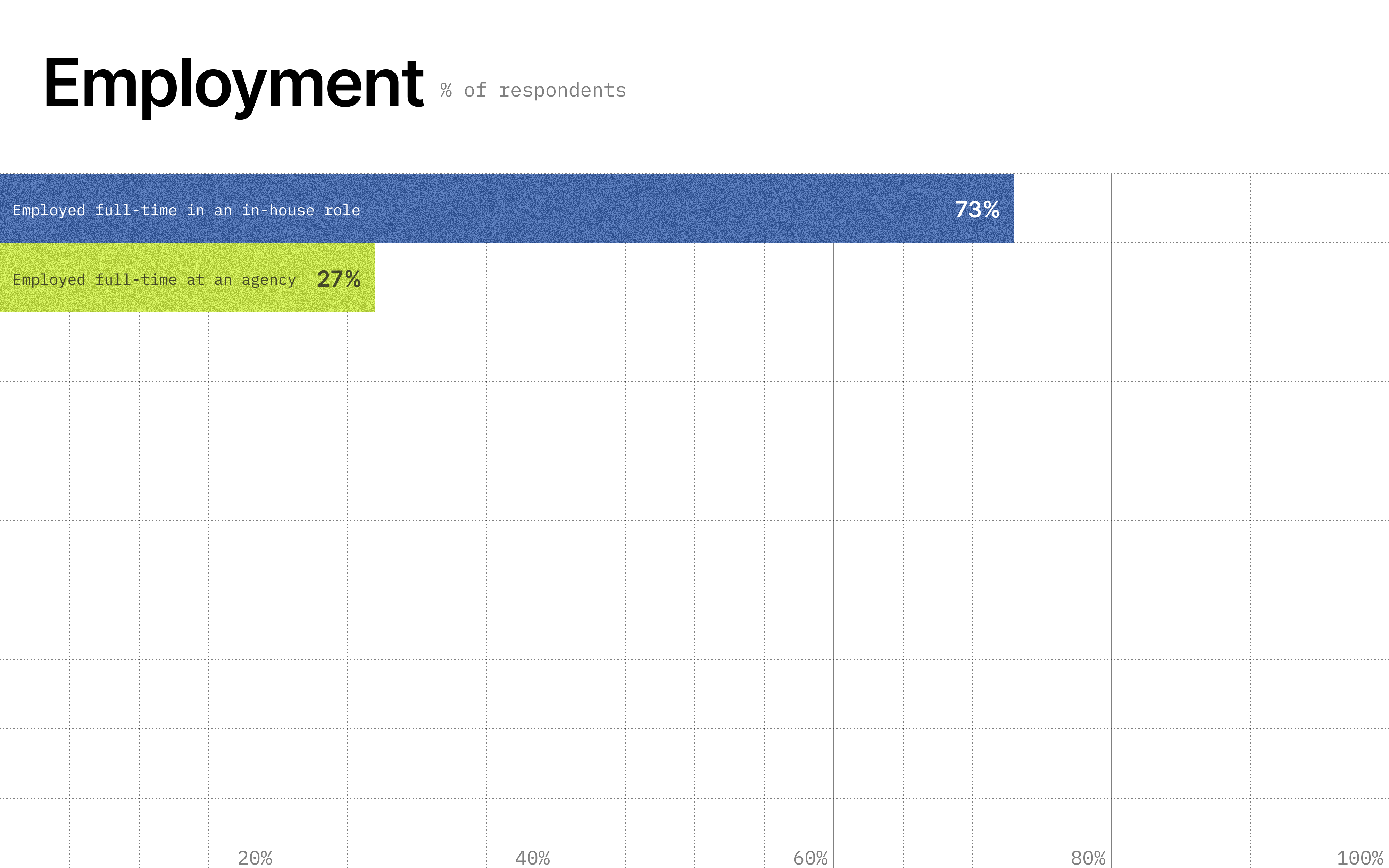
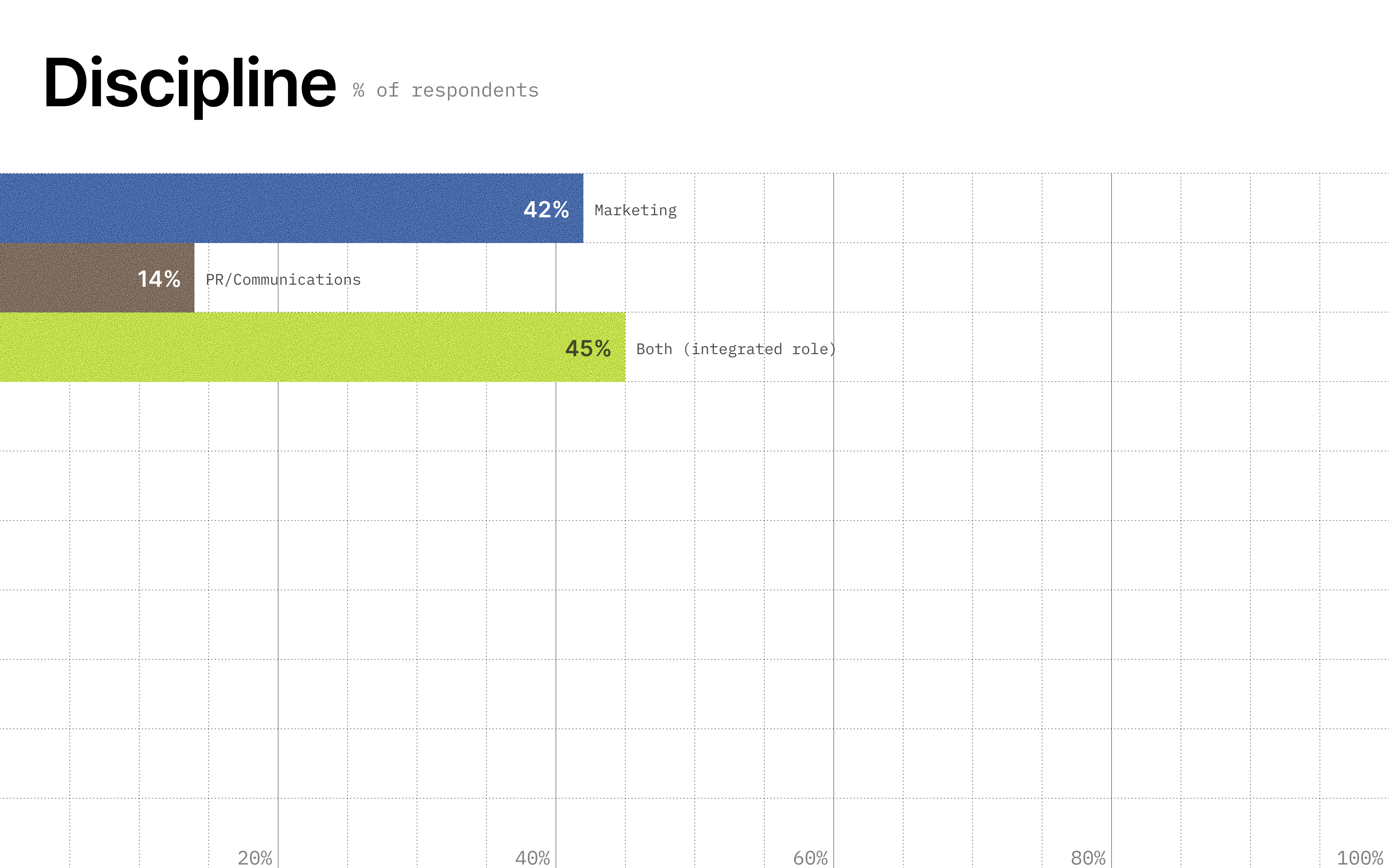
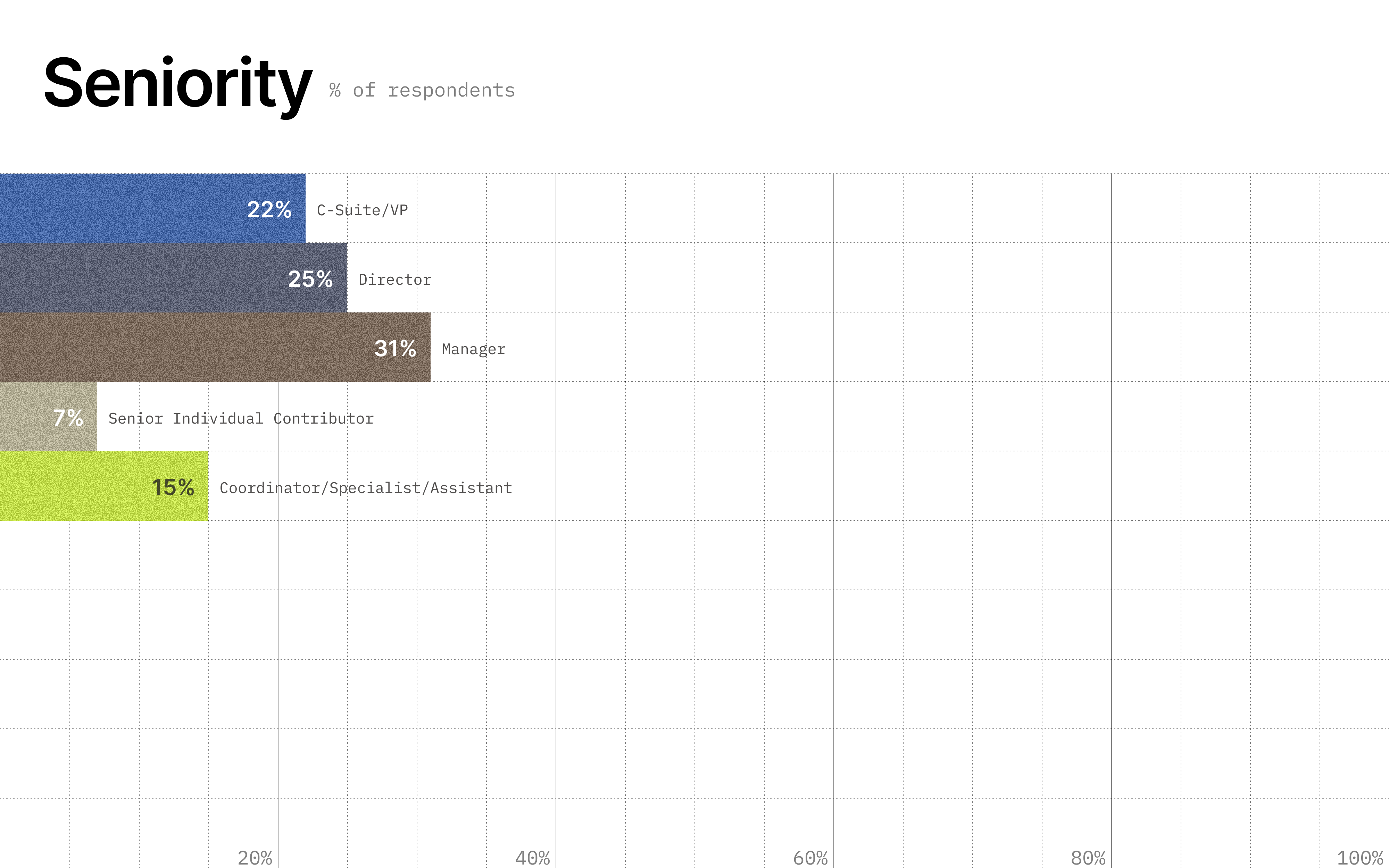
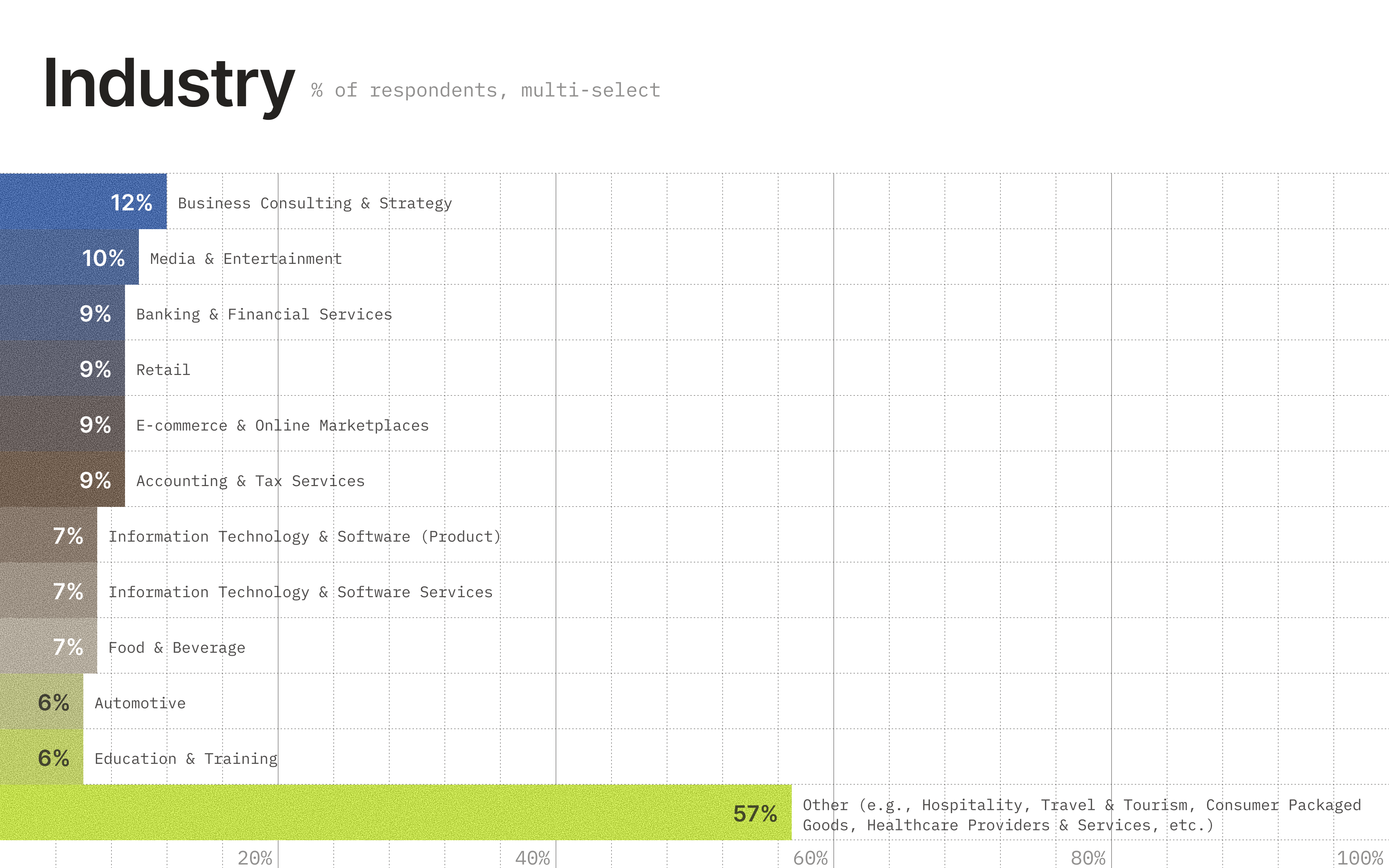
| Our survey was conducted between May 19, 2026 and June 2, 2026. Results have a 95% confidence, with a +/- 4% margin of error. | All survey respondents live in the US, are at least 18 years of age, and are employed full-time in a marketing or public relations role. | There were 602 respondents (69% male, 31% female) from across 44 out of 50 US states, not including Alaska, Hawaii, Kansas, New Hampshire, Vermont, and Wyoming. |
About Scrunch
Scrunch, a Sitecore company, is the Agent Experience Platform (AXP) that helps marketing and growth teams unlock the new way to reach customers: AI search. Observe what agents say and do—in AI platforms and on your site. Understand agent behavior to identify and prioritize optimization opportunities. Deliver what agents need to understand, reference, and recommend your brand. All in one workflow, all powered by always-on intelligence.
Learn more at scrunch.com.
About Scribewise
Scribewise helps professional services firms grow by combining thought leadership marketing, brand strategy, and generative engine optimization (GEO). We work with expertise-driven businesses to create trust-based relationships with clients—and ensure that your expertise is discoverable by humans and AI assistants alike.
Learn more at scribewise.com.