


TLDR:
- Forty-two percent of marketers are betting on content volume to win AI search.
- Only 23% say their primary approach to AI visibility content is refining and optimizing existing content to improve how AI systems interpret and cite it.
- Sixty-one percent aren’t working to secure brand mentions in trusted media sources.
When it comes to boosting AI visibility through content, 42% of teams reach for the same lever first: creating more of it.
The reflex is reasonable. Producing content feels productive, AI tools make it cheap and fast to scale, and sometimes it’s the right call (content gaps need to be filled).
But cranking out fresh pages doesn't resolve key questions. For example: Can AI read, understand, and recommend what you publish? And when AI answers a question about you or your category, is your brand present in the sources it pulls from?
Pretty much every vendor in the AI search space sells the same fix: Generate more content to juice AI visibility.
Here’s why we think it’s the wrong first move—and what teams should focus on instead.
More content doesn’t necessarily mean more visibility
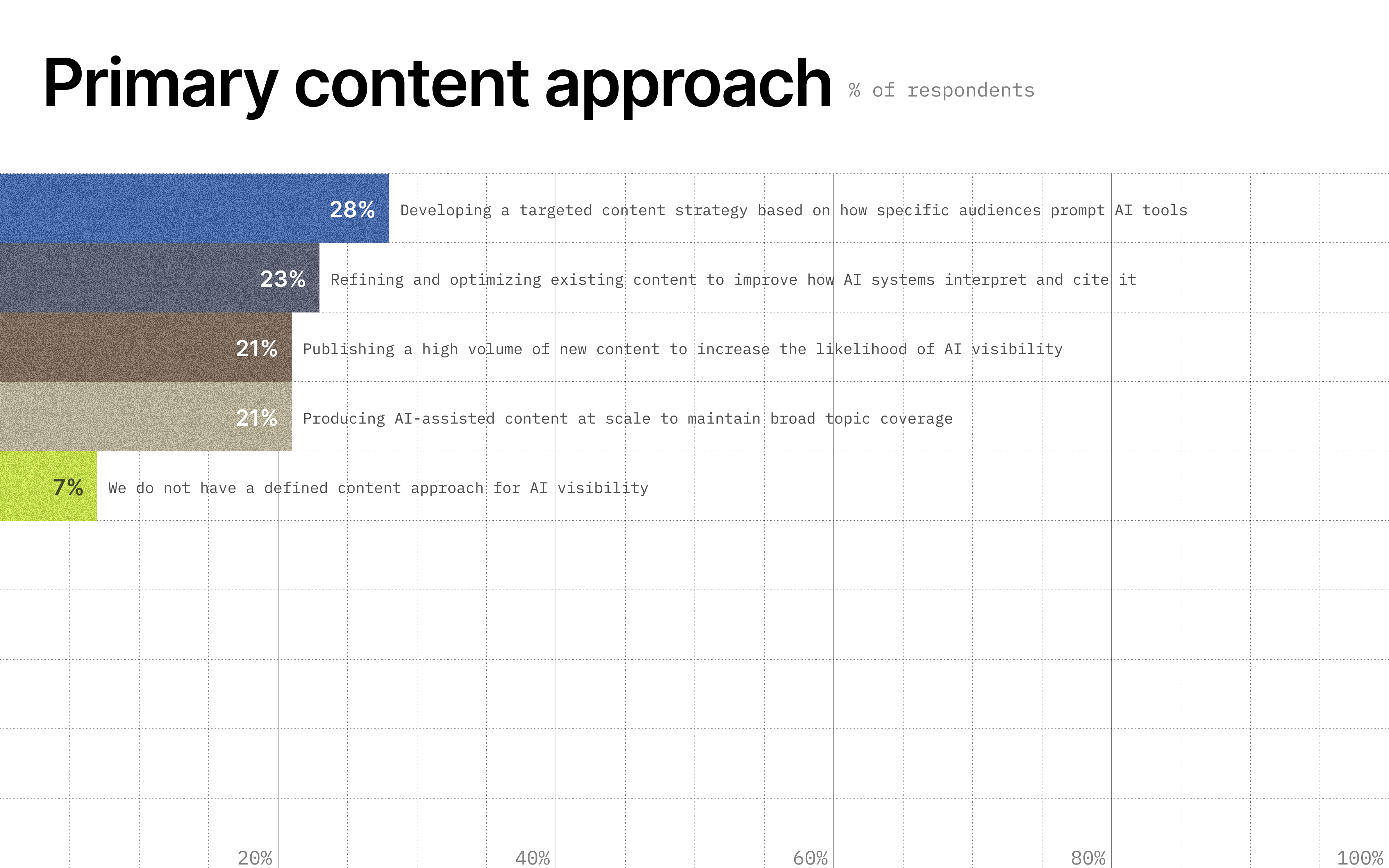
Our recent survey of 600-plus marketing and PR professionals found that, for 42% of respondents, the primary approach to AI visibility content is volume.
Twenty-one percent said their primary approach is publishing a high volume of new content to increase the likelihood of AI visibility. The same number said their primary approach is producing AI-assisted content at scale to maintain broad topic coverage.
AI-powered or not, the bet is the same: More content equals more visibility.
Comparatively, only 23% of respondents said their primary approach is refining and optimizing existing content to improve how AI systems interpret and cite it.
It’s easy to see why brands might bias toward net new content. If your dashboard tells you you’re not showing up for the prompts you care about, your natural instinct is probably to plug the hole with something new.
But search experts have flagged a problem with the sheer volume strategy: rapid gains in traditional and AI search, followed by a sharp falloff that often leaves brands worse off than when they started.
There’s a deeper problem still. Publishing content is no guarantee that AI can access, read, and understand it.
Volume doesn't fix that issue. It just piles more pages onto a site AI may not be able to parse.
Scrunch typically works with large enterprises (and the agencies that serve them). These brands usually already have plenty of relevant content.
The fix isn’t making more of it—it’s making what they have actually work for them.
How it works in Scrunch
- Site Diagnostics: Scrunch shows you a domain- and page-level breakdown of your website’s performance in AI search alongside prioritized recommendations for how to improve content retrievability and citability. Get a list of the technical and editorial issues you need to fix, all ranked by impact, mapped to specific URLs, and summarized in detail by an always-on predictive model.
- Optimizer: Scrunch lets you act on recommendations in an interactive editing surface. Review and approve suggestions for each page in bulk or one by one. Set up auto-approval to ship changes automatically.
- Content delivery: Scrunch lets you transform your entire AI-facing website into token-light, JavaScript-free HTML without changing the human-facing experience in any way. Automatically remove unnecessary code and fix common technical issues. Combine with Site Diagnostics to continually update site content based on content restructuring and enrichment recommendations week over week.
Your website isn’t the only input that matters
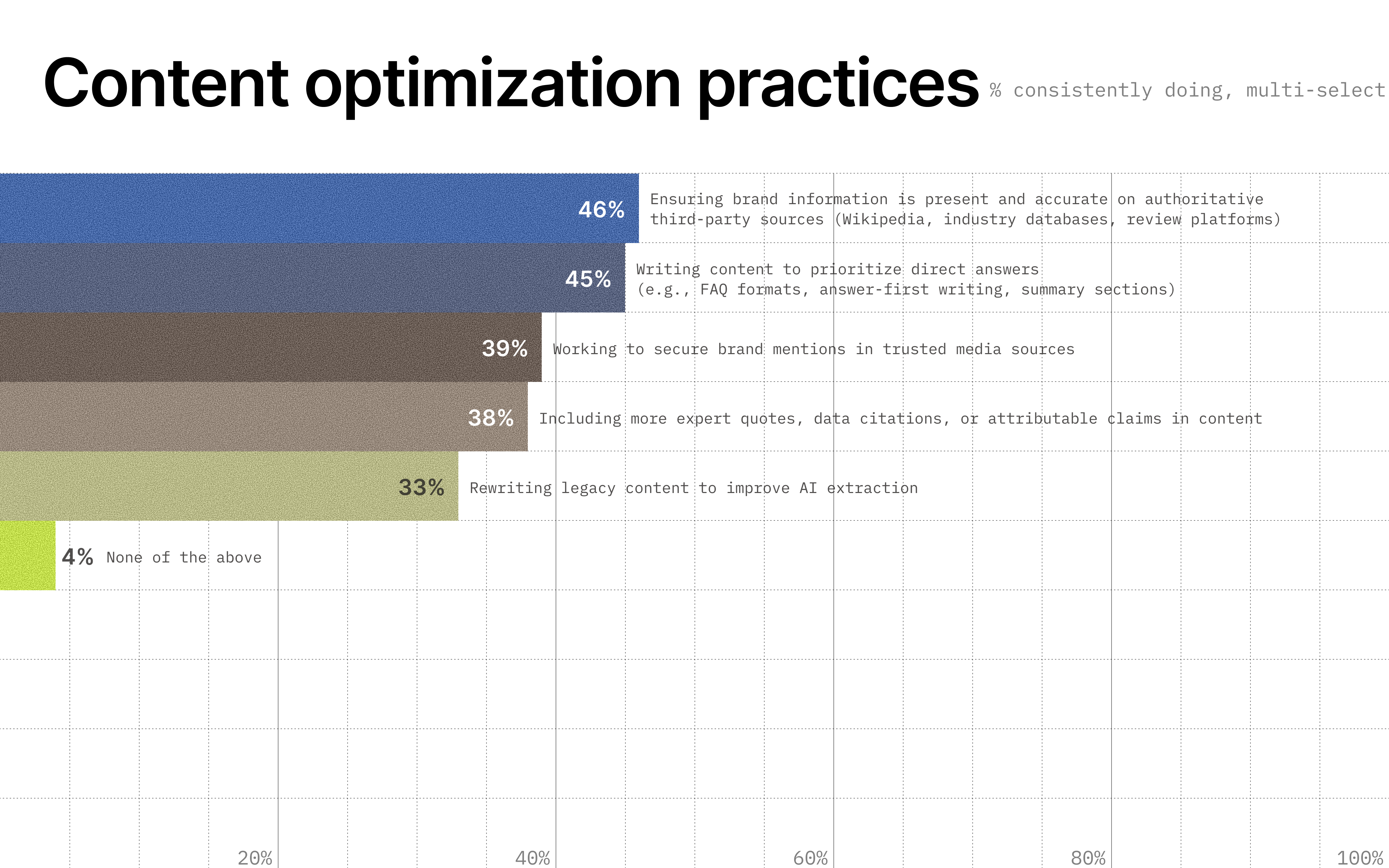
Our survey found that 61% of respondents aren’t working to secure brand mentions in trusted media sources.
Your website is the most powerful input you own, but it’s only one input of many. AI synthesizes answers about you from multiple sources, including competitors and third-party publishers.
Many brands understand the need to manage brand presence offsite: 45% say they’re ensuring brand information is present and accurate on authoritative third-party sources (e.g., Wikipedia, industry databases, review platforms).
But far fewer are taking the next step: actively expanding brand presence in the third-party sources AI cites.
Sometimes it makes sense to try to outrank a cited source outright, especially a competitor's. But when a trusted third-party domain shows up again and again across the prompts you track, getting your brand positively mentioned there may be a faster, longer-lasting play.
Reddit often gets singled out as the key to citation strategy, but the data tells a more specific story: Vertical specialists (think NerdWallet for finance or Tripadvisor for travel) often matter more.
The first step is figuring out which sources actually shape the answers for the prompts you care about.
How it works in Scrunch
- Citations: Scrunch shows you citations by owner (e.g., your brand, competitors, third parties) and segment (e.g., social media, SEO website) right out of the box. See citations broken down by domain and URL for your brand or sub-brands (as well as competitor brands and sub-brands), all filterable by prompt, platform, funnel stage, and beyond. Single out the most important sources with the Influence Score metric (aka the share of AI answers that cite a source multiplied by the number of distinct prompts it appears for).
- Noble: Scrunch partners with Noble to help you automate outreach, negotiation, and payment for getting mentioned in sources cited by AI.
- Stacker: Scrunch partners with Stacker to help you automate the process of getting native, non-sponsored placements in third-party publications.
Win the answer, not the word count
Net new content isn't the enemy. In fact, sometimes it's the exact right choice.
The point is priority.
For many brands, optimizing content for AI is more efficient and effective than blindly generating content for AI. So is showing up in the sources AI already trusts.
On your site, that means making sure AI can actually consume and cite what you’ve created. Off your site, it means making sure you have a strong brand presence in the sources AI pulls from.
We built Scrunch to help you do both, not get stuck on the content treadmill.
Want to go deeper? Read the full survey report or check out our AI search guide.
Get started with Scrunch
Get your site AI-ready so you show up in answers, get cited, and grow revenue. Try a free 7-day trial or book a demo.


