


Key takeaways:
- AI search trend and volume data is a compass, not a GPS. No vendor has native volume data from AI platforms, so the goal is directional accuracy at scale—and that comes from the kind of stable measurement system Scrunch offers.
- Volume only matters when it's paired with relevance. The trending topics worth investing in are the ones that intersect with your business and buyers—not just the ones with the biggest numbers.
- The real opportunity hides in the overlap of what's growing, what matters to your brand, and where you're missing.
You've got questions, we've got answers.
We dug through our call transcripts, scanned our support bot logs, and polled our sales, support, and customer success teams.
These are some of the AI search trend and volume questions that pop up again and again—and the answers you're looking for.
How do I see which AI search topics are growing in my industry?
Short answer: Use a tool like Scrunch.
Longer answer: AI platforms like ChatGPT, Perplexity, Gemini, and Claude don’t provide public dashboards showing query trends. Prompts are private.
If you want to know which AI search topics are growing in your industry—aka which ones are seeing an increasing level of prompt activity—you need a technology that provides visibility into AI search interactions over time via panel data.
Scrunch’s AI search trends feature does exactly that.
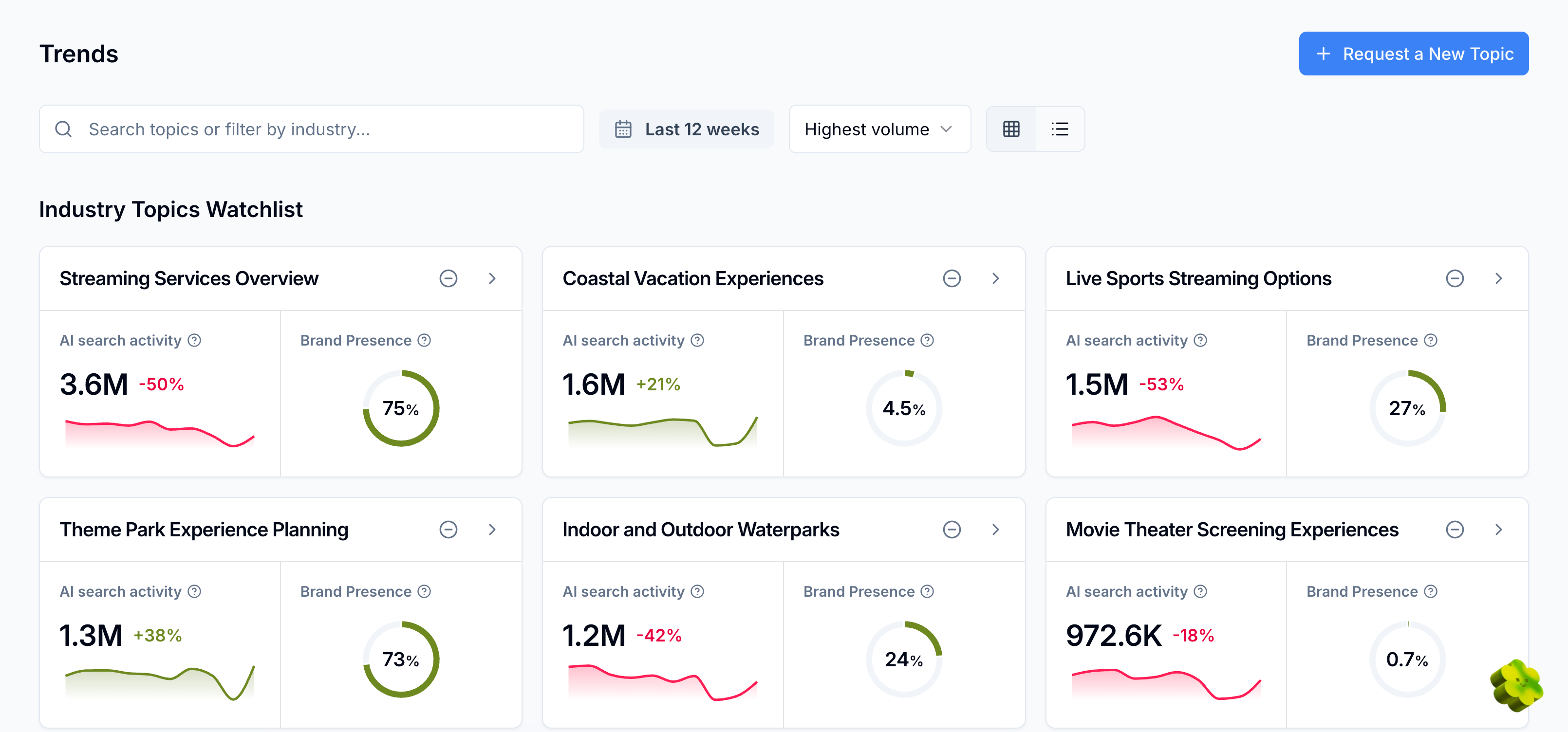
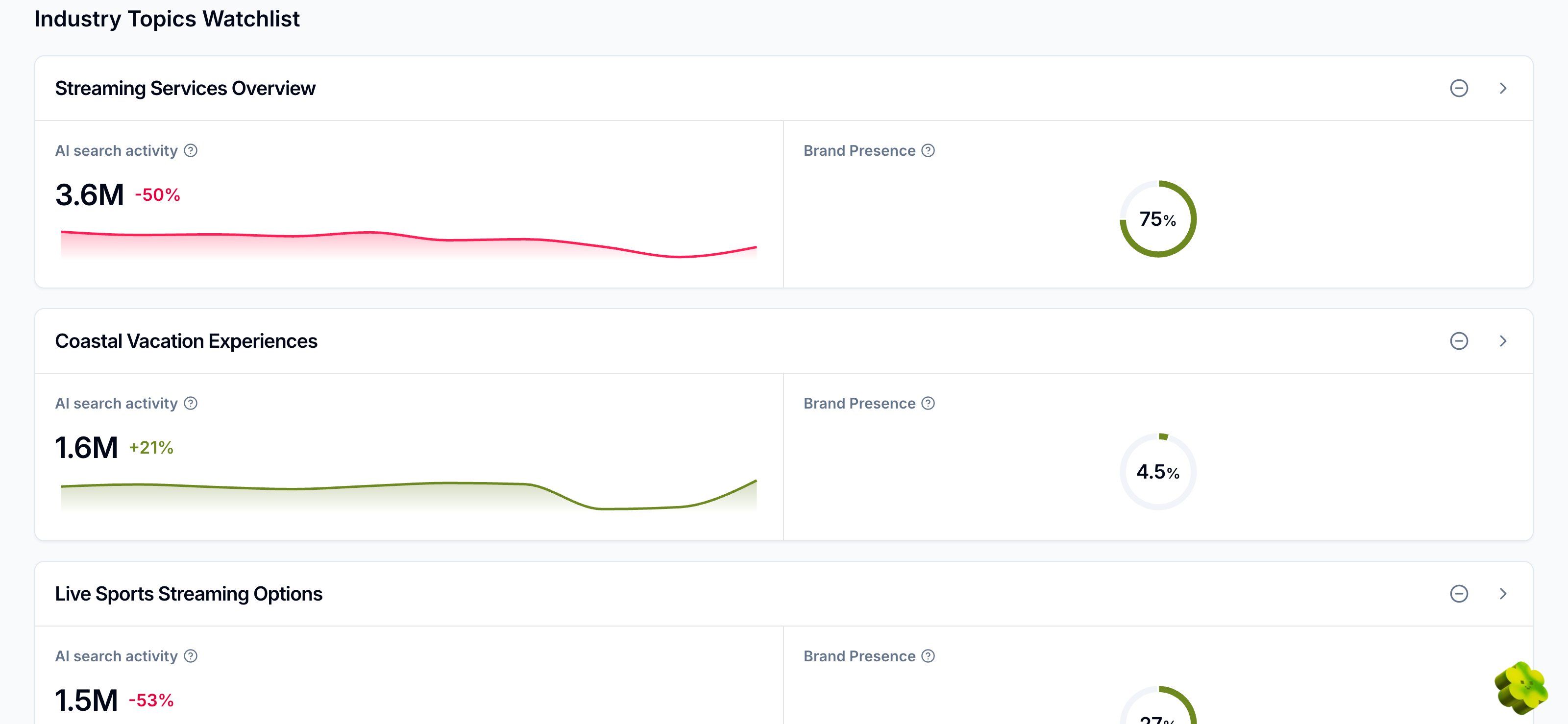
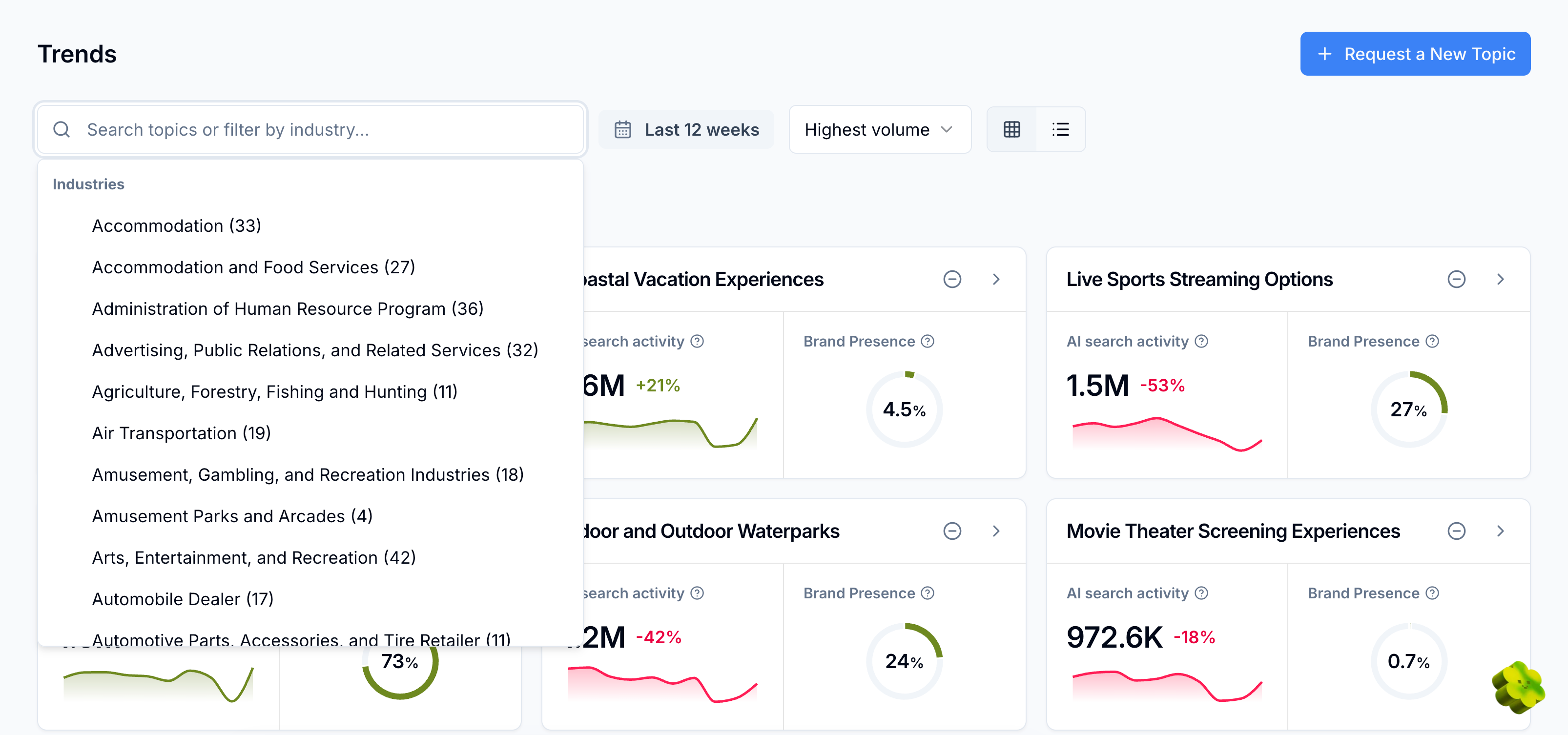
Open the Trends tab and you'll see your Industry Topics Watchlist—every topic you track, with estimated AI search volume, a momentum percentage, a week-by-week trend visualization, and your brand presence for each one.
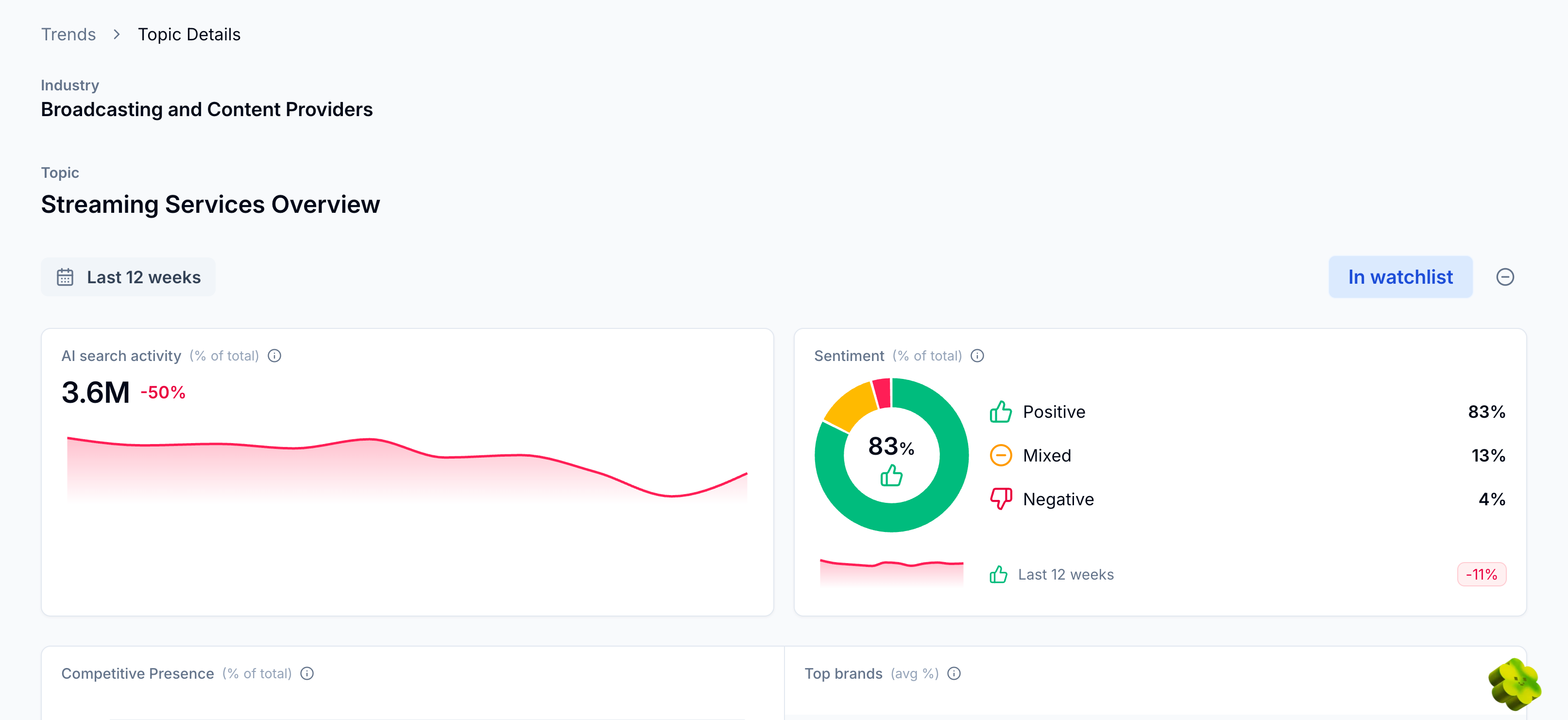
You can click into any topic to see brand sentiment and competitive presence, as well.
To find new topics to track, search by keyword or browse topics classified by North American Industry Classification System (NAICS) codes, then add them to your watchlist. Scrunch starts calculating volume and brand presence immediately.
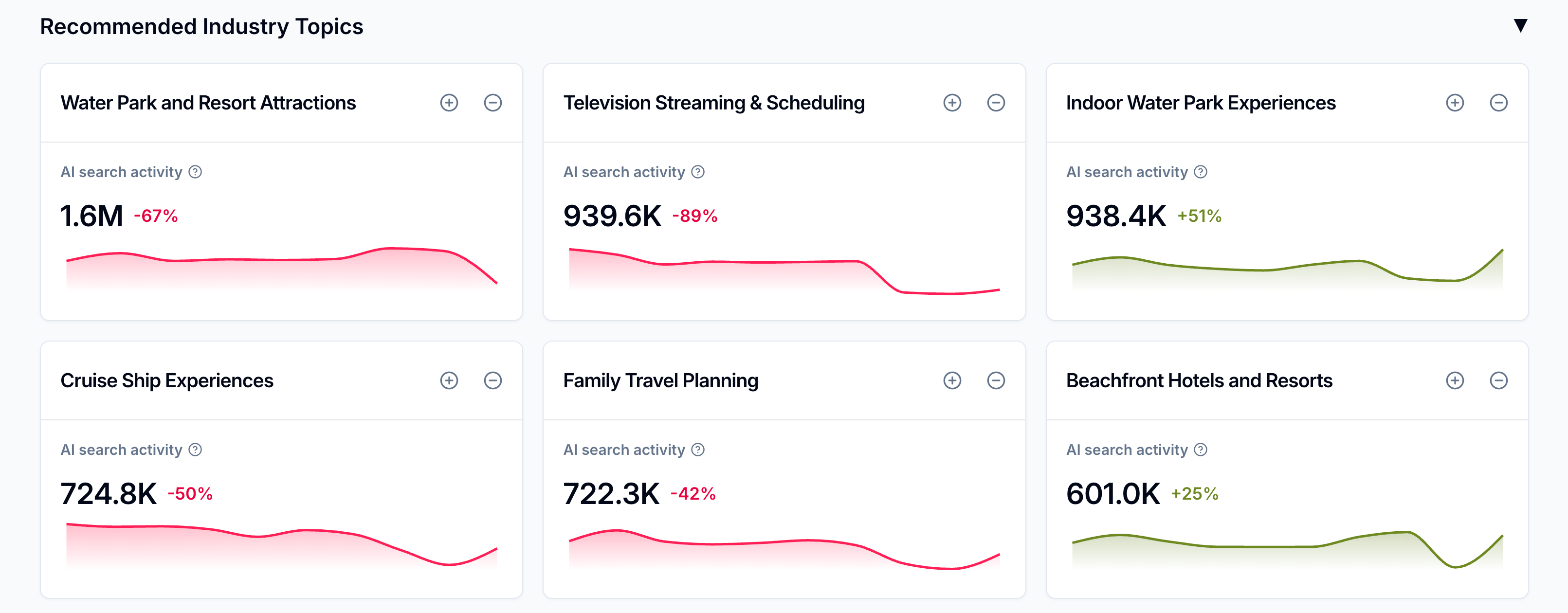
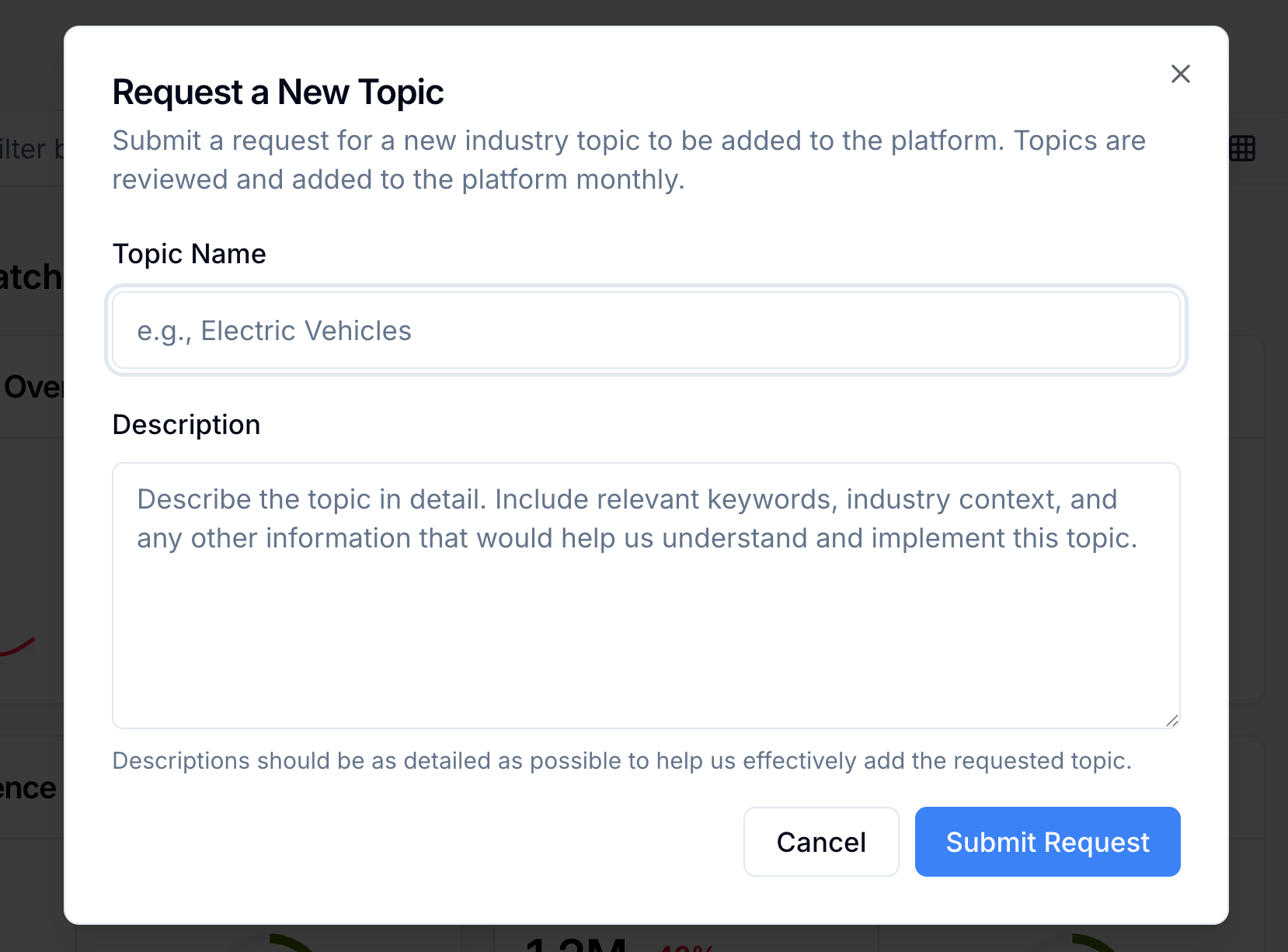
If you'd rather not start from a blank slate, Scrunch also recommends industry topics for you based on your brand context. And if a topic you want isn't there yet, you can submit a request—the team reviews submissions and adds new topics monthly.
How can I spot AI topics in my product category that have the highest volume?
Short answer: Track product category-relevant topics and sort them by volume using a technology like Scrunch.
Longer answer: Highest-volume topics aren't always the most important ones for your brand, but they're a useful place to start.
A high-volume topic tells you that a lot of real people are asking AI about that subject right now.
If the topic also overlaps with your product or category, that volume turns into a meaningful indicator of where attention is concentrated.
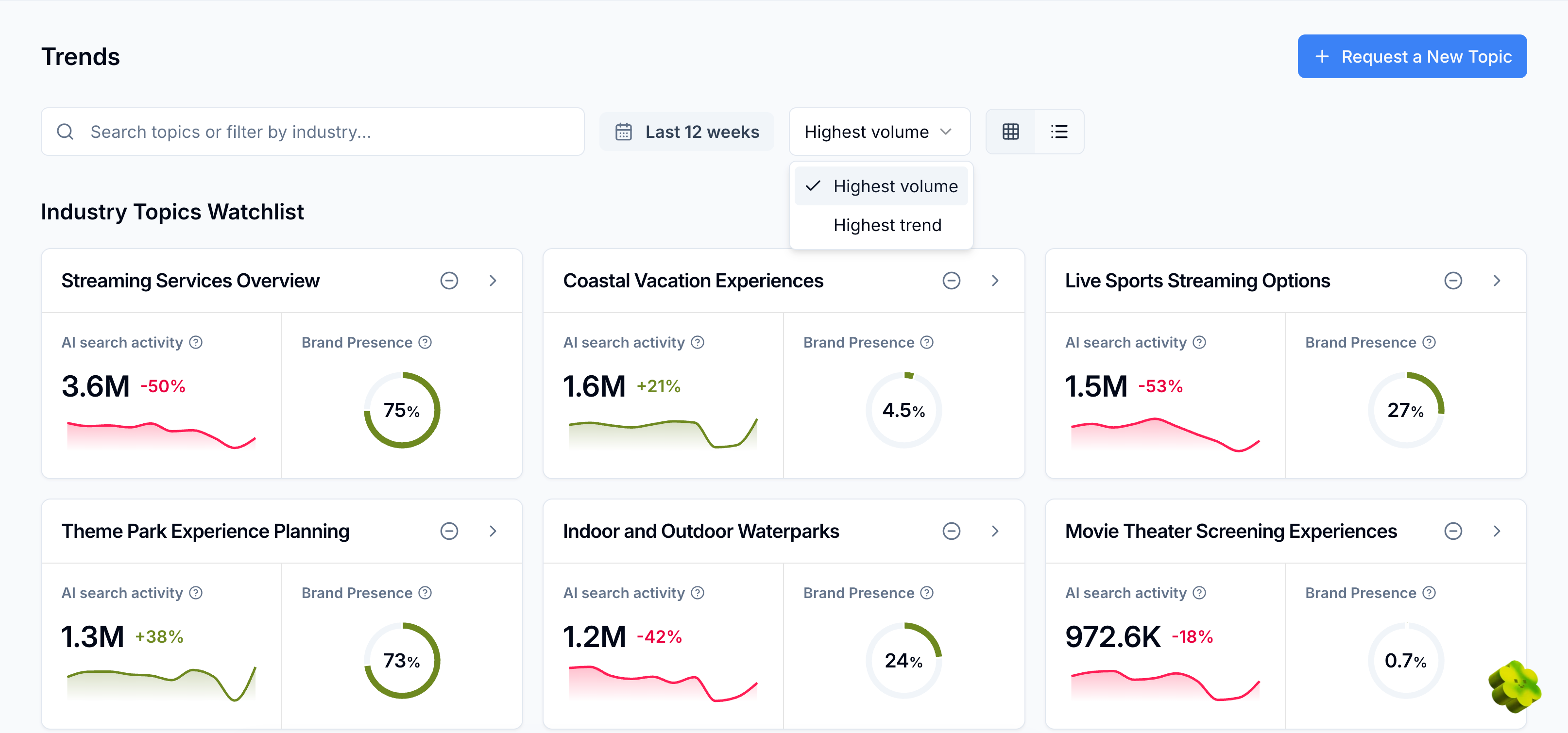
Scrunch's Trends feature has a sorting dropdown that arranges your watchlist by highest volume or highest trend, making it easy to tell which topics AI is generating the most queries or prompts for.
Highest volume surfaces the biggest pockets of demand first. Highest trend surfaces the topics with the most momentum, regardless of size.
Both are useful—and they answer different questions.
Our advice: Don't just chase the biggest number. Pair high volume with commercial relevance and momentum direction to find the topics where investment is most likely to pay off.
How can I tell if a trending AI search topic is worth investing content in?
Short answer: Determine if a commercially relevant topic is trending up in terms of AI search activity and if your brand is missing from the answers—both possible using the Scrunch platform.
Longer answer: A topic can be trending and still be a bad investment.
Teams should evaluate which AI search trends are worth investing in by answering the following questions:
- Is this topic commercially relevant? A trending topic that has nothing to do with how people buy your product isn't a priority, no matter how big the number is.
- Where is the momentum pointing? A topic on the way up is a different opportunity than a topic on its way down. Direction matters.
- Where does your brand show up today? If you're already cited prominently, the upside is smaller. If you're missing entirely from a fast-growing topic, that's a high-leverage gap.
- What do the actual prompts look like? A topic label is an abstraction. The real prompts behind it tell you what people are asking and whether your existing content is close to answering.
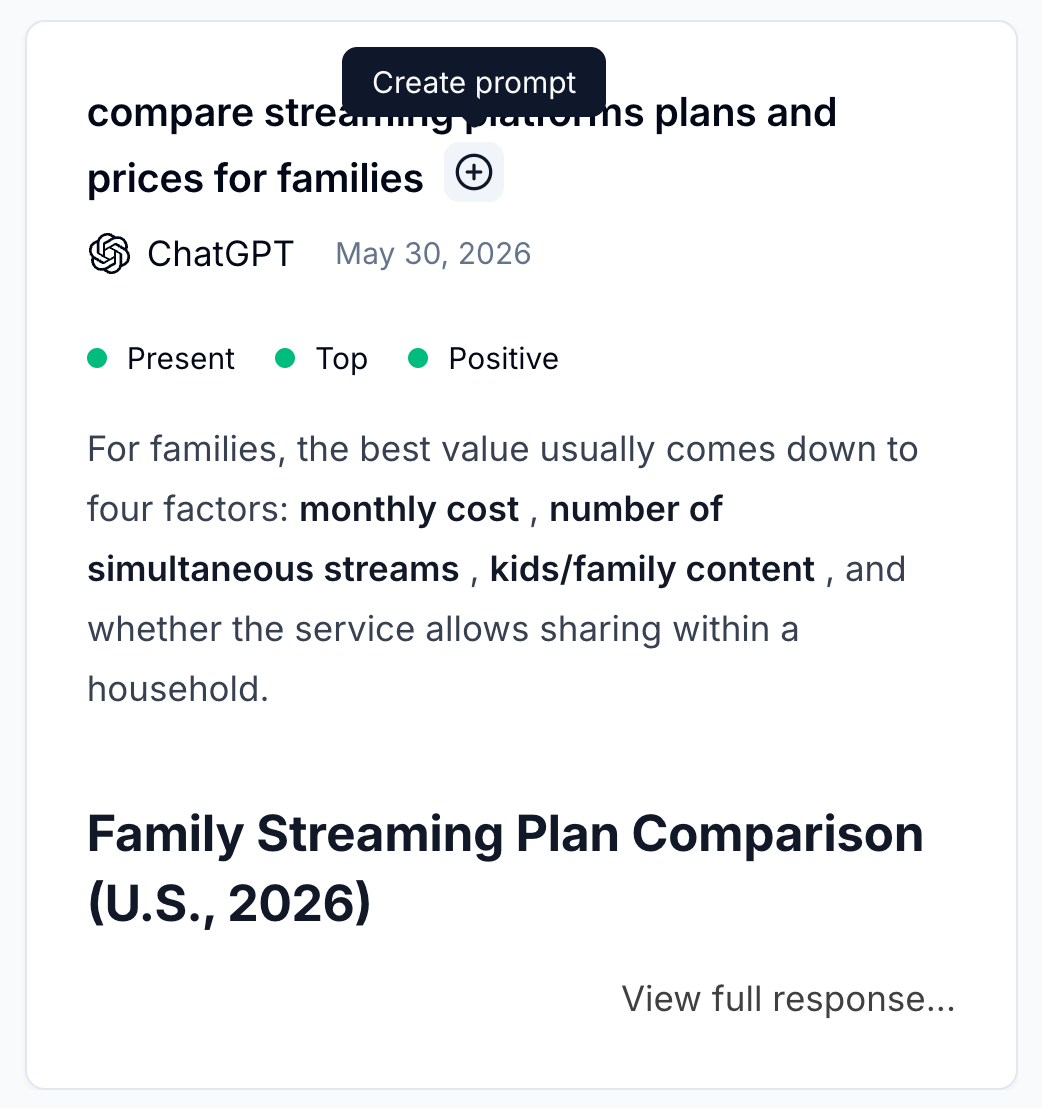
Scrunch's Trends feature bundles all of these signals into one view. You get trend data, brand and competitive presence, and a sampling of real prompts and responses pulled from AI platforms.
When you find a prompt worth tracking long-term, you can begin monitoring it in Scrunch with a single click. From there, you can watch presence, citations, position, and sentiment for that specific prompt over time.

How can I see which AI topics are fading so I don't waste content effort?
Short answer: Sort topics by trend momentum or view trend activity over a long time period to spot topics in steady decline using a tool like Scrunch.
Longer answer: Teams spend a lot of energy chasing what's growing. Fewer spend time mapping what's fading.
That's a missed opportunity.
Topics with declining momentum are signals worth paying attention to. They might mean that buyer behavior has shifted and people are asking about a specific topic less.
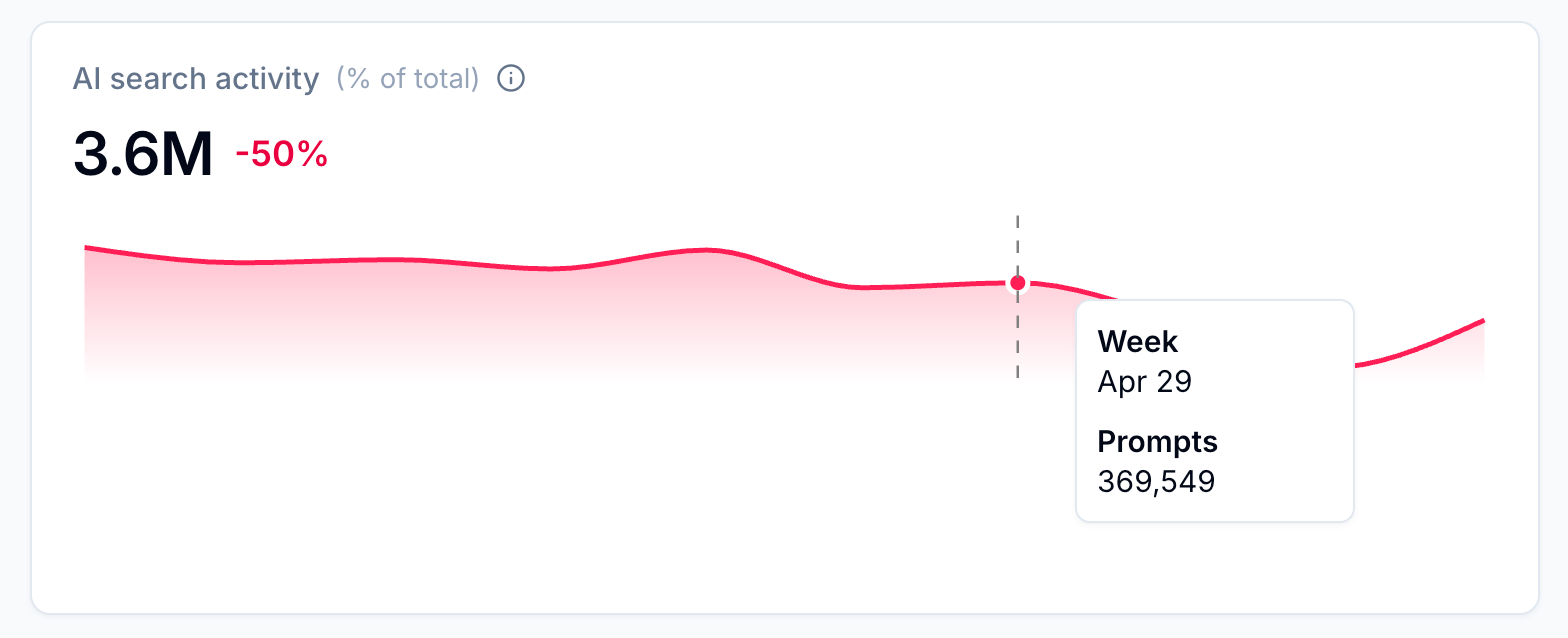
Scrunch's week-by-week trend visualization for each topic makes the direction obvious at a glance.
If the line has been pointing down for the past few cycles, that may be a topic to redirect effort away from—not toward.
What's the best way to measure whether an AI search topic is growing, stable, or declining over time?
Short answer: Lock in a stable set of topics, watch them over rolling 2-3-week windows, and look for direction across multiple cycles—not single-week spikes—with a technology like Scrunch.
Longer answer: Acting on AI search trends effectively isn't about chasing every surge in activity. It's about identifying real movement over time.
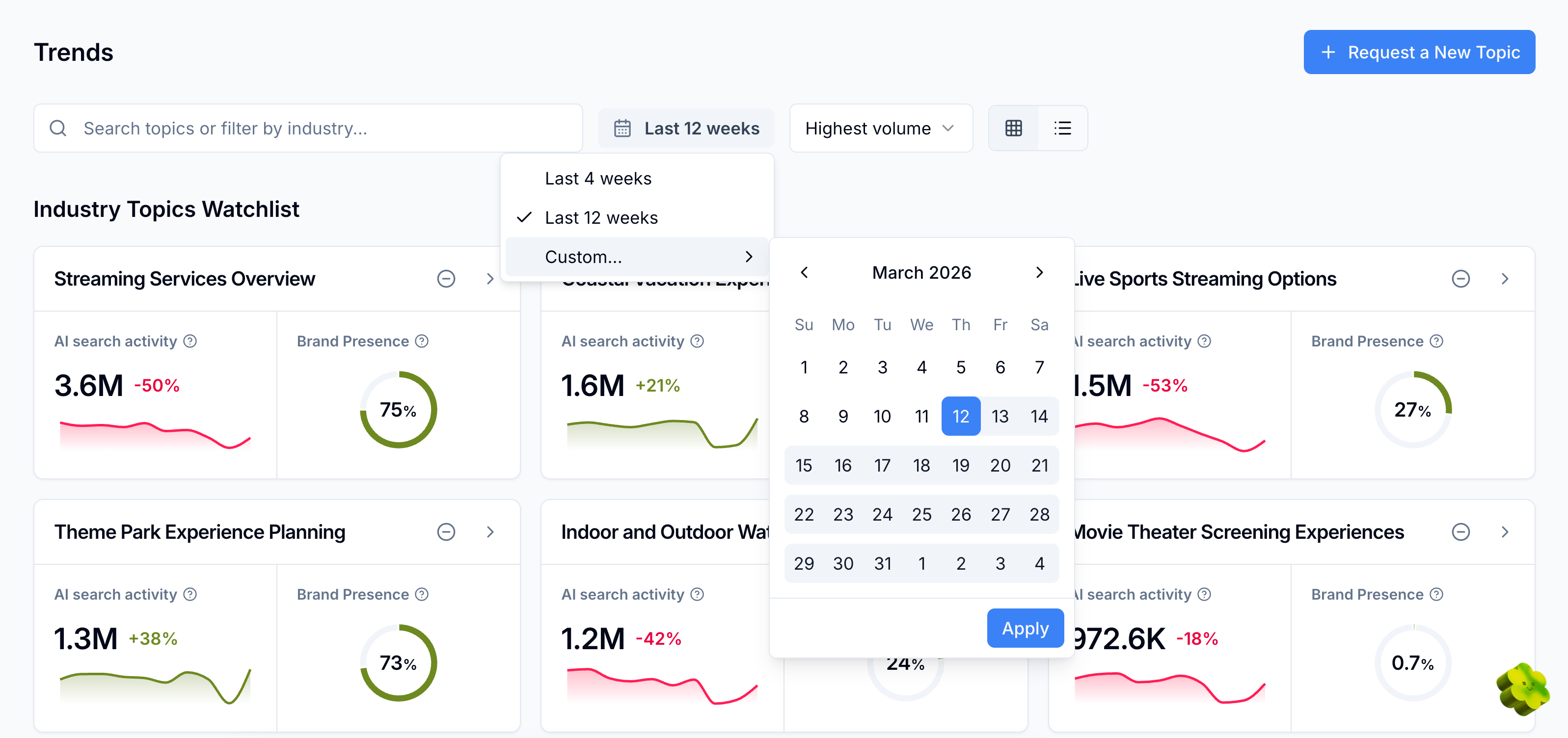
Our recommendation is to watch your tracked topics over a meaningful time period—ideally 2-3-week windows over 90 days.
Daily or weekly readings tend to be too narrow and noisy to mean much. Real trends show up over multiple cycles—and Scrunch makes it easy to compare windows using any time range you want, like this quarter versus the one before it.
How do I prioritize trending topics that have the highest potential impact for my brand?
Short answer: Use a platform like Scrunch to score trending topics across two dimensions—commercial relevance and current brand presence in AI answers—then prioritize topics that are brand-relevant but brand-absent.
Longer answer: When everything is "trending," nothing is prioritized. You need a framework.
Every trending topic sits somewhere on a 2x2:
- High commercial relevance, low brand presence: This is the sweet spot. Buyers are asking AI about subjects tied to your product, and you're not showing up. Invest here first.
- High commercial relevance, high brand presence: You're already winning. Protect the position, but don't expect outsized incremental upside.
- Low commercial relevance, low brand presence: Skip it. Trending or not, this isn't where your team's time should go.
- Low commercial relevance, high brand presence: Interesting but tangential. Don't worry about actively defending it; let it ride.
Scrunch makes both axes visible in one place. The Industry Topics Watchlist shows volume, momentum, and your brand presence side by side.
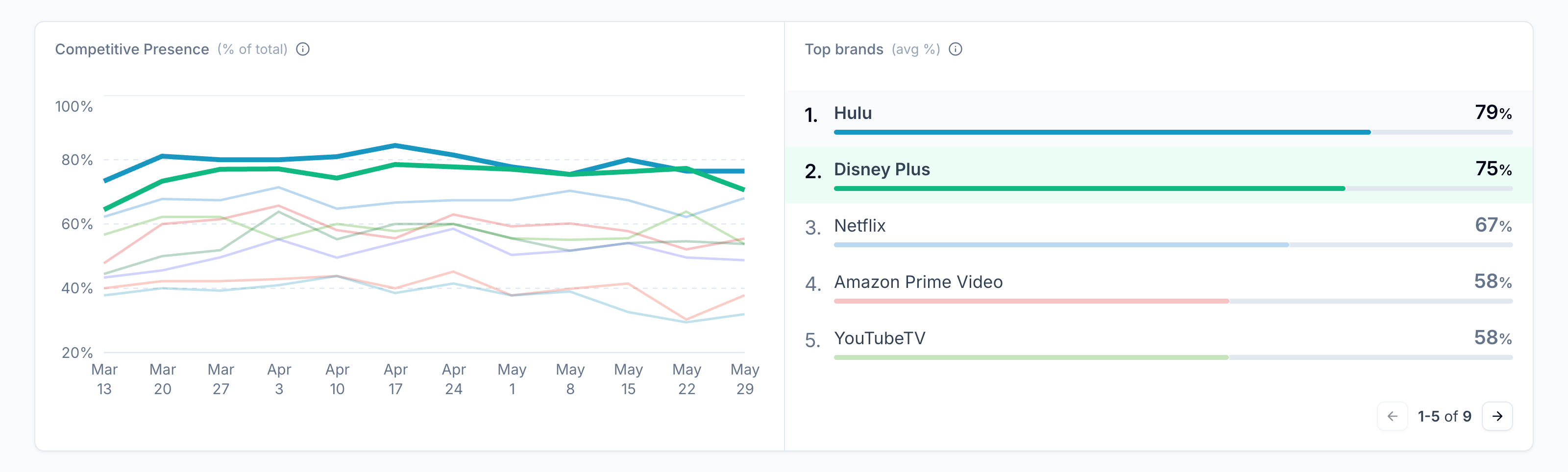
Topic Details pages add competitive presence and the top brands cited in each topic.
And if you're not sure where to start, Recommended Industry Topics will surface suggestions mapped to your brand context automatically.
From there, prioritization becomes a lot less subjective.
How do I see if my brand is mentioned in any of the major AI topic clusters?
Short answer: Tools like Scrunch show you the topics where your company might already be appearing in AI and which topics AI associates with your brand.
Longer answer: Trend data without brand context only tells you so much. The point of tracking topic clusters is to see how often your brand shows up when AI is answering questions inside those clusters—and how you stack up against the brands that compete with you.
Scrunch handles this natively.
Once a topic is on your watchlist, the Trends feature measures the percentage of AI responses for that topic that mention your brand. Click into the Topic Details page and you get more: sentiment toward your brand in those responses, competitive presence over time, and the top brands cited in the topic.
This gives you three useful reads:
- Where you're already winning: Business-relevant topics where you have strong presence are worth protecting.
- Where you're missing entirely: Topics with high commercial intent and zero brand presence are your biggest opportunities.
- Where competitors are taking ground: Topics where rivals appear more often than you should inform both content and competitive strategy.
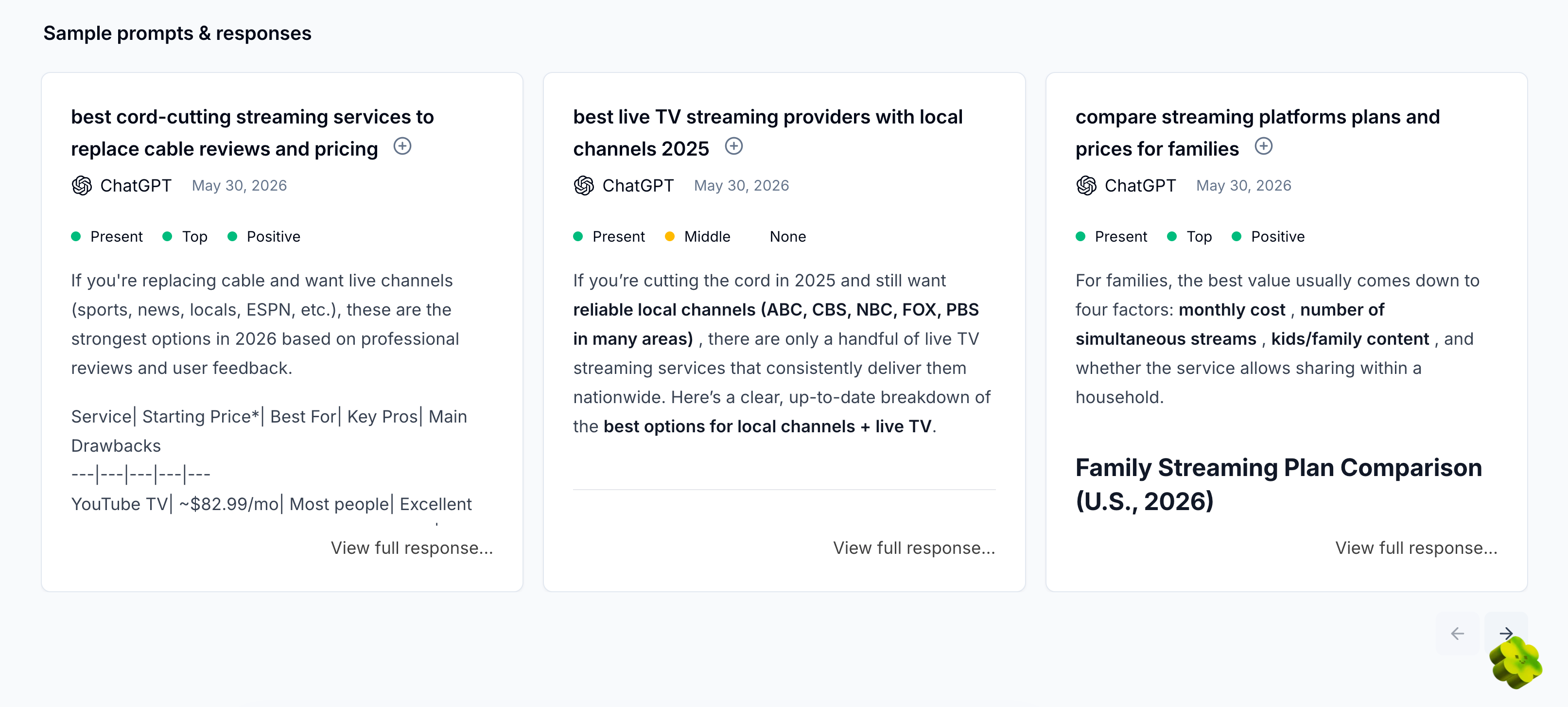
This is also where the sample prompts on the Topic Details page come in handy.
Once you know a brand gap exists at the topic level, you can drill into the actual prompts behind the topic to see exactly which questions are driving the gap—and convert any of them into a tracked prompt with one click.
How does Scrunch measure share of voice within AI topics?
Short answer: Scrunch measures share of voice at the topic level as the percentage of AI responses inside a tracked topic that mention your brand, benchmarked against the other brands appearing in the same responses across AI platforms.
Longer answer: Share of voice in AI is about brand presence across a defined surface of prompts and topics—how often your brand appears when AI is answering, relative to everyone else who shows up in those same answers.
This is how teams evaluate their share of voice within an AI topic compared to competitors.
Scrunch calculates this by mapping prompts to topics, running them consistently across the major AI platforms—ChatGPT, Perplexity, Gemini, Claude, Google AI Overviews, Google AI Mode, Meta AI, Microsoft Copilot, and Grok—capturing every brand mentioned in each response, and aggregating brand presence at the topic level.
A few things this approach gets right:
- Apples to apples: Your share of voice is measured against the same prompt set as your competitors, on the same platforms, at the same time.
- Filterable: You can view share of voice by topic, persona, funnel stage, AI platform, and more—so you can see exactly where you lead and where you trail.
- Trended: Share of voice is captured over time, so when it moves, you can connect movement to content changes, citations, or competitor activity.
Our two cents: Don't just look at share of voice as a monolithic number. The most useful read is sliced—by topic, by funnel stage, by platform, etc. Aggregate share of voice is helpful; segmented share of voice is more actionable.
How should AI search volume be interpreted when prompts vary widely in wording but reflect the same intent?
Short answer: Use a technology like Scrunch that clusters semantically related prompts into topics so volume reflects what people are actually asking about, not just the specific phrasing they happen to use.
Longer answer: AI search isn't keyword search. People don't phrase questions in tidy, repeatable strings—they ask in full sentences, in their own words, with their own context. The same underlying intent can show up in hundreds of different wordings.
Focusing solely on specific keywords can cause you to dramatically underestimate real demand.
The fix is to roll wording up to intent. A topic like "beginner stock investing" might absorb prompts like:
- "How do I start investing as a beginner?"
- "What's the best way to begin investing in stocks with $500?"
- "Where should a new investor put their money first?"
All three reflect the same intent. Counted separately, each looks small. Counted together as one topic, the actual demand becomes legible.
Scrunch's Trends feature is built on a curated library of thousands of high-signal topics, each one defined as a cluster of semantically related prompts.
AI search activity is estimated at the topic level, and the Topic Details page lets you drill into the real prompts behind any topic to see how people are actually phrasing the question and whether your content matches the language they're using.
What trend data does Scrunch provide that competitors don't?
Short answer: Scrunch provides trend data at the topic level versus the prompt level to ensure it’s as accurate and useful as possible.
Longer answer: There are lots of tools on the market that sell dubious data as real insights.
Think datasets built on ChatGPT wrappers, raw panel data minus any statistical methodology, and “precise” demand forecasts that are impossible to know.
Scrunch doesn’t want to trade accuracy for a more impressive-looking dashboard.
Here’s what Scrunch can claim:
- Millions of real, complete, consumer-to-AI interactions every month from high-quality, privacy-compliant, third-party providers
- High confidence in the integrity and population typicality of the interaction data
- Verified and explicitly consented data collection
- Time-bucketed and debiased data
- Highly curated topics at consistent granularity
- Population-level estimates that account for demographics and consumer-interest signals
Scrunch is also very upfront about how this data should be used: as a compass, not a GPS.
The honesty is the point. Trend data dressed up as an exact count is a liability. Trend data presented as what it is—a proxy, not an unimpeachable source of truth—sets the stage for smarter decision-making.
How reliable are Scrunch's trend signals for predicting future AI demand?
Short answer: Scrunch’s trend signals are reliable for predicting future AI demand because they come from a stable measurement system and a strong data foundation built on hundreds of millions of privacy-complicant consumer AI interactions held at the topic level to ensure data quality. That said, no matter the vendor, AI search trend data should be treated as directional, not 100% accurate.
Longer answer: No vendor has native AI search volume data. AI platform operators are the only ones with a complete view of activity on their platforms, and they don't share it.
Anyone telling you they have precise prompt-level numbers is overestimating their capabilities.
Here's how Scrunch builds reliability into the data it produces:
- High-quality panel data: Scrunch acquires end-to-end AI search interaction data from privacy-compliant, third-party providers, covering millions of consumer-to-AI interactions every month across AI platforms. Every panelist is verified and explicitly consents to data collection.
- Quality over quantity: Scrunch curates high-signal topics at a consistent granularity instead of letting long-tail noise drown out the signal. It anonymizes a dataset of hundreds of millions of AI search events, maps prompts to topics, time-buckets for stability, benchmarks coverage against external AI use totals, debiases and weights to improve representativeness, and applies proprietary models to extrapolate population-level estimates.
- Topic-level estimates only: Scrunch holds analysis at the topic level on purpose. There isn't enough reliable prompt-level data to estimate AI search volume per prompt without misleading customers, so it doesn’t.
- Stable measurement over time: Tracked topics and the prompts behind them stay consistent week to week, which is what makes Scrunch good at telling you whether AI demand is climbing, flat, or fading.
Used this way, Scrunch's trend signals are reliable for what they're built to do: Indicate where AI demand is concentrated today and where it's moving over time. They're not crystal balls, they're weather stations.
How does Scrunch measure AI search trend volume compared to traditional keyword tools?
Short answer: Both Scrunch and traditional keyword tools rely on panel data extrapolation because the source platforms don't share native numbers. The difference is that keyword tools count discrete search engine queries, whereas Scrunch estimates AI search activity at the topic level by clustering prompts that share intent—built from the ground up for the way people talk to AI.
Longer answer: Most SEO tools build their keyword volume estimates from panel data (datasets collected from a pool of people repeatedly over time) and then extrapolate to a population. The exact methodology is usually under NDA, but the shape is consistent across the industry.
Scrunch uses a similar foundation—a privacy-compliant consumer panel—but for a different question.
Keyword tools answer: How many people typed this exact phrase into a search engine last month?
Scrunch answers: How much AI search activity is happening around this topic, across AI platforms, in the way real people actually phrase questions?
Practically, that means:
- Intent-level volume, not phrase-level volume: AI search activity is estimated at the topic level because that's where the signal is meaningful. A keyword tool can estimate exact-match volume on "best CRM for small business," but it can't tell you anything about the dozens of paraphrased prompts asking the same question inside ChatGPT. Scrunch can.
- Wired into brand and citation data: Every volume number ties back to brand presence, sentiment, competitive presence, and real prompts. There's no jumping between tools to make the data usable.
- Honest about precision: Both keyword tools and AI search trend tools produce directional numbers. Scrunch says the quiet part out loud: This is directionally helpful, but shouldn’t be used for exact forecasting. Use it that way and it can be a valuable tool for deciding where to focus time and effort.
Remember: Don't treat AI search volume like keyword volume—the numbers mean different things.
This isn't every question our team fields about AI search trends and volume, but it covers a lot of conversational ground.
Got more questions? See our FAQs.
Want to dig deeper? Check out our AI search guide.
Ready to see for yourself? Get in touch or take Scrunch for a test drive.
Get started with Scrunch
Start reaching more customers on AI platforms. Spin up a free account or see Scrunch in action today.


