


Key takeaways:
- The most common reason AI skips your content isn't weak writing. It's technical—access controls, content buried in JavaScript, pages built for humans instead of machines.
- An AI site audit isn't a traditional SEO audit wearing a new name tag. It checks something different: whether AI agents can actually access, read, and cite your pages—a test lots of sites are failing.
- Finding the issues is only half the job. Scrunch connects site audits to action: what to fix, where to focus, and how to serve AI-friendly content directly to AI agents without disrupting the human experience.
You've got questions, we've got answers.
We dug through our call transcripts, scanned our support bot logs, and polled our sales, support, and customer success teams.
These are some of the AI site crawlability questions that pop up again and again—and the answers you're looking for.
What technical issues might make AI skip the content on my website?
Short answer: Access controls that block AI bots, content buried in JavaScript, and pages structured for humans instead of machines can all cause problems—and they’re all issues surfaced by tools like Scrunch.
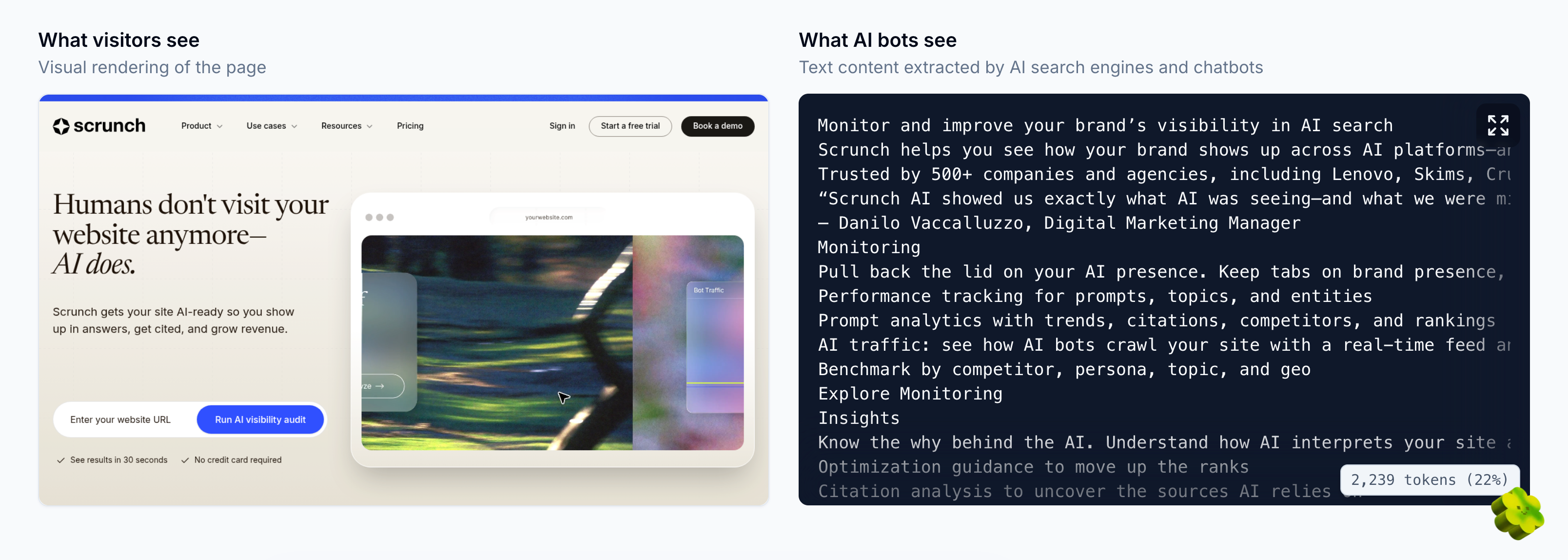
Longer answer: Your website seems fine to you because you're a human using a browser that renders everything beautifully. AI agents don't get that experience.
Most AI platforms find your pages through regular web search and consume the HTML they get back. If the part of the page that actually answers a question only appears after JavaScript runs, an agent may never see it.
The same goes for content trapped in carousels, tabs, lazy-loaded sections, or interactive widgets.
Then there's the cruft. Analytics scripts, tracking pixels, and layers of markup that mean nothing to a model still cost tokens to wade through—and can drown out the content that matters.
And sometimes the problem is simpler than all of that: Your robots.txt or a firewall rule is blocking AI crawlers outright, so they never get in the door.
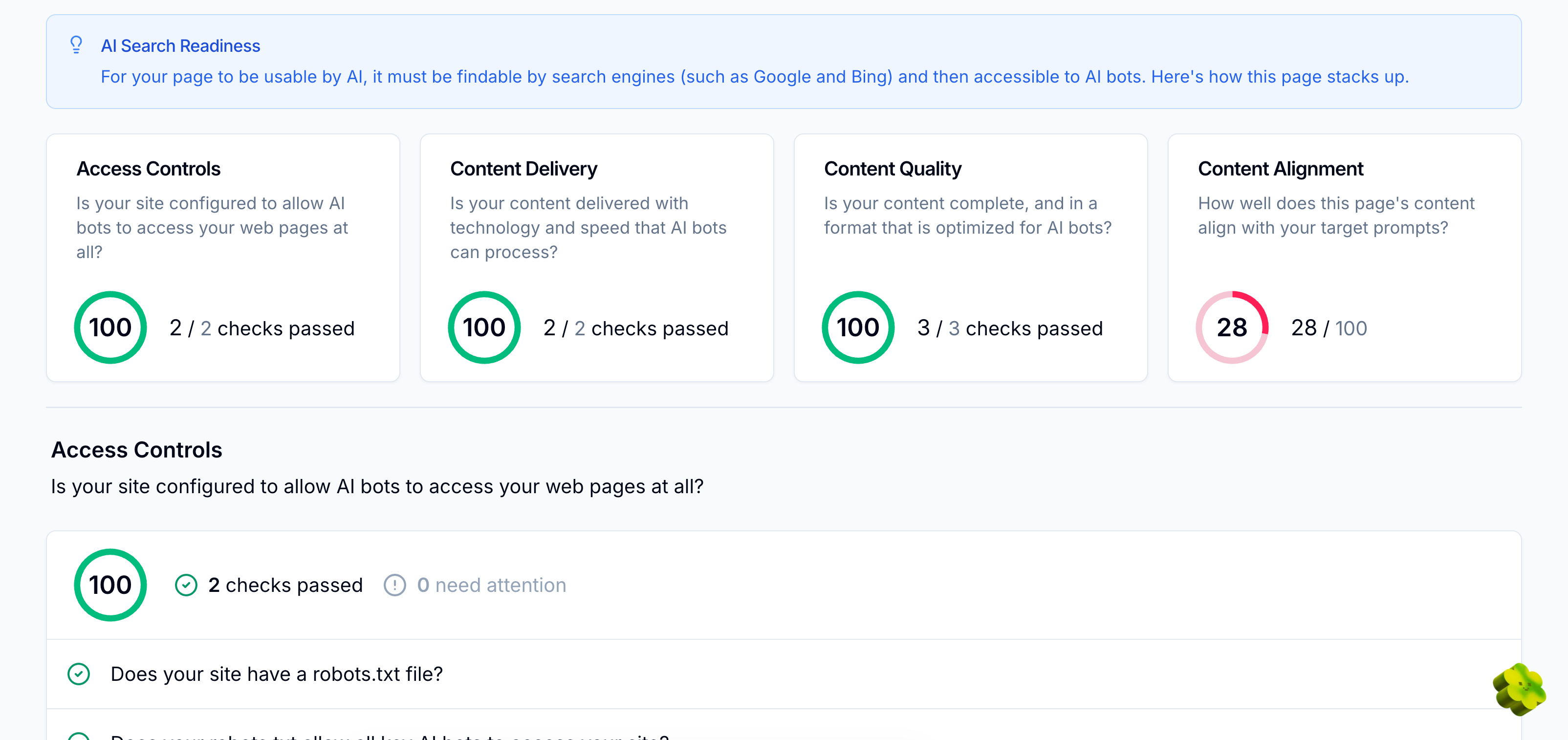
Scrunch's Deep AI Audit feature is built to surface these issues. It pinpoints problems across access controls, content delivery, content quality, and content alignment, so you can see what's standing between AI and your content.
How do I find technical blockers that make AI assistants skip over key parts of a page?
Short answer: Audit the page the way an AI user agent experiences it—not the way a browser renders it—using a technology like Scrunch.
Longer answer: You can do a version of this manually.
Disable JavaScript, view the raw HTML source, and check whether the content you care about is actually there. If it disappears, an AI agent probably can't see it either.
That works for one page. It falls apart across a site with hundreds or thousands of them.
Scrunch is built to handle the scale. It analyzes how AI consumes each page and pinpoints the blockers—access restrictions, content that depends on JavaScript to appear, structural issues.
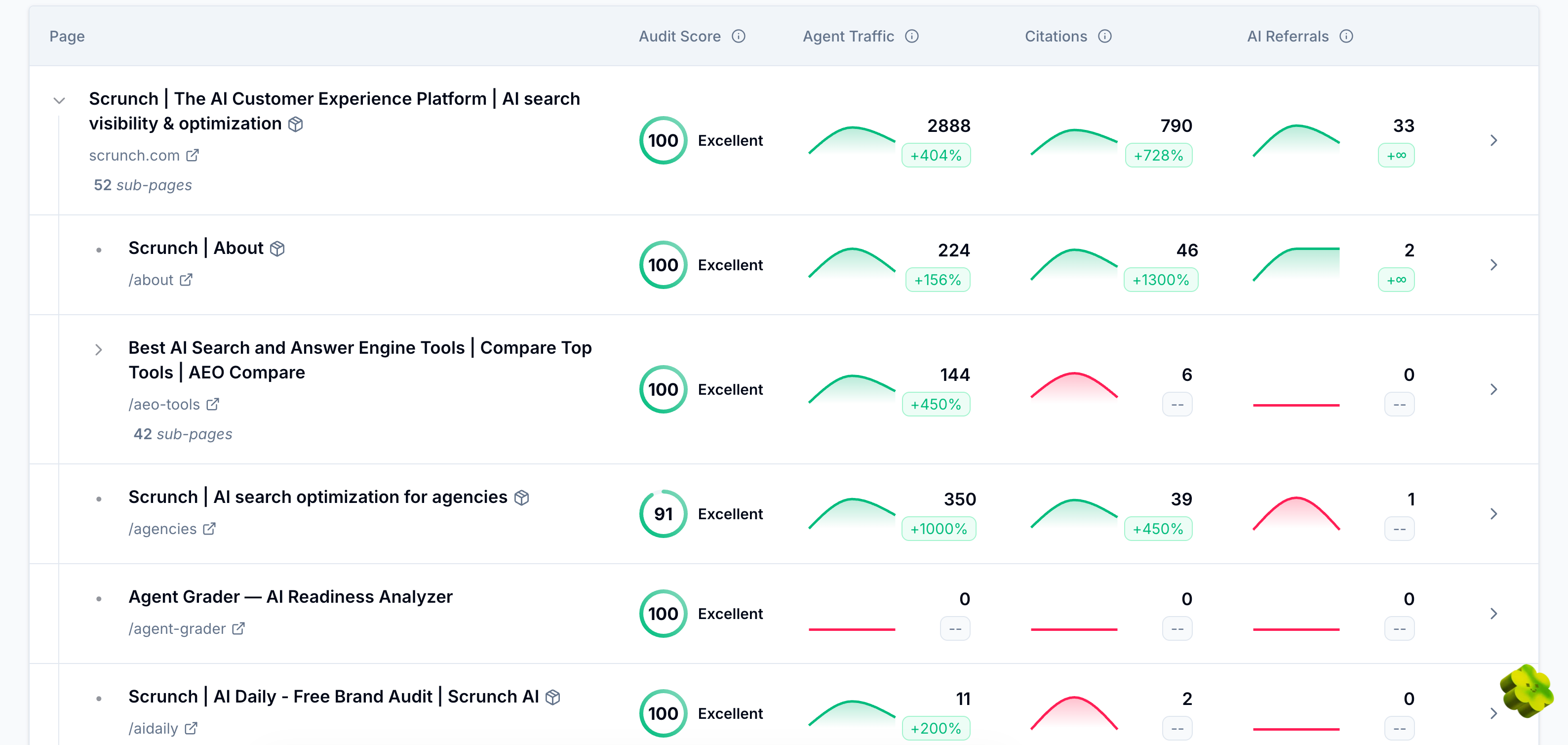
Scrunch’s Site Maps feature ties it together with a site-wide view, so you can see performance page by page instead of guessing where the trouble spots are.
The goal isn't to admire a list of errors. It's to find the specific things keeping AI from retrieving the content you want it to read and cite.
How do I know which technical issues should be fixed first to improve AI visibility?
Short answer: Start with access controls, then fix the issues on the pages that matter most using a platform like Scrunch.
Longer answer: First and foremost, make sure your robots.txt allows AI agents to access your site. If bots can’t get their hands on your content, no amount of technical fixes will make a difference.
Next, triangulate priority based on which pages AI actually visits and which issues are doing the most damage.
Not every page deserves equal attention, and not every issue carries equal weight. A rendering problem on a high-traffic product page matters a lot more than a minor structural quirk on a page no bot visits.
That's why prioritization needs two inputs.
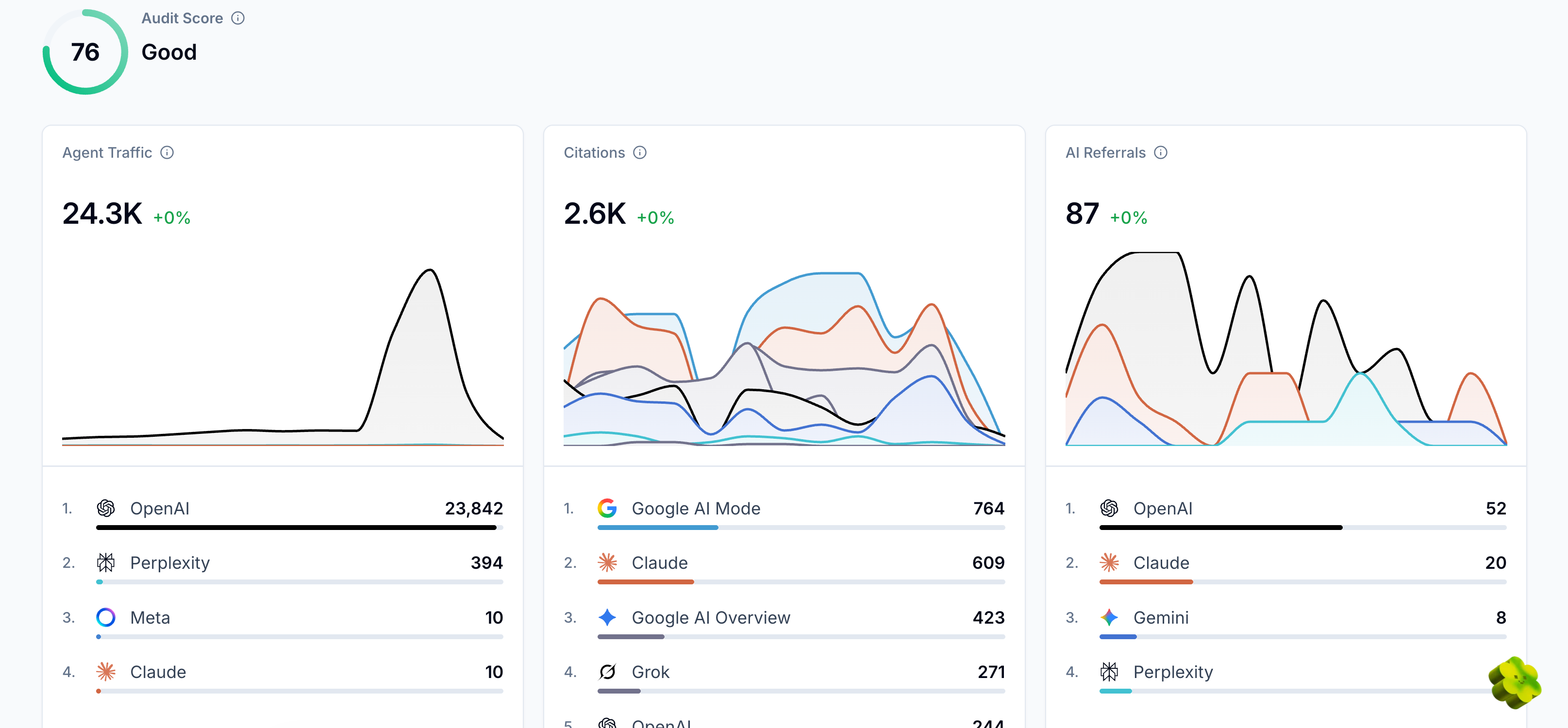
The first is relevance: Which pages are pulling their weight in AI search? Scrunch's Agent Traffic feature shows you where AI agents are actually spending their time, and Site Maps shows you how each page is performing.
Pages getting heavy AI attention are where fixes pay off biggest.
The second is severity: Which issues are most likely to make AI skip a page entirely? Content locked behind JavaScript is a big problem. Weak page titles and descriptions are more of a drag than a wall.
Stack those together and you get a clear order of operations—high-relevance pages with high-severity issues go to the top. Scrunch surfaces both so you're spending effort where it moves the needle.
How should teams determine whether AI agents can fully access and index their pages?
Short answer: Check two things in order—whether AI agents can reach your pages at all, and whether they can actually read the content once they're there. Tools like Scrunch answer both.
Longer answer: "Access" and "index" are two separate questions.
The first is about reachability. Can AI crawlers get in? A robots.txt rule or firewall setting can shut agents out before they ever see a page.
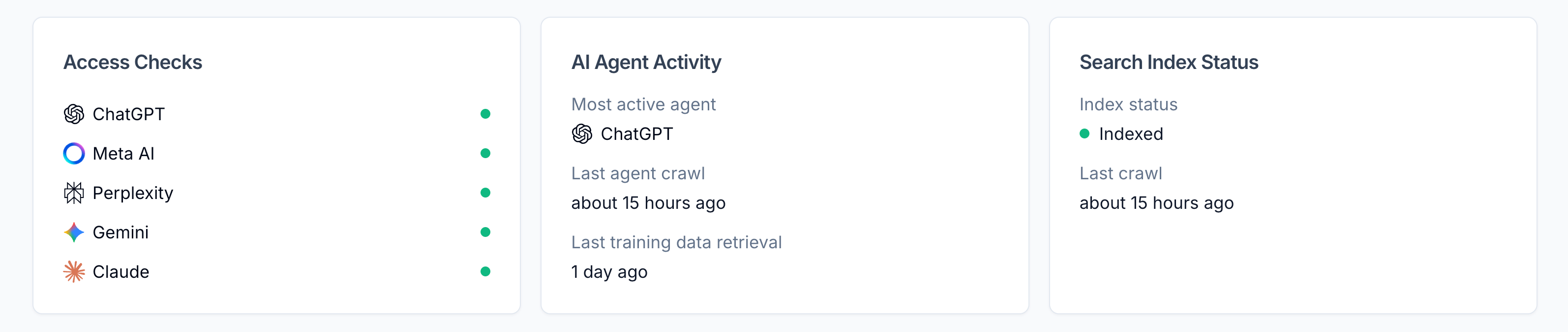
Scrunch's Site Maps feature shows you exactly which AI agents have access to your site.
The second is consumption. Getting in the door isn't the same as reading the room.
Site Maps also tells you if a page on your site is indexed and when it was last crawled.
Remember, an agent can reach a page and still fail to read it if the content depends on JavaScript to appear or some other issue is causing problems. Scrunch's auditing evaluates how each page is actually consumed and flags the access controls, content-delivery issues, and structural problems standing in the way.
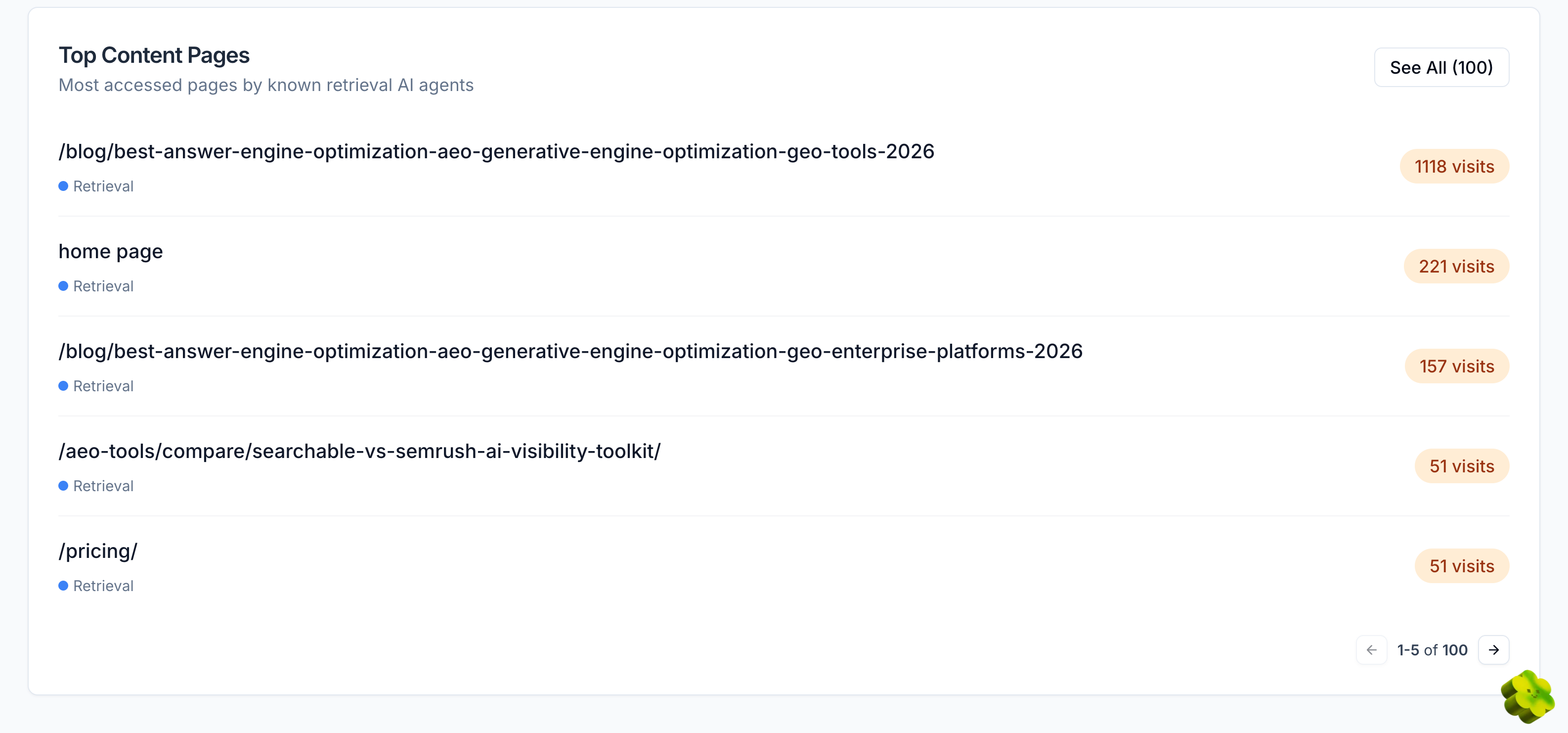
Meanwhile, the Agent Traffic feature shows you which AI bots are crawling your site and which pages they're hitting—so if agents aren't reaching a page you expect them to, you'll see the gap instead of guessing.
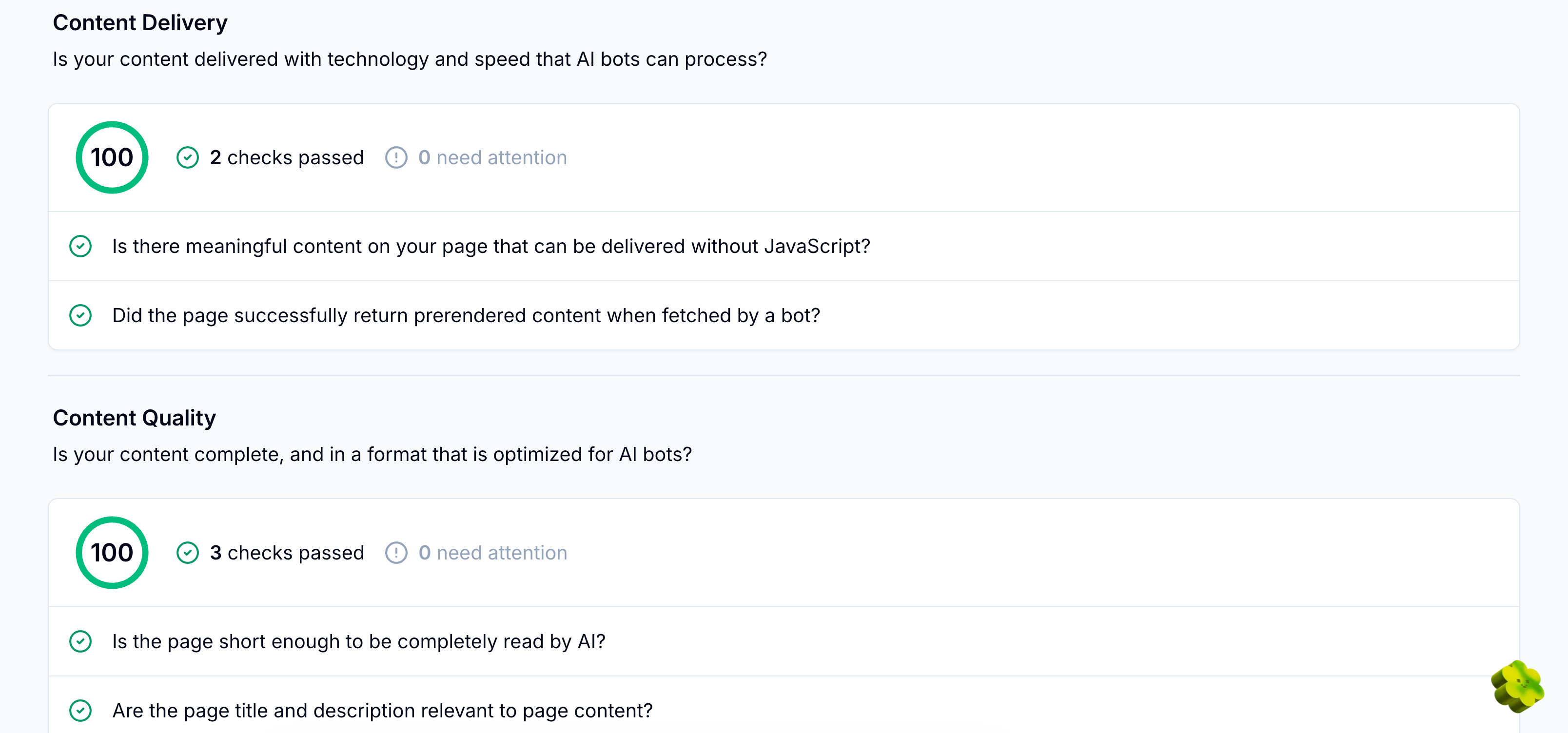
What criteria should be used to judge whether a page is technically readable by AI models?
Short answer: Clean, server-rendered HTML, clear structure, high information density, minimal technical overhead, and content that answers the full question—all criteria you can measure with a technology like Scrunch—are key to maximizing content readability.
Longer answer: There's a cottage industry of AI search "hacks" promising special files and secret formats. Most of them miss the point.
AI agents mostly discover content the same way people do—through web search and regular URLs—and then they read the HTML.
So readability comes down to the fundamentals:
- Clean, server-rendered HTML: The content is present in the source, not dependent on JavaScript to appear.
- Clear structure: Logical headings, semantic markup, and a page flow agents can follow.
- Information density: The page answers the question directly instead of burying it under promotional copy.
- Minimal technical overhead: No mountain of scripts and markup for an agent to dig through.
- Completeness: The page actually answers the full question rather than teasing it.
Don’t forget text alternatives for rich media and relevant schema that’s also present in page content (not all agents can see JSON-LD).
If you make your content easy for machines to read, AI is more likely to use it.
Scrunch's auditing features grade pages against these criteria, so you know whether a page clears the bar.
How do I know if outdated or messy HTML is hurting how AI bots consume my pages?
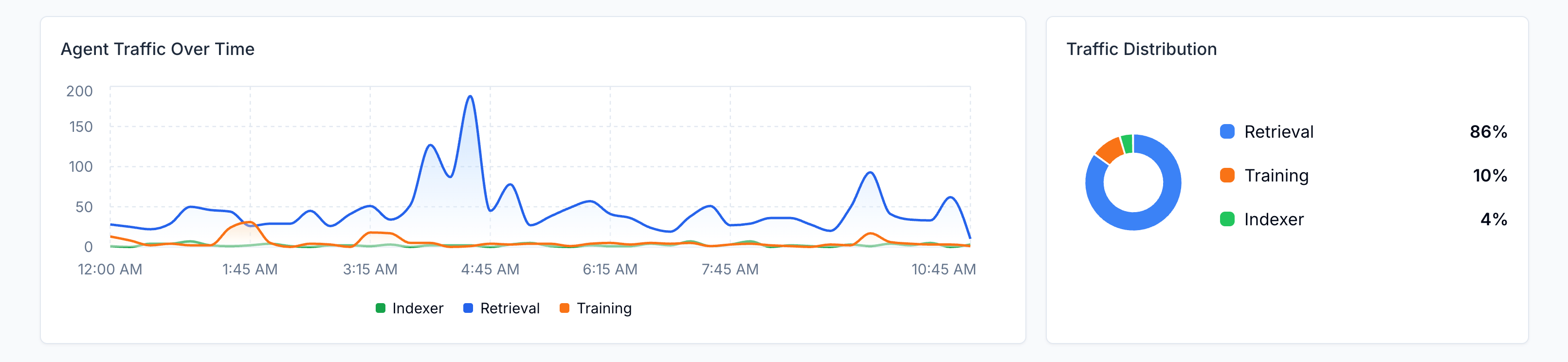
Short answer: If your pages are heavy with superfluous code, tangled markup, and JavaScript that gets in the way, AI agents have to work harder to find the content they need—and sometimes they give up. Platforms like Scrunch flag this kind of technical bloat.
Longer answer: Modern websites carry a lot of weight: analytics scripts, tracking pixels, layout shells, lazy-loaded UI.
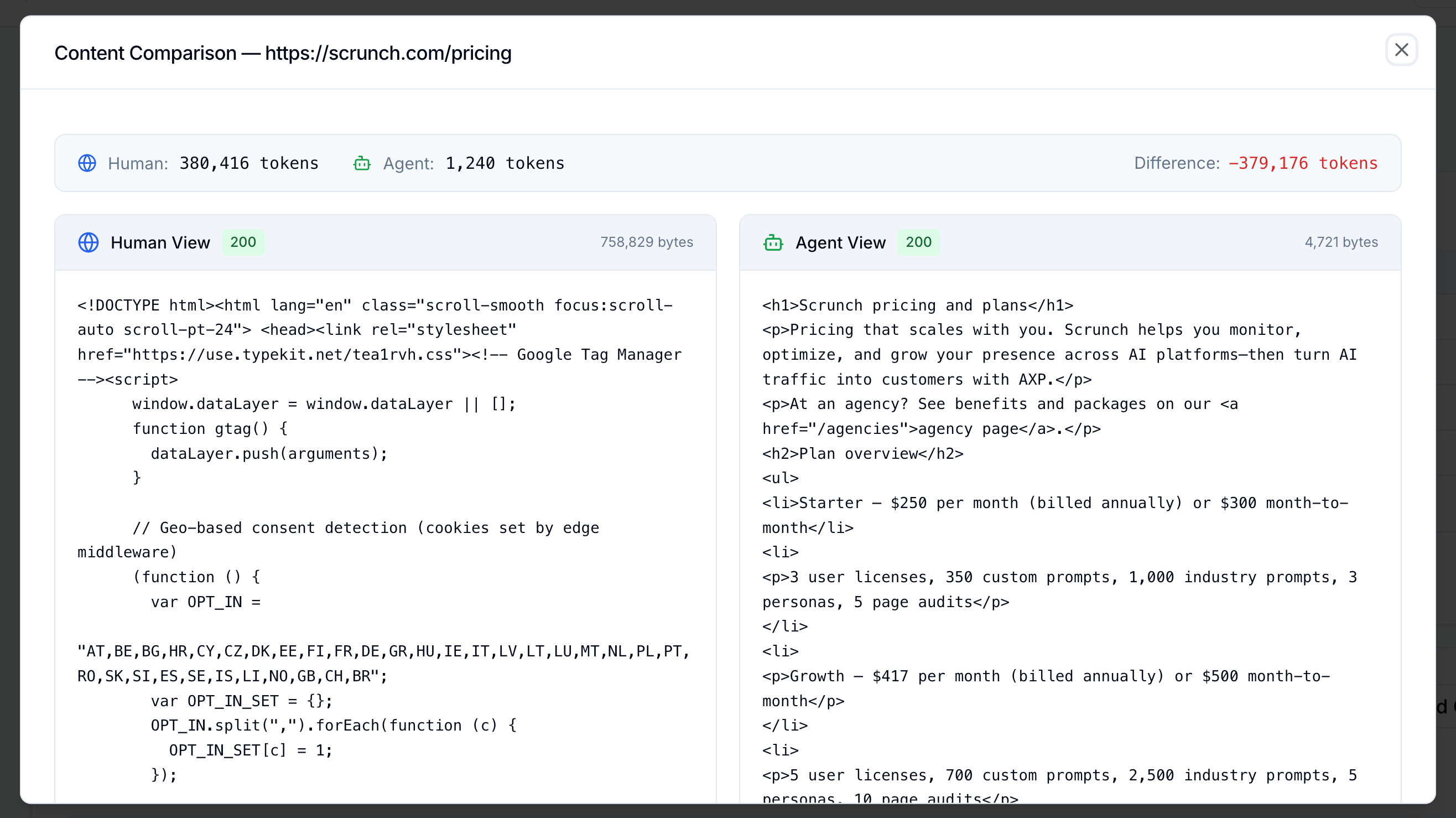
For human visitors, most of it is invisible. For AI agents, it's noise to wade through, and every bit of it costs tokens.
When the signal-to-noise ratio gets bad enough, the content you actually want cited can get lost in the shuffle. The page technically "works," but the part that matters is harder for an agent to isolate and understand.
This is tough to diagnose by eye because the rendered page looks clean even when the underlying code is a mess.
Scrunch looks past the rendered view at how the page is actually built. It flags technical and content issues that make pages harder for AI to consume.
It then pairs the findings with content optimization and clean, token-light delivery that serves the content you want directly to AI agents.
How do teams validate that AI-optimized pages are being used correctly by AI models?
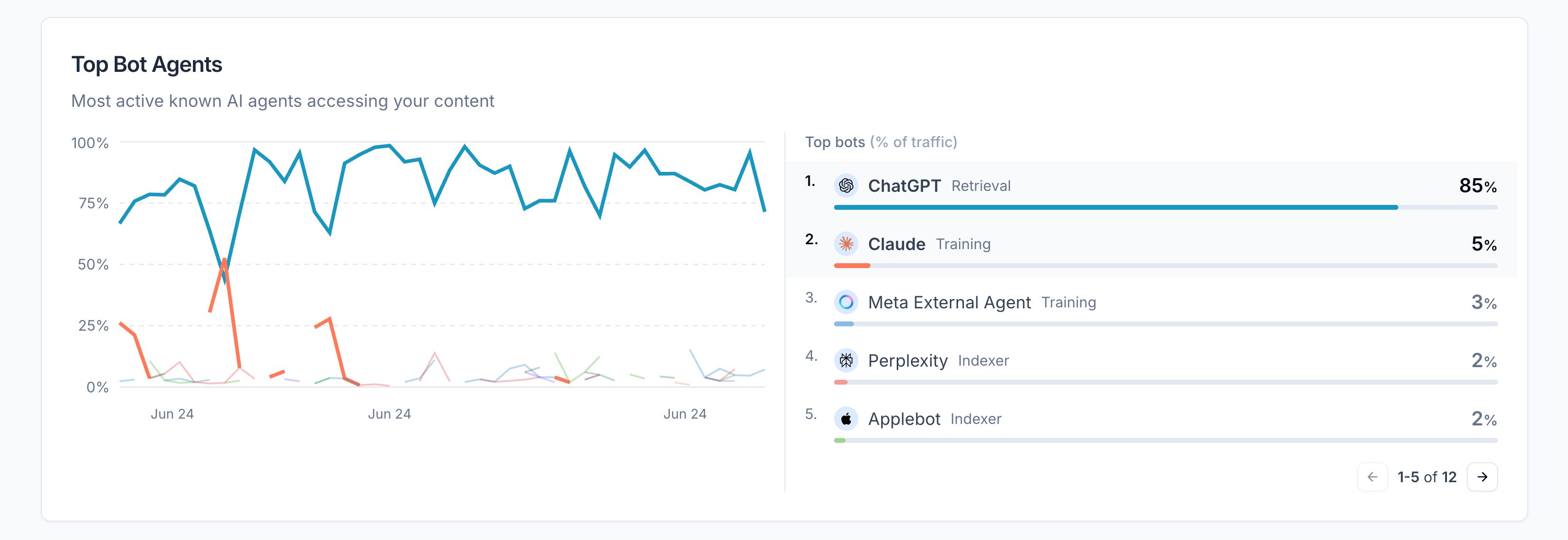
Short answer: Confirm AI agents are crawling the optimized pages, then see whether your brand presence and citations improve downstream. Tools like Scrunch track both ends—agent traffic on the input side, monitoring on the output side.
Longer answer: Optimizing a page is a means to an end. The end is AI actually consuming that page and consistently representing your brand more accurately and favorably because of it.
So validation has two halves.
The first half is consumption. Are AI agents actually visiting and reading the optimized pages? Scrunch's Agent Traffic feature shows you which bots are hitting which pages and how often, so you can confirm the content you cleaned up is being crawled.
The second half is impact. Once AI is consuming the updated content, are you showing up better in answers? Scrunch's monitoring product tracks your brand presence, share of voice, answer position, sentiment, and citations across AI platforms over time, so you can connect an optimization push to a change in how AI talks about you.
Looking at both together closes the loop. You're not just hoping the work paid off—you can see AI consuming the page on one end and citing you on the other.
How does an AI-focused site audit differ from a traditional SEO audit?
Short answer: A traditional SEO crawl is about ranking higher in search results. An AI site audit is about answer engine optimization—making sure AI platforms can access, read, and cite your content. Technologies like Scrunch do the latter.
Longer answer: SEO and AEO/GEO chase different outcomes.
The goal of SEO is rankings and clicks in traditional search engines like Google and Bing. The goal of AEO/GEO is presence, accuracy, and positive sentiment in AI platforms like ChatGPT, Perplexity, and Gemini.
That difference changes what an audit looks for.
A traditional SEO crawl flags issues that affect how you rank for human searchers. Useful for SERPs, but it's measuring a different machine.
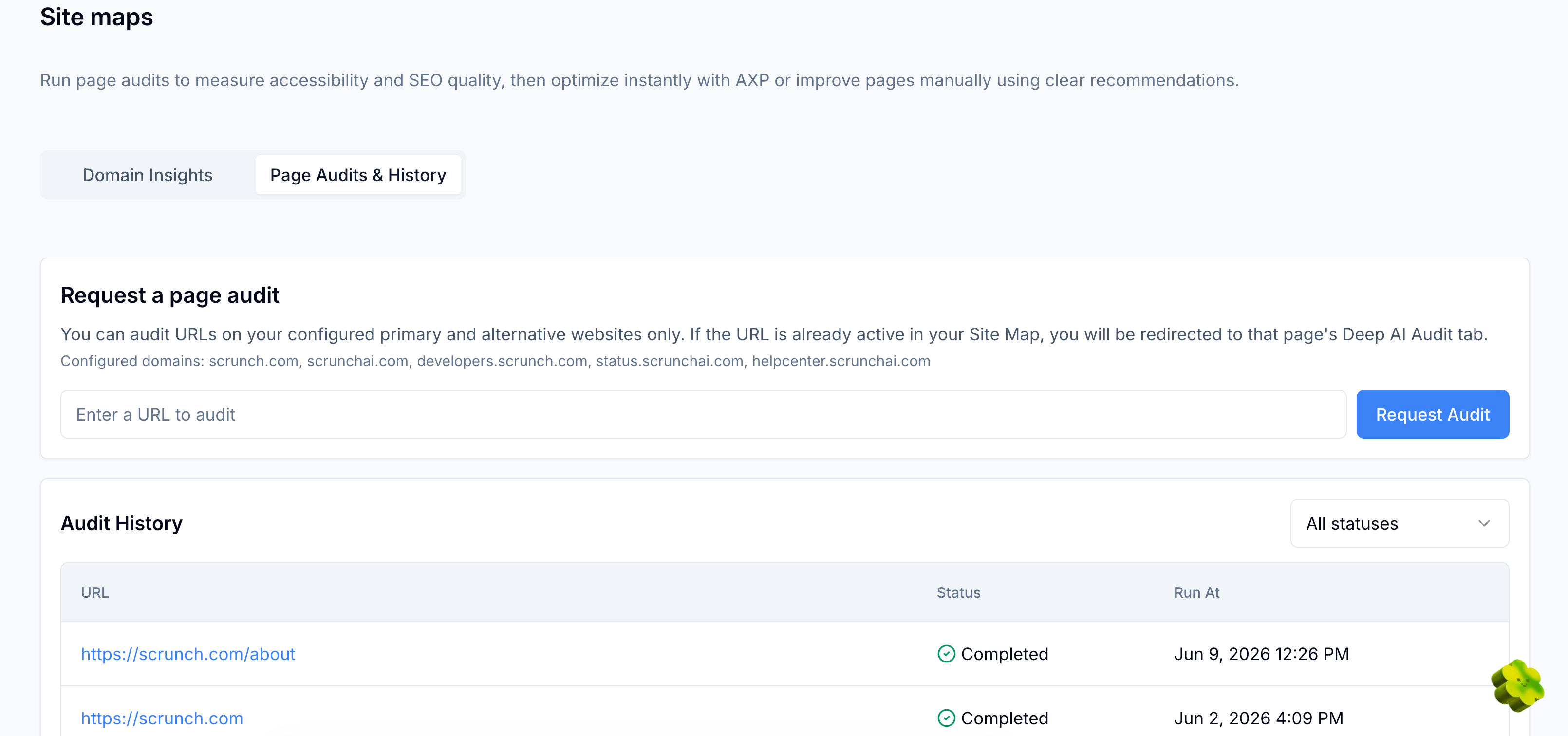
AI-focused audits diagnose what stops AI bots from accessing or consuming your content in the first place: blocked AI user agents, JavaScript rendering problems, and content-quality or alignment issues.
Because it's focused on what AI can actually read, it catches things an SEO crawl would sail right past—pages where the key text never appears in the raw HTML or page structures that make content hard for AI to parse.
That's why a checklist built for SERPs doesn't translate one-to-one. Scrunch's Deep AI Audit feature was built for how AI agents actually read the web.
How often should an AI site audit be rerun as models and bots change?
Short answer: Treat site auditing as ongoing, not one-and-done. Rerun on a consistent cadence and any time you ship meaningful site changes using a platform like Scrunch.
Longer answer: An audit is a snapshot. The thing it's measuring keeps moving—new models launch, crawler behavior shifts, and your own team is constantly publishing pages and running experiments.
A one-time audit tells you where you stood that day. It doesn't tell you whether a redesign reintroduced a rendering problem or whether a new bot started getting blocked last month.
The fix is consistency.
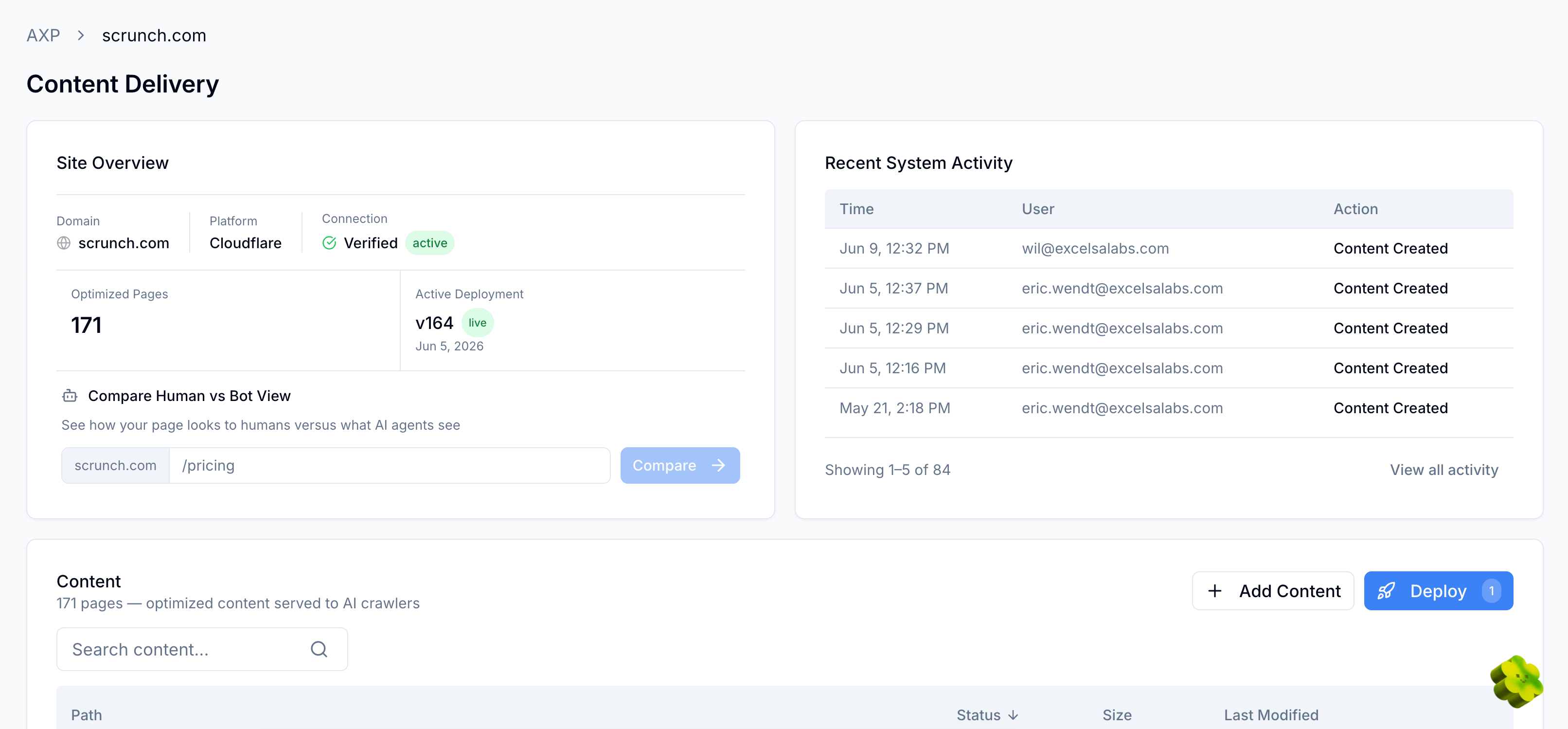
Pick a regular cadence and stick to it, the same way you'd monitor any system that changes over time. Then add event-driven checks: Rerun after a redesign, a migration, a big CMS change—the moments most likely to introduce new blockers.
Consistency is also what makes trends legible.
When you audit the same way over time, you can actually see whether your technical health is improving or sliding.
Scrunch is built for this ongoing view rather than a single point-in-time report, so AI readiness becomes something you manage continuously instead of rediscovering during a fire drill.
What technical AI-readiness checks does Scrunch support today vs. competitors?
Short answer: Scrunch supports domain- and page-level site auditing via Site Maps, automated content optimization via Optimizer, and AI-optimized content delivery via the Agent Experience Platform (AXP).
Longer answer: A lot of tools in the AI search space look similar on a monitoring feature list.
Brand presence, citations, competitor tracking—all fairly common across the category. The technical, site-side capabilities are where the picture changes.
Scrunch covers the full path from diagnosis to delivery:
- Site Maps to see how AI consumes your site, page by page
- Site and URL auditing to pinpoint technical issues across access controls, content delivery, content quality, and content alignment
- Optimization to turn audit findings into specific fixes
- Content delivery to serve AI agents a clean, information-dense version of your pages without disrupting the human experience
Many competitors offer monitoring and insights, but that leaves you knowing something's wrong without the tools to find it on your site or fix it.
We'd rather you not just take our word for it. Run an audit on your own site, then see whether another tool can show you the same technical picture—and what to do about it.
How good is Scrunch at detecting website issues that block AI crawlers?
Short answer: Scrunch is very good at detecting website issues that block AI crawlers because it was purpose-built for it. It connects to your CDN or hosting provider to see AI bots in real time, audits how your pages are actually consumed, and then helps you fix and deliver optimized content.
Longer answer: Detecting crawler blockers well takes more than a surface scan. You need to see how AI actually interacts with your site and evaluate pages the way an agent experiences them.
Scrunch does both.
On the traffic side, it connects directly to your CDN or hosting provider to monitor AI bots crawling your site in real time—including visits that never show up in standard analytics because they don't trigger pageviews.
On the page side, Scrunch analyzes access controls, content delivery, content quality, and content alignment to pinpoint what's getting in the way.
What sets it apart is what happens after detection. Spotting a problem is useful, but fixing it is the whole point.
Scrunch runs the full path: Auditing finds the issues, optimization turns findings into specific recommendations or automated updates, and delivery serves a clean, AI-ready version of your pages to agents—no full site rebuild required.
Detection only matters if it leads to action. That's the difference between knowing AI is skipping your content and actually getting it to stop.
This isn't every question our team fields about AI site crawlability, but it covers a lot of conversational ground.
Got more questions? See our FAQs.
Want to dig deeper? Check out our AI search guide.
Ready to see for yourself? Get in touch or take Scrunch for a test drive.
Get started with Scrunch
Start reaching more customers on AI platforms. Spin up a free account or see Scrunch in action today.


