


Key takeaways:
- You may be earlier than you think: Most marketers claim an AI search strategy, but more than half aren't sure it’s the right one. Activity isn't the same as maturity.
- What AI says about your brand is up to you: The brands climbing the maturity curve treat AI visibility and its business impact as something they invest in and proactively optimize, not something that just happens to them.
- The only wrong move is waiting: AI search is new enough that no one has run out of room to climb the maturity curve, so the earlier you start, the more ground you take before your category catches up.
Most brands optimizing for AI search are stuck in a strange place: information vacuum and information overload at the same time.
That leaves teams guessing at what good looks like, let alone how to reverse-engineer it at their own organizations.
Case in point: 91% of marketers claim to have a clear, documented strategy for AI search visibility. Yet more than half aren’t sure it’s any good.
We began building out a framework based on what we see working in the field, collecting input from our customer-facing teams and, most importantly, our customers.
This is the output: The AI search maturity model.
Model your AI search maturity
Use our free assessment app to find out where your brand sits on the AI search maturity curve. Scan your site, answer a few quick questions, receive your readout, and get next steps.
We want to share it, not gatekeep it. Whether you’re a Scrunch customer or not, we think you can learn a lot from the hundreds of companies and agencies we’ve helped climb the AI search maturity curve.
We designed our model to span the full spectrum, from barely started to best-in-class.
The goal: To show you where you sit within it, where you want to go, and how to get there.
One note before you dive in: The word “maturity” has certain connotations, but it’s independent of company size or technical sophistication.
Enterprise or startup, AI search optimization is an emerging discipline for every brand.
And no matter how it may feel in the market, trust us: Most teams are still near the beginning of the journey.
How to use the AI search maturity model:
- Step 1: Identify which phase most accurately reflects your organization.
- Step 2: Understand which steps are necessary to reach the next phase.
- Step 3: Plan your path to get there and fine-tune your strategy as you go.
Dimensions:
- Ownership: Who’s accountable for how your brand appears in AI search results
- Insights: What you see—the metrics you track and how you analyze them
- Optimization: What you do about it onsite and off, and how effectively
- Presence: Where and how you show up in AI answers
- Impact: How you connect visibility to business results
Keep in mind: No brand will be a perfect match for any single phase. You may be strong in one area and weak in another. In general, we recommend selecting the phase most of your dimensions point to.
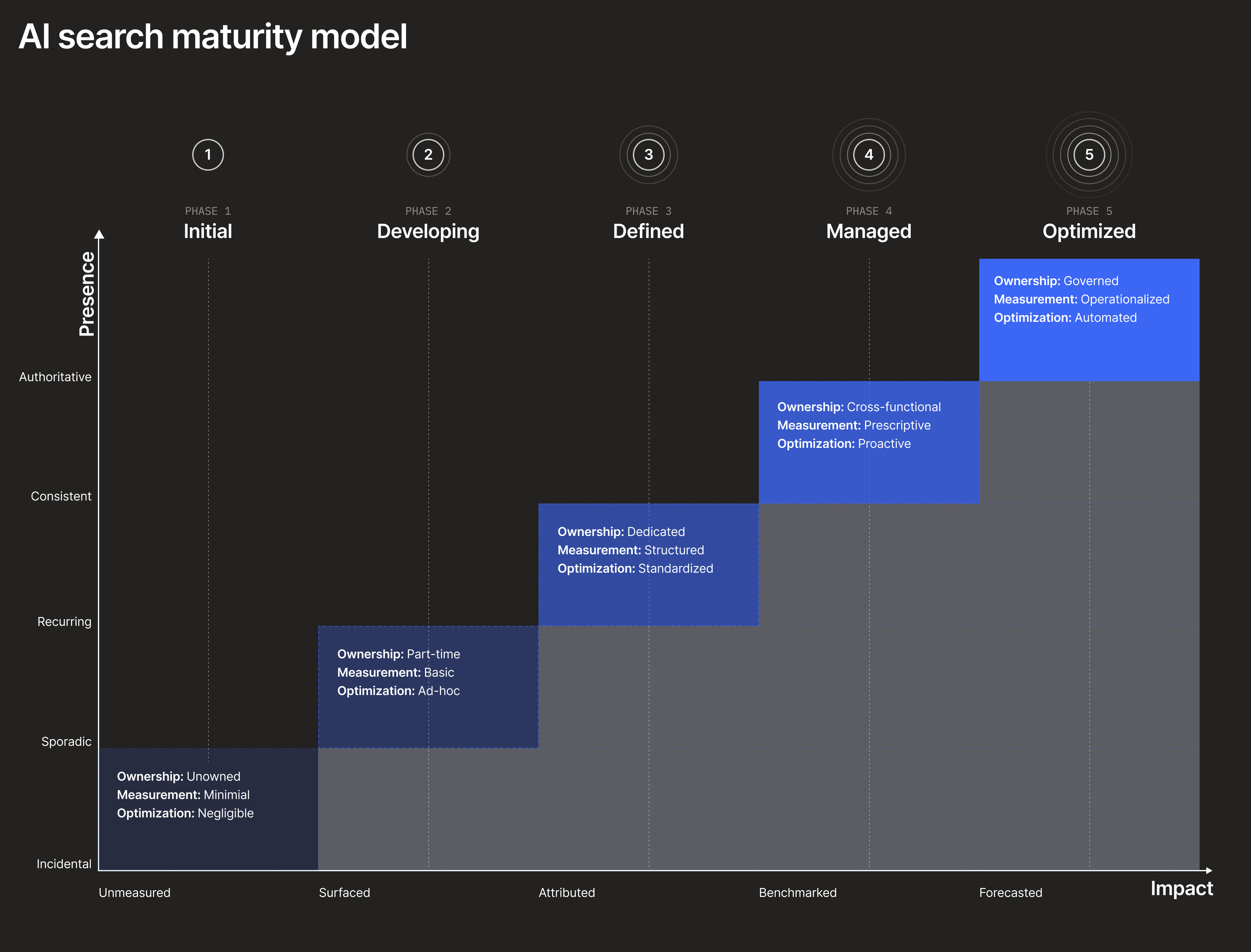
| Dimension | Ownership | Insights | Optimization | Presence | Impact |
|---|---|---|---|---|---|
| Phase 1 | Unowned | Minimal | Neglible | Incidental | Unmeasured |
| Phase 2 | Part-time | Basic | Ad hoc | Sporadic | Surfaced |
| Phase 3 | Dedicated | Structured | Standardized | Recurring | Attributed |
| Phase 4 | Cross-functional | Prescriptive | Proactive | Consistent | Benchmarked |
| Phase 5 | Governed | Operationalized | Automated | Authoritative | Forecasted |
Mapping the AI search maturity model

Phase 1: Initial
Looks like: Someone typed your brand into ChatGPT and didn’t like the answer. No owner, no baseline, no tooling, no budget. “Measurement” is a person opening a chat window and eye-balling it, not real trend monitoring.
Your main objective: To understand how AI is talking about your brand.
Gut check: Can you say what share of AI answers to business-relevant prompts mentioned you last week?
Signs you’re in this phase
| Ownership | Insights | Optimization | Presence | Impact |
|---|---|---|---|---|
| Unowned | Minimal | Negligible | Incidental | Unmeasured |
- Ownership: No one really owns AI search (which means no one has a good answer when a board member suddenly asks, “What’s our AI strategy?”).
- Insights: Measurement, if it happens at all, involves checking AI answers by hand (e.g., typing questions into AI assistants and copy-pasting the responses into a spreadsheet)—something 37% of marketers tracking AI search are currently doing.
- Optimization: Either no optimization work is taking place, or it’s unplanned and speculative. The common assumption is that standard SEO is all that’s required.
- Presence: Your brand is missing from AI answers (or coasts on widespread name recognition alone), and is often described inaccurately. Competitors tend to dominate.
- Impact: No one can say whether AI is sending traffic to your site or how it converts.
What to watch out for
- Buyer blindness/reputation risk: If your brand isn’t present in AI answers (67% of marketers say their brand appears less often than they’d like), it’s practically invisible to a growing number of buyers. And if AI is misrepresenting your brand (something 50% of marketers say has happened in the past 12 months), it will drive buyers away.
- Default losses: If your competitors are well-represented in AI search and you’re not (62% of marketers believe they’re already behind competitors), they’ll reap the down-funnel rewards and you won’t.
- Measurement guesswork: If you're checking prompts manually, you can't tell a meaningful change from model randomness, so any optimization efforts can’t be proven.
How to level up
Step 1: Assign ownership
Assign ownership of AI search to at least one person, even if it’s only part-time.
If no one owns it, every board question turns into a scramble and next steps won’t survive a busy quarter.
Step 2: Build a representative and consistent prompt set
Build a representative and consistent prompt set that covers both unbranded and branded queries at different stages of the funnel.
You need to watch a fixed, business-relevant slice of prompts over time to separate signal from noise.
Step 3: Verify AI bot access
Verify AI bot access to your website, including making sure your robots.txt or bot management software isn’t turning AI user agents away.
The easier it is for training, indexing, and retrieval bots to access your site, the more likely you are to show up in AI answers.
Step 4: Scale visibility into AI answers
Scale visibility into AI answers by tracking brand performance across multiple AI platforms simultaneously.
It’s nearly impossible to track every platform and prompt manually at the necessary speed and scale, so consider investing in a tool if you haven’t already.
Step 5: Establish your baseline
Establish your baseline performance in AI search by quantifying how often your brand is mentioned in answers to tracked prompts, how often your website is cited as a source, and how often people click through to your site from AI answers.
Mentions and citations are the basic building blocks of AI search presence, and AI referrals are the most readily available business impact signal.
Direct AI referrals are rarer than organic traffic and only capture a small slice of AI’s influence on the funnel, but they can be tracked automatically in AI search tools and Google Analytics.
Step 6: Benchmark performance against competitors
Benchmark performance against competitors by comparing your mentions and citations to theirs.
You and your competitors’ baselines give you a reference point for measuring progress within your category.
Do it with Scrunch
- Multi-model monitoring: Scrunch tracks your brand (and your competitors) across every major AI platform in one place, so you're not juggling a dozen chat windows and a spreadsheet.
- Out-of-the-box benchmarking: Scrunch benchmarks your brand presence against any competitor you name, so you see where you stand in your category from day one, not just how you're doing in isolation.

Phase 2: Developing
Looks like: AI search has an owner, albeit part-time. Tooling has been procured, but there are no reporting cadences, shared KPIs, or serious budget lines. Little thought has been given to response collection or filtering. Numbers can be produced, if not reliably explained or acted on.
Your main objective: To understand why AI talks about your brand the way it does.
Gut check: Can you name the five sources AI cites most often when it answers questions about your category?
Signs you’re in this phase
| Ownership | Insights | Optimization | Presence | Impact |
|---|---|---|---|---|
| Part-time | Basic | Ad hoc | Sporadic | Surfaced |
- Ownership: A member of the marketing team, often an SEO, growth, or content manager, watches AI search intermittently. They may get help from an agency.
- Insights: The measurement process involves basic monitoring and occasional data reviews, often using features that are bolted onto a legacy SEO or PR platform. Reporting is a screenshot in a deck when someone asks (aka static).
- Optimization: When it occurs, optimization takes the form of haphazard content updates (e.g., adding FAQs to a blog post), third-party outreach (e.g., requesting placement in a comparison listicle), and technical page edits (e.g., fixing page metadata). Teams may try to game AI visibility with high volumes of AI-generated content.
- Presence: Your brand appears in AI answers, but unpredictably, and responses are often incorrect. AI usually favors competitors.
- Impact: You’re tracking AI referrals in Google Analytics, but you’re blind to the wider impact of AI on your funnel.
What to watch out for
- Slop collapse: If you prioritize pumping out more content over optimizing content for AI (something 42% of teams are doing), you risk trading a short-term visibility gain for a long-term deficit.
- Wasted resources: If your optimization approach is disorganized, you’ll fall into a reactive pattern and prioritize the wrong things.
- Metrics myopia: If you’re tracking AI visibility, but ignoring how it impacts pipeline and revenue, you’re focusing on leading indicators at the expense of business ROI.
How to level up
Step 1: Treat AI search as a dedicated channel
Treat AI search as a dedicated channel by making sure team members have the necessary time and tooling to devote to it (teams using dedicated AI search tools outperform their peers). Also align on check-in cadences and KPIs.
Sixty-two percent of marketers say they’re still judged on SEO and web traffic metrics, something that 52% say is limiting their ability to execute.
Step 2: Expand your measurement aperture
Expand your measurement aperture by tracking share of voice, sentiment, answer position, and answer rank alongside mentions and citations. Also introduce self-reported attribution (e.g., a “How did you hear about us?” option for AI on form fills) to better capture business impact.
These additional metrics tell you how likely you are to be named versus competitors, as well as how likely AI is to recommend you versus only name you. Meanwhile, self-reported attribution helps you draw a direct line between AI search performance and lead generation.
If you’re a CPG or B2C brand, also make sure your tooling provides visibility into AI search performance at the SKU and retailer level.
Step 3: Identify the most influential sources
Identify the most influential sources for your tracked prompts: the ones cited most frequently across the greatest number of unique prompts.
This shows you which sources you may want to secure placement in or attempt to overtake with content of your own, and it’s something 58% of marketers are missing.
Step 4: Analyze AI agent traffic
Analyze AI agent traffic on your website: agent traffic over time, traffic distribution (i.e., the type of bot it is), the most active agents on your site, and which webpages are accessed most.
This upstream activity influences downstream results, and it’s another impact signal brands can reliably capture. Right now, 67% of teams aren’t tracking it.
Step 5: Track AI visibility trends
Track AI visibility trends (i.e., how frequently people are asking AI about certain topics and how that activity changes over time).
This information helps you understand which topics and prompts should be top of mind for your brand, as well as where demand is shifting.
Step 6: Connect your data to AI
Connect your data to AI, whether through your tool's in-app chatbot or an MCP server that pipes data into your preferred AI assistant.
The ability to query performance data conversationally and rapidly follow up removes analysis bottlenecks and makes it easier to go from insight to action.
Do it with Scrunch
- Comprehensive reporting: Scrunch measures share of voice, sentiment, answer position, answer rank, and other metrics alongside mentions and citations, all filterable by topic, prompt, AI platform, persona, funnel stage, and more.
- Influence scoring: Scrunch ranks the sources cited most across your tracked prompts, so you know exactly which pages are shaping what AI says about your category.
- Agent Traffic: Scrunch shows you which AI agents are visiting your site, what they’re doing, which pages they hit most, and how this activity trends over time.
- Trends: Scrunch tracks how demand for different topics shifts across AI platforms over time: what’s rising, what’s fading, and how you and your competitors show up.
- Scrunchie/Scrunch MCP: Scrunch enables you to connect your AI search data to your AI tooling, either in-app via the Scrunchie chatbot or in your chosen platform through the Scrunch MCP.

Phase 3: Defined
Looks like: A real operating rhythm exists: regular working sessions, dashboards that more than one person pays attention to, a prompt taxonomy with topics, personas, and funnel stages. The team is experimenting with technical and editorial optimizations and working to systematize the process.
Your main objective: To shape what AI says about your brand.
Gut check: Can you name the last three site updates you shipped because of AI search data and how your performance changed afterward?
Signs you’re in this phase
| Ownership | Insights | Optimization | Presence | Impact |
|---|---|---|---|---|
| Dedicated | Structured | Standardized | Recurring | Attributed |
- Ownership: AI search has a named lead, even better if AEO or GEO is in their job title. Their work might still be SEO-anchored, but they have the bandwidth, budget, and/or external agency support to take AI search seriously instead of treating it as just an add-on.
- Insights: Measurement is in-depth, consistent, and regularly shared with a director or VP. Teams may go beyond Excel sheets and connect AI visibility tooling to their preferred business intelligence software.
- Optimization: Optimization opportunities are systematically documented, if not always acted on in a timely manner. Teams are regularly filling in content gaps, rewriting existing content for AI consumption, and pursuing placement in content from high-value third-party publishers.
- Presence: Your brand is beginning to regularly appear in AI answers for the prompts you care about, and the information is mostly correct. You understand which levers to pull to shape AI responses, and you’re starting to see early competitive lift.
- Impact: In addition to tracking AI referrals and AI agent traffic, you’re capturing AI search attribution with form fills.
What to watch out for
- Reporting theater: If your dashboards and data reviews don’t drive decision-making and iteration (73% of teams have invested in tools, but only 41% can confidently turn the data into action), they’re nothing more than check-the-box rituals.
- Missed signals: If you only catch meaningful changes at your next data review, you're finding out days or weeks too late.
- Manual ceiling: If you're auditing pages and identifying optimization opportunities by hand, the work stalls the moment your list outgrows your team.
How to level up
Step 1: Make AI search a cross-functional effort
Make AI search a cross-functional effort by pointing teams across and outside of marketing at goals that align with their current workflows.
Web dev can own technical site updates, PR can chase analyst and earned-media coverage, social can build an influencer strategy aimed at where AI cites, product marketing can take on AI answer accuracy, and sales and customer success can feed back the questions and objections that become the prompts you track.
Eighty-one percent of teams say more collaboration from technical teams like web development would improve their AI visibility strategy, and 76% say the same about input from sales.
Step 2: Tie AI search to revenue
Tie AI search to revenue and compare conversion rate, conversion speed, and deal value to other channels.
Volume will look smaller compared to more established, easier-to-attribute channels. Don't let that undersell it: The story is in the quality of the buyers, not just the size of the crowd.
Step 3: Stay alerted to meaningful changes in AI search data
Stay alerted to meaningful changes in AI search data: threshold breaches, trend shifts, anomalies, new entity appearances, entity disappearances.
These are the types of signals that require immediate attention, and your tooling should serve them up automatically.
Step 4: Automate site auditing
Automate site auditing to uncover the specific technical and editorial issues holding pages back from being considered and selected by AI agents.
Running a manual audit across every page on your website doesn’t scale. Your tooling should surface opportunities for you and rank them by impact, so you end up with a prioritized, page-by-page plan instead of a backlog you have to triage yourself.
Step 5: Optimize site content for verified AI agents
Enhance site content for verified AI agents by making the content you have easier for AI to read and understand. This means targeting agents at the CDN level with clean, clear, information-dense text delivered as server-rendered HTML, as well as restructuring and enriching content specifically for AI consumption.
If your site is buried in code and technical clutter, AI will have to battle it to retrieve your content (or just skip it entirely). Meanwhile, easier-to-parse, more contextual content improves information retrieval for AI agents.
Step 6: Systematize shipping content from your CMS
Systematize shipping content from your CMS by routing data and optimization recommendations from your AI search tool to your content management system.
When your tooling is connected, content changes get staged right where your team publishes, and every change runs through the approval workflows and permissions you already have.
Do it with Scrunch
- Signals: Scrunch alerts you the moment your AI search data moves in a way worth acting on, from a sharp drop in citations to a new competitor appearing in answers, by telling you what’s happening, why it matters, and what to do about it.
- Site Optimization: Scrunch crawls your site, identifies technical and editorial issues, provides prioritized recommendations, and reoptimizes with new suggestions week over week.
- Agent Pages: Scrunch automatically serves AI agents optimized versions of site content at the edge without changing the human-facing site in any way, no rewriting or replatforming required.
- Scrunch in SitecoreAI: Scrunch puts AI observability and optimization directly in SitecoreAI, allowing you to draft and stage data-backed content updates with a click from your website’s system of record.

Phase 4: Managed
Looks like: Measurement is continuous and actionable. Optimizations ship on a regular cadence, not just in response to problems. Ongoing experiments are designed properly, with control groups and defined observation windows. Execs are regularly updated with ROI numbers.
Your main objective: To turn AI search into a proven growth channel.
Gut check: Can you forecast what AI search will contribute to revenue next quarter, not just report what it did last quarter?
Signs you’re in this phase
| Ownership | Insights | Optimization | Presence | Impact |
|---|---|---|---|---|
| Cross-functional | Prescriptive | Proactive | Consistent | Benchmarked |
- Ownership: AI search has dedicated stakeholders across teams, with defined handoffs. Recommendations pipe into project management software and content management systems. Approval workflows and permissions split by change type.
- Insights: Measurement is tightly scheduled and increasingly automated via AI. Reporting leads to tangible next steps and is exec-visible, going straight to a VP or CMO.
- Optimization: Optimization efforts follow a consistent cadence, always iterating on prior pushes. Technical and editorial recommendations are routed to specialized teams versus simply falling on SEO or content teams. Growth experiments are run intentionally and always measurable.
- Presence: Your brand consistently shows up in AI answers across topics, with high placement and high accuracy.
- Impact: Self-reported AI attribution is a named source in your CRM, alongside sales-captured AI influence logged from conversations with prospects (teams may use call auto-capture or manual entry). AI-assisted pipeline and revenue are reported to executives on a regular basis, with conversion rate and deal value compared against other channels.
What to watch out for
- Strategy complacency: If you’re seeing gains in AI search performance, it’s easy to mistake positive traction for sustained improvement.
- Category drift: If your prompt set, competitor list, and topics were built for last year's business, your presence may look strong but no longer match the market reality.
- Attribution undercount: If you benchmark AI search with last-click logic built for more mature channels, you may underfund it right as it's proving out.
How to level up
Step 1: Make AI search a company-wide objective
Make AI search a company-wide objective by treating it like pipeline or revenue: Set objectives and key results, then put a date on it.
When the whole company works toward one number, AI search stops being a marketing experiment and becomes a line item leadership co-manages. Data, not just gut feeling, decides what gets prioritized.
Step 2: Keep your measurement system honest as you scale
Keep your measurement system honest as you scale by revisiting your tracked topics, prompts, and competitors every quarter.
The idea is to hold your core prompts fixed so you don’t lose the trend line, add new ones as your category shifts, and archive obsolete ones, but only with a documented reason.
Step 3: Align AI answers with your brand truth
Align AI answers with your brand truth by connecting your internal, brand-approved knowledge to your optimization efforts and reconciling it with what AI currently says about you.
The accurate, up-to-date, comms-and-legal-approved version of your brand usually lives where AI can't reach it: product marketing briefs, sales enablement docs, internal wikis, DAMs. Ensure content is augmented based on these sources.
Step 4: Harden your attribution model
Harden your attribution model so the numbers you're now showing executives can survive scrutiny. Blend AI referral data, self-reported attribution, and CRM-sourced influence into one method you can defend and repeat, instead of a different guess every quarter.
A number is only as trustworthy as the model behind it. Tightening the methodology is what lets you forecast forward instead of only reporting backward.
Step 5: Forecast AI search's contribution to revenue
Forecast AI search's contribution to revenue by projecting forward from the attribution model you just hardened, then put that number in front of finance the way you would any other channel.
This is what moves AI search to a CFO-approved program finance plans around.
Step 6: Define what automation can and can’t touch
Define what automation can and can’t touch, like product claims, competitive positioning, and regulated or legally sensitive language, then let automation handle the optimization work that can run on autopilot.
Keep a human in the loop on every change, but lean on your tooling to do the heavy lifting.
Do it with Scrunch
- Knowledge Studio: Scrunch connects the dots between your internal knowledge and what AI says about you in order to help you flag and fix inconsistencies.
- Content reoptimization: Scrunch automatically reanalyzes site content and a proprietary data corpus of real AI answers and cited content week over week to provide new recommendations.
- Automated approvals: Scrunch allows you to preapprove certain content recommendation and delivery pipelines to accelerate site optimization.

Phase 5: Optimized
Looks like: Automated correction pipelines, spanning AI-optimized content served directly to AI agents and agent-aware publishing workflows. All actions are approved by a human in the loop, and all actions are tied to measured revenue. The gap between spotting a shift in AI answers and shipping the fix keeps shrinking.
Your main objective: To widen your lead in AI search faster than competitors can close it.
Gut check: How long does it take you to go from signal to shipped change, and is that number still dropping?
Signs you’re in this phase
| Ownership | Insights | Optimization | Presence | Impact |
|---|---|---|---|---|
| Governed | Operationalized | Automated | Authoritative | Forecasted |
- Ownership: AI search performance is handled primarily by automated systems, with humans approving every change and sharing reporting across teams and seniority levels.
- Insights: Meaningful data changes are instantly surfaced and diagnosed by AI, and approved next best action recommendations are acted on automatically.
- Optimization: Optimization is automated through structured pipelines and human-approved updates that ship before problems are even identified by your team. Verified AI agents are served optimized content deliberately.
- Presence: Your brand is routinely recommended in AI answers and dominates your category.
- Impact: AI search is one of your company’s top growth channels. It has a substantial budget line and CFO-approved revenue forecast, and its impact is reported the way paid and organic channels are reported today.
What to watch out for
- Autopilot inertia: If you’ve automated the majority of your AI search strategy, you may skip human review and miss potential problems.
- Automation overconfidence: If you’re receiving insights without asking and applying fixes without looking, you may stop questioning assumptions and probing for new opportunities.
- Optimization plateau: If your metrics are strong, but flat quarter over quarter, you're maintaining share while competitors may be capturing new territory.
How to stay ahead
Step 1: Audit your automated systems and approval patterns
Audit your automated systems and approval patterns. On a set schedule, check that your automation is flagging the right issues and applying the right fixes. Likewise, look at your approval workflows to make sure updates are being evaluated, not just waved through.
Regularly inspecting the methodology behind site optimization is what keeps "automated" from sliding into "unaccountable."
Step 2: Measure yourself against your category, not just your last quarter
Measure yourself against your category, not just your last quarter, to make sure your strategy is continuing to drive real results.
Strong and flat can look like success, but there’s a difference between holding your position in AI search results and losing share in a market that grew around you.
Step 3: Reinvest the time automation gives back
Reinvest the time automation gives back into the tasks it can't handle, from messy edge cases to long-term strategic bets.
Automation should free teams up to hypothesize, test, and iterate, not cause them to coast.
Step 4: Close the loop on growth experiments faster
Close the loop on growth experiments faster in order to turn cycle velocity into competitive distance.
Once presence and impact are proven, speed is the advantage. Every experiment that lands makes the next one sharper, so the more you run and the faster you run them, the further ahead you get before the rest of the category closes the gap.
Step 5: Turn your learning loop into a feedback loop
Turn your learning loop into a feedback loop by treating prompt and citation data as voice of customer arriving in real time.
You learn what buyers are asking about, which objections keep surfacing, who gets named alongside you, and more. Route it to product, marketing, and sales as fast as it lands.
Step 6: Stay up to date on new AI surfaces and protocols
Stay up to date on new AI surfaces and protocols to keep pace with how AI search evolves.
AI platforms change how they retrieve and cite content on a timeline nobody publishes, all while new AI assistants launch and new standards get proposed for how agents find and buy.

Climbing the AI search maturity curve
AI search optimization is a continuous process of observing what AI agents say and do, optimizing based on agent behavior, and delivering what agents need.
The goal is to proactively manage this loop, not reactively scramble to keep up with it.
We know that’s easier said than done.
Eighty-seven percent of marketers feel more pressure to build new skills in the AI era, and 58% say their training isn't keeping pace.
But the right technology partner can help: We found that teams using a dedicated AI search tool outperformed on 25 of the 26 optimization tactics we measured as part of our 2026 AI search survey.
Remember: The AI search maturity curve is new enough that no one's run out of room to climb.
Our advice? Move now before your category catches up.
Model your AI search maturity
Use our free assessment app to find out where your brand sits on the AI search maturity curve. Scan your site, answer a few quick questions, receive your readout, and get next steps.
Get started with Scrunch
Get your site AI-ready so you show up in answers, get cited, and grow revenue. Try a free 7-day trial or book a demo.


